The Secret Weapon Every Fly Caster Needs to Master
There is a moment in every fly angler's development when something clicks — when the line unfurls with an effortless, almost supernatural grace and shoots across the water like it was born to travel. More often than not, that moment arrives not because of a better rod, a more expensive reel, or even years of repetitive practice swinging a casting arm. It arrives because the angler finally discovers the double haul.
For the uninitiated, the double haul is fly casting's most transformative technique — a coordinated, rhythmic pull of the non-casting hand that dramatically increases line speed, tightens loops, and unlocks distances that would otherwise seem impossible. It is the difference between working hard and casting smart. And according to some of the most respected names in fly fishing, it is not a technique reserved for saltwater guides or competitive distance casters. It is, quite simply, the foundation of all great fly casting.
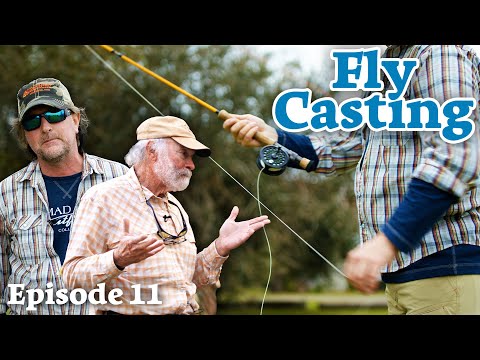
Mad River Outfitters' Brian Flechsick has been teaching the double haul for decades through his Midwest Fly Fishing Schools, and he recently sat down with legendary angler and guide Flip Pallot — a man whose casting philosophy has quietly reshaped the way serious anglers think about the sport — to break down the technique from its most fundamental principles. What emerged from that conversation on Pallot's front porch was as much casting philosophy as it was instruction.
Rethinking the Fly Rod Entirely
Before you can truly understand the double haul, you may need to unlearn something. Most fly anglers instinctively think of their casting hand — the hand gripping the rod — as the engine of the cast. They push harder into the wind. They muscle the line for extra distance. They work the rod as though it were a whip. And it is precisely this instinct, according to Flip Pallot, that holds most casters back.
"The fly rod is an overpriced pointing tool. You don't cast with a fly rod — you cast with your opposite hand."
— Flip Pallot
Flechsick recalls the moment Pallot delivered that line to him from the deck of a boat in the 1990s, visibly irritated by watching a capable angler rely too heavily on his rod arm. It was a provocation, of course — deliberately over the top — but it contained a truth that Flechsick has been passing along to students ever since. The rod directs the cast. The non-casting hand powers it.
This reframing matters because it shifts the caster's attention to where the real action is happening. Once you stop thinking of the rod as the source of speed and start thinking of it as a precision pointing device, the role of the left hand — or non-casting hand — comes into sudden, sharp focus.
What the Double Haul Actually Does
At its core, the double haul is elegantly simple: it is a short, sharp pull of the non-casting hand synchronized with both the back cast and the forward cast. Two pulls, one for each stroke — hence the name. But the physics behind why it works so dramatically are worth understanding, because that understanding transforms a mechanical exercise into an intuitive skill.
When a caster makes a forward cast, the fly rod bends backward under the weight and wind resistance of the fly line. As the rod loads — that is, as it stores energy in its bend — a well-timed haul with the opposite hand pulls additional line through the guides at a right angle to the rod's travel. This action super-loads the rod tip, compressing even more energy into the flex of the blank. When the cast fires and the rod straightens, it releases that accumulated energy all at once, launching the line with far greater velocity than the casting arm alone could generate.
"You're coming forward with your forward cast, rod loaded, and all of a sudden you haul — you super-load the tip of the rod, and then it fires off your loop."
— Brian Flechsick
Pallot puts it in equally precise terms: the haul exploits friction at the rod's tip top — the very end guide — to create a mechanical advantage that the casting arm simply cannot replicate on its own. Every action produces an equal and opposite reaction, and the haul primes that reaction in both directions, effectively multiplying the energy stored in the rod at the moment of delivery.
The Mirror Image Principle
One of the most clarifying concepts in Flechsick's teaching is what he calls the simultaneous mirror image — the idea that both hands should travel equal distances at equal speeds throughout the casting stroke. This is where many self-taught casters go wrong. They understand the concept of hauling but apply it asymmetrically, one hand dramatically outpacing the other, throwing the entire mechanics of the cast into chaos.
The principle works like this: on the back cast, as your thumb drives the rod tip back and up to roughly the one o'clock position, your non-casting hand should pull down an equivalent distance at the same moment. If the rod tip travels twelve inches, the hauling hand should travel twelve inches. If it travels six, the hand travels six. The motions are not just simultaneous — they are proportional, a kind of physical symmetry that keeps the system balanced and efficient.
"The distance that rod tip travels and the distance that your opposite hand travels should be exact mirror images. That's how this works."
— Brian Flechsick
Critically, both hands must stop at the same moment. Allowing one to continue while the other pauses breaks the mechanical chain that makes the haul so effective. Timing, in this sense, is everything — and it is the timing, more than the power of the pull, that separates a fluid double haul from a clunky, ineffective approximation of one.
Pull, Catch Up — The Rhythm of the Haul
If there is a single phrase that encapsulates the double haul's rhythm, it is this one: pull, catch up. Flechsick returns to it again and again, and for good reason. Once the haul is complete on either stroke, the non-casting hand must immediately return — "catch up" — to a position near the rod hand, ready to execute the next pull. This recovery is the part most beginners struggle with and the part that, once mastered, makes the whole technique feel effortless.
Think of it as a piston motion. The hand pulls down sharply with the cast, snapping into the haul, then springs immediately back upward to meet the rod hand as the line loop travels behind or in front. Down and back. Pull and catch up. The cycle repeats with every stroke, and when it is working correctly, it produces a rhythm that experienced casters describe, almost universally, as feeling like butter.
A common mistake — one Flechsick made himself early on, at the advice of a well-meaning instructor — is hauling too far. Ripping the line all the way down to the thigh might seem like it would generate more power, but it creates a mismatch between the hands that disrupts timing and loop formation. The haul should be short, sharp, and proportionate. Bigger is not better. Faster and more precise is.
"It doesn't have to be this big jerk — it's just a simple little tug on the fly line. Tug, catch up. Tug, catch up."
— Brian Flechsick
The Cast That Proves the Point
Perhaps the most compelling demonstration of the double haul's power is one that Flechsick performs regularly in his casting schools — and it never fails to stop observers in their tracks. He tucks the rod handle under his arm, drops his casting hand into his pocket, and makes a cast using almost nothing but his non-casting hand and the subtle guidance of his body. The line shoots out across the water in a clean, respectable cast.
It is a theatrical demonstration, certainly, but it makes an undeniable point. Strip away the rod arm and what remains still produces a cast — because the line speed, the energy, the driving force were coming from the other hand all along. The rod was, just as Pallot insists, pointing the way.
For the many anglers who write to Flechsick convinced they cannot cast more than twenty feet, the lesson is both humbling and liberating. The limitation is almost never the rod. It is almost never physical strength or the quality of the fly line. It is the absence of a properly learned haul — a skill that, once acquired, unlocks the full potential of whatever tackle is already in hand.
A Drill That Actually Works
Learning the double haul does not require a pond or a river. It does not even require a full casting stroke at first. Flechsick recommends a beginner's drill that isolates the mechanics of each haul individually before combining them into the fluid, rhythmic whole.
Lay the fly rod on the ground horizontally, to your side. From a stationary position, practice the pull-and-catch-up motion of a single haul — up cast, pull, catch up, lay the line back on the ground — then do the same in the opposite direction. Because the line is not moving through the air, the caster is free to focus entirely on hand coordination without the additional variable of loop formation. It is repetitive, unglamorous work, and it is extraordinarily effective.
As the motion becomes more natural, gradually introduce movement. Begin to pick the line up off the ground, feel the timing of the haul against the loading rod, and let the rhythm of pull-catch-up-pull-catch-up develop organically. When you shoot line at the end of the cast, cup the line loosely in the hauling hand rather than releasing it completely — this controls the shoot, prevents tangles around the rod, and keeps the line organized and ready to be pinned under the index finger of the rod hand when the fly arrives on the water.
Not Just for Distance — Not Just for Salt Water
A persistent misconception surrounds the double haul — that it is a specialist technique, useful only to anglers chasing bonefish on sun-bleached tropical flats or attempting heroic distance casts on wide-open rivers. Flechsick has heard every variation of this argument and refutes each one with characteristic directness.
"The double haul is just for distance? Not true. The double haul is just for salt water? Not true. I heard somebody say once, 'You don't need a double haul in Ohio.' Well, friends — the double haul should be at least fifty percent of every cast you ever make, no matter what you're fishing for or where you are fishing."
— Brian Flechsick
The double haul tightens loops. Tighter loops cut through wind more efficiently and turn over heavier flies more cleanly. It improves accuracy by stabilizing the cast. It reduces the physical effort required to fish for long hours, protecting elbows and shoulders from the wear that comes with muscling a rod all day. And crucially, it works just as well on a two-weight in a brushy trout stream — where a precise, efficient cast matters enormously — as it does launching a heavy crab pattern into a Florida wind.
Pallot and Flechsick both place the haul's contribution somewhere between fifty and ninety percent of every cast, depending on conditions and distance. That is not a small adjustment. That is a fundamental reorientation of how fly casting energy is generated and applied.
The Philosophy Behind the Cast
What makes the conversation between Flechsick and Pallot so valuable — beyond the technical content — is the casting philosophy it articulates. Both men describe a cast that is quiet, economical, and efficient. A cast where the rod arm does less because the whole system is working together. A cast that feels, in Flechsick's recurring phrase, like butter.
Fly casting instruction has a tendency to accumulate complexity — rules about rod angles and elbow position and haul length that can overwhelm beginners and frustrate intermediate anglers who feel perpetually stuck. The double haul, approached through the mirror-image framework and the pull-catch-up rhythm, cuts through that complexity with something closer to elegance. It is a skill built on feel as much as technique, and it rewards patient, deliberate practice.
The rod tells the line where to go. The opposite hand tells it how fast to get there. Learn to trust that division of labor, and something shifts in your casting that no amount of new equipment ever could. The line begins to behave differently — flatter, faster, more certain of itself. The distance you struggled for starts to arrive without strain. And somewhere out on the water, in the middle of a presentation you made look effortless, you will understand exactly what Flip Pallot meant all those years ago on that boat.
The fly rod really is just an overpriced pointing tool. Everything else comes from your other hand.