The sea lamprey collapsed Lake Erie's native lake trout fishery in twenty years. The TFM control program is one of the longest-running invasive-species controls in North American conservation history. The modern stocked salmonid program is operationally possible only because the lamprey is held in check.
No honest history of Great Lakes fishery management can skip the sea lamprey. The lamprey — Petromyzon marinus, an Atlantic-coast parasitic species — entered the upper Great Lakes through the Welland Canal in the late 1930s and 1940s and proceeded, within twenty years, to collapse the lake trout populations that had anchored the Great Lakes' coldwater predator community for ten thousand years. The fishery we now manage on Lake Erie and Lake Ontario is the fishery that exists in the wake of that collapse and the wake of the program built to control the lamprey.
The invasion
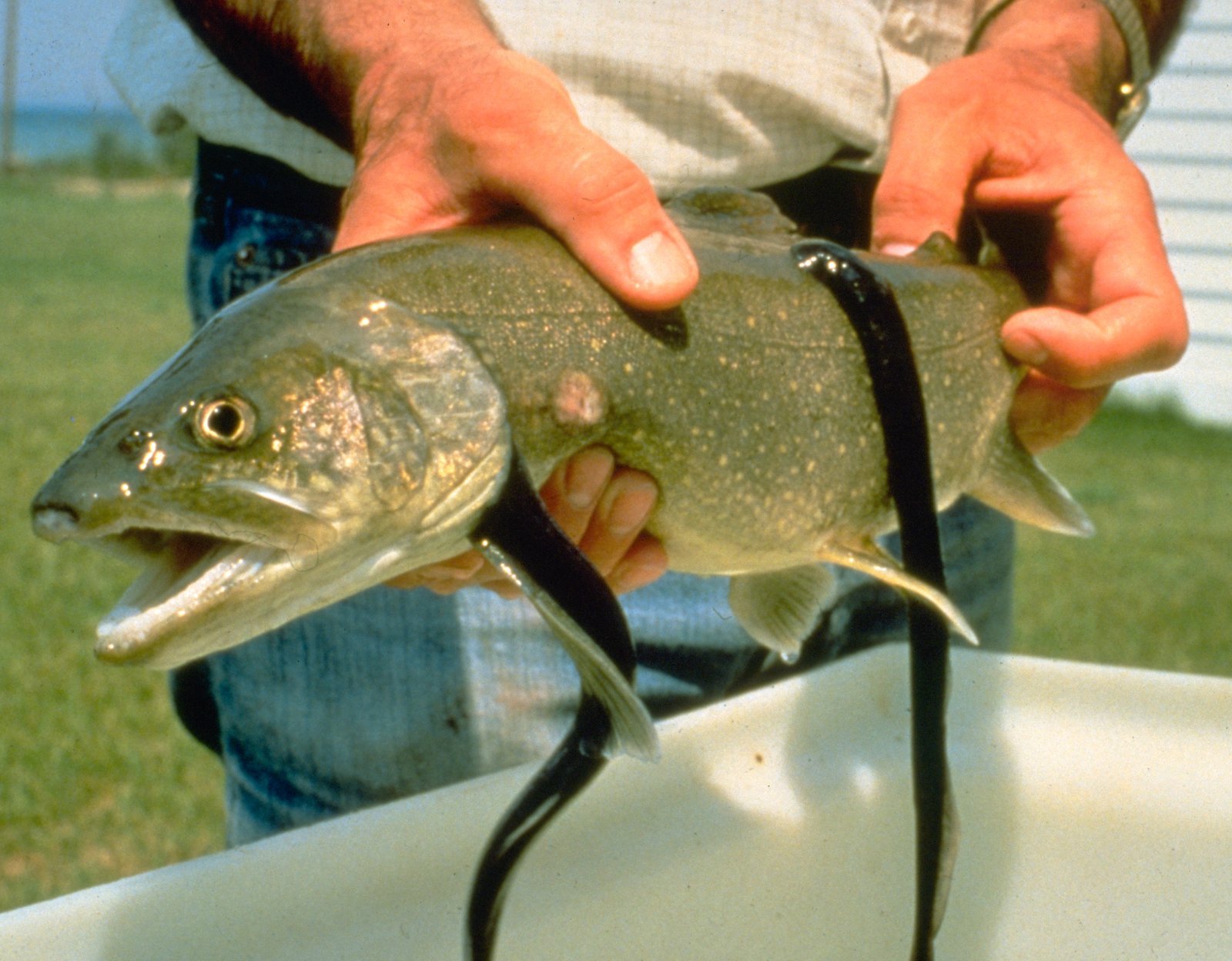
The sea lamprey is native to the North Atlantic. It evolved over the past several hundred thousand years to parasitize Atlantic salmon, cod, and other large fish, attaching with a circular sucking mouth, rasping a hole through the host's skin, and feeding on blood and body fluids. Each lamprey kills, on average, several large fish over its parasitic lifecycle. In the Atlantic, where co-evolution has produced host species with some defenses, lamprey predation is a normal part of the ecosystem.
In the Great Lakes, where the resident lake trout had no co-evolutionary defenses, lamprey predation was catastrophic. The lamprey reached Lake Erie in the early 1920s through a canal that bypassed Niagara Falls, and Lake Superior by the late 1940s. By the early 1960s, lake trout populations across all five Great Lakes had collapsed to the point of functional extinction. The lakes' apex predator was gone.
The TFM program
The response was one of the most ambitious continent-scale invasive-species control programs ever attempted. The U.S. and Canadian governments, working through the Great Lakes Fishery Commission established by treaty in 1955, identified TFM (3-trifluoromethyl-4-nitrophenol) as a chemical with an unusual property: highly toxic to lamprey larvae in the streams where they spend the first three to seventeen years of their lifecycle, but minimally toxic to other fish species at controlled doses. Beginning in 1958, the agencies began applying TFM systematically to lamprey-producing tributaries across the Great Lakes basin.
The program continues today. Lamprey-producing tribs are surveyed on a multi-year rotation, and TFM applications are scheduled when larval populations exceed control thresholds. The cost is substantial — millions of dollars annually across the basin — and the program is one of the longest-running, most successful invasive-species controls in North American conservation history. Lamprey populations remain a fraction of their peak, the lake trout fishery has partially recovered (though never to pre-invasion levels), and the salmonid stocking programs that built the modern Lake Erie and Lake Ontario fisheries are operationally possible only because the lamprey is held in check.
Lake Erie's specific situation
Lake Erie's relationship to the lamprey is somewhat different from the deeper lakes'. Erie is shallower and warmer, less ideal lamprey habitat, and the Erie tributaries that produce lamprey are mostly the larger systems — Cattaraugus on the New York side, the Maumee on the western Ohio side, and a handful of others. The Lake Erie south-shore Alley creeks are largely not lamprey-producing tribs, which means the Alley steelhead program is, ecologically, in better lamprey-control circumstances than the Lake Ontario program.
This is not a guarantee. Lamprey distribution shifts with water-temperature changes, and the long-term picture under climate-driven warming is genuinely uncertain. But the current operational reality is that most south-shore Alley steelhead anglers will never see a lamprey in their fishery, while Lake Ontario anglers periodically catch lamprey-scarred fish that show, on the body, exactly what an unchecked invasion would produce.
The lake trout was the apex predator of the Great Lakes for ten thousand years. The lamprey collapsed it in twenty. The fishery we now manage is the fishery in the wake of that collapse — and the salmonid program is operationally possible only because the lamprey is held in check.
Why this matters to the archive
The lamprey story belongs in this archive because the steelhead fishery we drive across three states to chase exists in the ecological vacancy left by the lake trout's collapse. We did not stock steelhead into a healthy native salmonid fishery. We stocked them into a damaged ecosystem to fill a niche that the native predators could no longer occupy. That framing matters when we think about the management commitments required to keep the program going — both the ongoing TFM control work and the broader watershed stewardship that the Alley fishery depends on.
It also matters for thinking about what the lakes might look like in the future. The lake trout populations are slowly recovering on Lake Superior, where lamprey control has been most effective and the cold-water habitat is most suitable. There is a long-term ecological scenario in which native salmonid recovery overlaps with the stocked salmonid programs in ways that will require management decisions nobody has fully written down yet.