Smallmouth are the trout angler's gateway drug to summer -- a fish that hits harder per ounce than is strictly reasonable, holds in rocky current the way a trout would, and refuses to take itself seriously. The Great Lakes shoreline and lower river reaches are full of them between May and October, and they would rather you didn't tell anyone.
Smallmouth Bass


Identity & ID
Who this fish is, how to ID, world & state records.
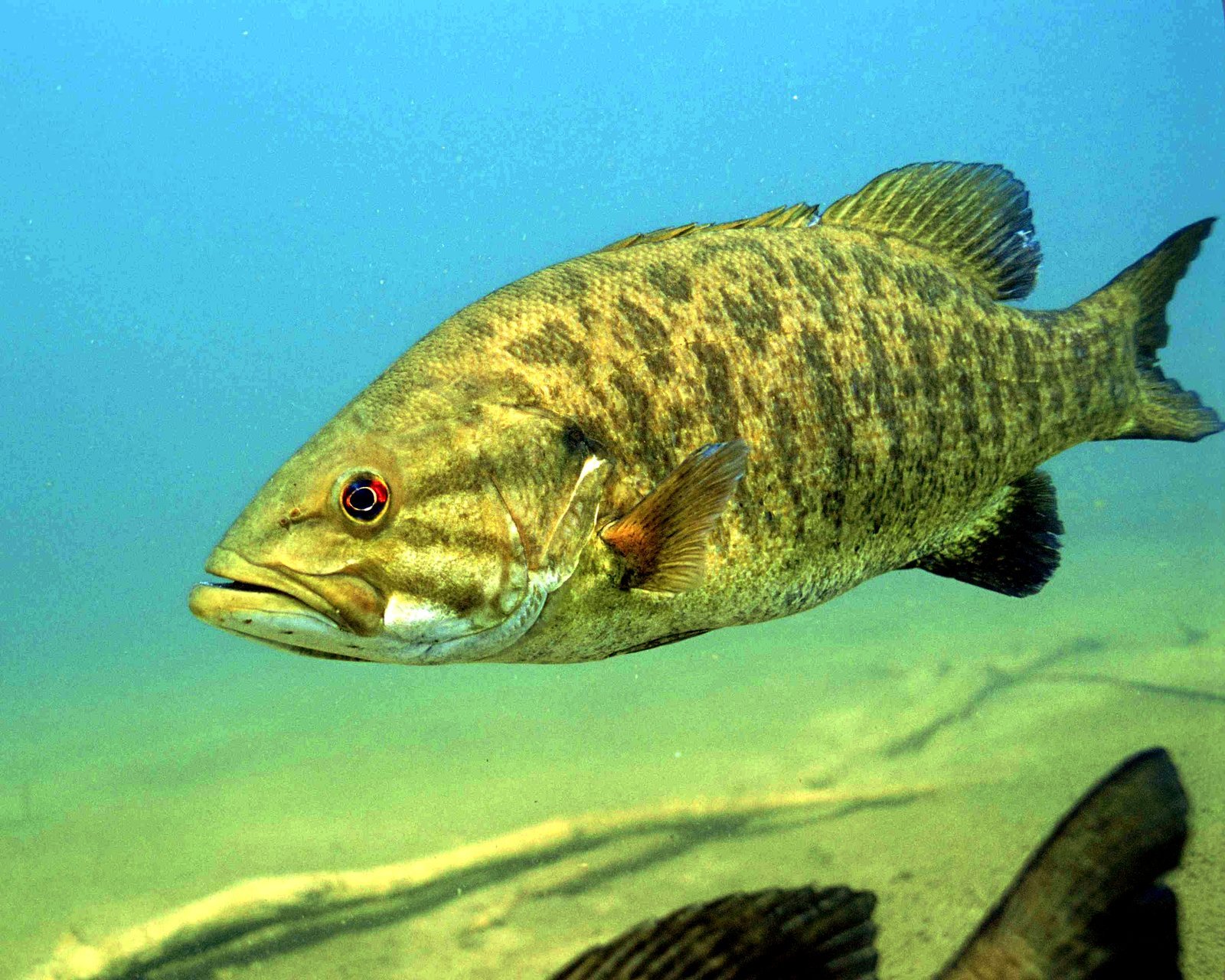
Micropterus dolomieu — bronze, muscular, and aggressive. The smallmouth's body is more torpedo-shaped than its largemouth cousin, with vertical bars (rather than a single horizontal stripe) along its sides and an upper jaw that doesn't extend past the eye. Eyes are commonly red. Body color ranges from olive-brown to bronze depending on water clarity — fish from clear Erie water are golden bronze; fish from stained tribs are nearly olive-black.
The "small" in smallmouth refers only to the mouth size relative to its largemouth cousin. The fish itself can grow to 7+ pounds in our region. Size benchmarks:
- 12 inches = a "keeper" by most state regs
- 17-18 inches = "smallie of a season"
- 20+ inches = "smallie of a lifetime"
- 22+ inches = legitimate trophy water (Lake Erie)
Smallmouth bass (Micropterus dolomieu) — bronze flanks, vertical bars, red eye. — USFWS Mountain Prairie (Public Domain)
Range & abundance in the Alley
Where in the SHA region they live and where they're best targeted.
Smallmouth dominate the Steelhead Alley region in two distinct fisheries:
Lake Erie
The western basin (Toledo to Sandusky) and the islands (Bass Islands, Pelee Island, Kelly's Island) hold one of the world's premier smallmouth fisheries. Reefs, rock piles, and deep weed lines produce 4-7 pound fish from May through November. The eastern basin (Erie, PA → Buffalo, NY) is rockier and often produces bigger average fish but in lower numbers.
The tributaries
Smallies move into the lower miles of the Alley tribs (the same rivers that hold steelhead in winter) once water temps cross 60°F — typically late May. They use the same boulder runs and pool-tailouts steelhead use, but in summer instead of winter. River smallies max out smaller than lake fish (3-4 lbs is a great river fish), but the fight is unreal in current.
Inland reservoirs and rivers — Pymatuning Lake (PA), Chautauqua Lake (NY), French Creek (PA), Allegheny River — round out the picture and are often less crowded than the Erie reefs in mid-summer.
Seasonal calendar
Month-by-month: when they bite, spawn, hide, or run.
| Month | What is happening |
|---|---|
| April | Pre-spawn staging. Fish move from deep wintering structure into 8-15 ft staging areas adjacent to spawning flats. |
| May | Spawn. Water at 60-65°F triggers nesting. Males build saucer-shaped nests in 4-10 ft, females visit briefly. Aggressive bite — but ethics matter (see lore). |
| June | Post-spawn peak. Hungry fish recovering. Best month of the year on Erie reefs. Tubes, drop shots, jerkbaits. |
| July | Summer pattern. Erie smallies move to deeper rock structure (15-30 ft) on bright days, shallower at low light. River fish settle into pool/run rotations. |
| August | Same summer pattern; thermocline established. Topwater windows narrow to dawn/dusk. Rivers fish best on overcast days. |
| September | Fall feed. Cooling water = aggressive feeding. Often the second-best month of the year. Schools begin to consolidate. |
| October | Late fall. Fish move shallower as alewife and emerald shiner concentrate. Big fish day window opens. |
| November | Smallies stage on deep rock pre-winter. Slow, deep techniques. |
| December–March | Deep wintering. Fishable but specialized — vertical jigging deep structure on Erie. Most anglers are chasing steelhead instead. |
Spawning & life cycle
Reproduction biology, age curves, lifespan, behavioral phases.
Females reach sexual maturity at 3-4 years (~12 inches in our region). Spawn timing: water temp 60-65°F, late May to mid-June. Males construct nests by sweeping a saucer-shape in gravel or rock, typically 3-10 feet deep. Females visit nests, deposit eggs (up to 21,000 per fish, though more typically 5-10K in our colder northern range), then leave. Males guard the nest aggressively for 5-10 days through hatching, plus another week or two as fry hold above the nest.
Growth in Lake Erie is faster than in most of the smallmouth's range — abundant emerald shiner and round goby forage drives Erie fish to 4 lbs in 5-6 years. Inland and tributary fish grow more slowly. Lifespan: 10-15 years; trophy-class fish are usually 8+ years old.
Diet & forage
What they eat at each life stage; key forage species.
The Erie smallmouth diet shifted profoundly with the round goby invasion in the late 1990s. Today gobies are 60-80% of an Erie smallmouth's stomach contents in many studies. crayfishCrayfish remain important — and "crawdad" colored tubes/jigs remain the deadliest single bait. Other major forage:
| Food | Why it matters |
|---|---|
| Round goby | Bottom-dwelling, abundant on rock structure |
| Crayfish | Soft-shell stages drive gorging in early summer |
| Emerald shiner | Open-water schooling forage |
| Yellow perch fry | Late summer |
| Aquatic insects | Hex emergence, dragonflies, stoneflies (more important on rivers) |
| Frogs and small mammals | Opportunistic shoreline strikes |
Smallmouth feed by sight in clear water and by lateral-line vibration in stained water. They are visual hunters in a way largemouth aren't — color and presentation realism matter more on smallies than on most species.
Behavior patterns
Daily rhythm, weather response, water temp tipping points.
Smallmouth are structure-oriented schooling fish in the lake and territorial loners in the river. Same species, two different temperaments based on environment.
Daily rhythm
Peak feeding windows: dawn (first hour after sunrise), dusk (last 90 min before sunset), and pressure changes. Midday on bright days they go deep and lethargic. Cloud cover extends the feeding window all day.
Water temp tipping points
| Rule | Detail |
|---|---|
| Below 50°F | Cold-deep mode. Hard to fool; vertical presentations only. |
| 50-60°F | Pre-spawn staging. Suspending jerkbaits and small swimbaits. |
| 60-68°F | Spawn → post-spawn. Aggressive shallow bite; tubes, jigs, drop shots. |
| 68-75°F | Prime summer pattern. All techniques work. |
| 75-80°F | Heat-stress threshold. Fish move deep; surface bite collapses except dawn/dusk. |
| Above 80°F | Stress zone. Practice rapid release. |
Today's conditions read for Smallmouth Bass
Live from the river network. Pulled at page load — refresh for the latest.
Prime water-temp window for Smallmouth Bass is 60–75°F. 6 rivers are sitting in the window — fishable on multiple options today. Lake Erie surface is 75.9°F — warm-water summer pattern in effect.
Rivers in Smallmouth Bass's prime water-temp window today
| River | Water temp | Flow | Clarity |
|---|---|---|---|
| Conneaut Creek | 74.1°F | 96 cfs | Clear |
| Walnut Creek | 74.7°F | 9 cfs | Clear |
| Genesee River | 73.8°F | 302 cfs | Clear |
| Irondequoit Creek | 70.5°F | 133 cfs | Clear |
| Johnson Creek | 72.1°F | 917 cfs | Muddy |
| Eighteenmile Creek (Niagara) | 71.6°F | 882 cfs | Muddy |
Alley Index today: 97 (Excellent) · Lake Erie surface: 75.9°F
Habitat preferences
Pool / run / riffle, depth, structure, cover, current speed.
If a smallmouth could pick its perfect spot it would be a rocky point or boulder pile in 8-18 feet of water with a sand or gravel transition adjacent and a deep break within a cast's reach.
Lake Erie key structures
- Rocky reefs and shoals — Niagara Reef, Crib Reef, Locust Point
- Boulder fields — northeast shore of Pelee, Pelee Passage
- Deep weedline transitions — west basin marshes
- Wreck and crib structures — Lorain breakwall, Cleveland harbor
- Bridge pilings — Bay Bridge, Toledo
River key structures
- Boulder runs at the trib mouth → first half mile upstream
- Bedrock ledges
- Pool tailouts in 3-6 ft
- Eddies behind midstream rocks
- Bridge piers
How locals fish for it
Editorial — DJ + community on signature presentations.
The drop-shot is the single most productive Erie smallmouth technique. A 3-4 inch finesse worm or goby imitation, hooked through the nose, fished above a 1/2-3/4 oz weight, vertically over reefs in 15-30 ft. Light line (8 lb fluoro), spinning rod, dead-stick or twitch.
Tubes on a heavy jighead (3/8-1/2 oz) dragged across rock in 8-20 ft. Goby brown, watermelon, or green pumpkin. The Erie smallmouth's favorite meal is something the size and shape of a tube.
Jerkbaits in spring (Rapala Husky Jerk, Smithwick Rogue) when water is 50-60°F and fish are pre-spawn. Slow twitch-pause-twitch over hard bottom 6-12 ft.
Topwater in summer windows — Whopper Plopper, Spook Jr, frog patterns at dawn over rock. Most explosive smallmouth bite there is.
River smallies reward smaller offerings — 3-inch Senkos wacky-rigged, 1/8 oz tube jigs, small crankbaits (Rapala Shad Rap #5). Fish current seams behind boulders the same way you'd fish for a steelhead.
Local lore & storied waters
Specific Alley waters, history, ethics, traditions.
Bass Islands. South Bass (Put-in-Bay), Middle Bass, North Bass — the heart of the western Erie fishery. Smallmouth tournaments draw thousands of anglers. June is the celebration month.
Pelee Island, Ontario. Cross the international line and the average size jumps. Less pressure, bigger fish.
French Creek, PA. One of the most biodiverse streams in the eastern US. Wild river smallies in pristine water, plus a chance at musky on the same outing.
The bed-fishing debate
During spawn, males guard nests aggressively and will hit anything dropped on the bed — they're defending eggs, not feeding. Many anglers consider sight-fishing nests unethical because removing the male leaves the nest vulnerable to bluegill predation, potentially eliminating that year's contribution to the population. Local convention: if you must fish during spawn, hook fast and release fast back at the nest. Don't tournament-fish actively spawning beds. Some states (NY) close inland smallmouth season specifically to protect spawn.
Regulations & ethics
OH/PA/NY/Ontario regs, slot limits, season dates, C&R.
| Authority | Rules of note |
|---|---|
| Ohio | Lake Erie: 14-inch min, 5 fish daily, no closed season. Inland: variable by water; check ODNR. |
| Pennsylvania | Lake Erie: 12-inch min, 4 fish daily, year-round (note: PA smallie regs differ from rest of state). Inland: 12-inch min, 5 daily; closed season April 16 to Saturday before Memorial Day on most waters. |
| New York | Lake Erie/Niagara: 12-inch, 5 daily, year-round. Inland and Lake Ontario tribs: 12-inch, 5 daily, but closed season March 16 - 3rd Saturday in June. |
| Ontario | Varies by zone; check provincial regs annually. |
Catch-and-release smallmouth fishing is encouraged year-round; during the spawn closure on inland NY/PA waters it's mandatory immediate release.
From the Archive · Other Species
The Smallmouth Story
Native, durable, underappreciated — the warm-water fishery that shares the steelhead's water for half the year.
Smallmouth are native to these waters, survived the industrial era better than most species, and quietly produce a season-long fishery in the same trib pools that hold chrome in November. Lake Erie's...
Read the chapter →