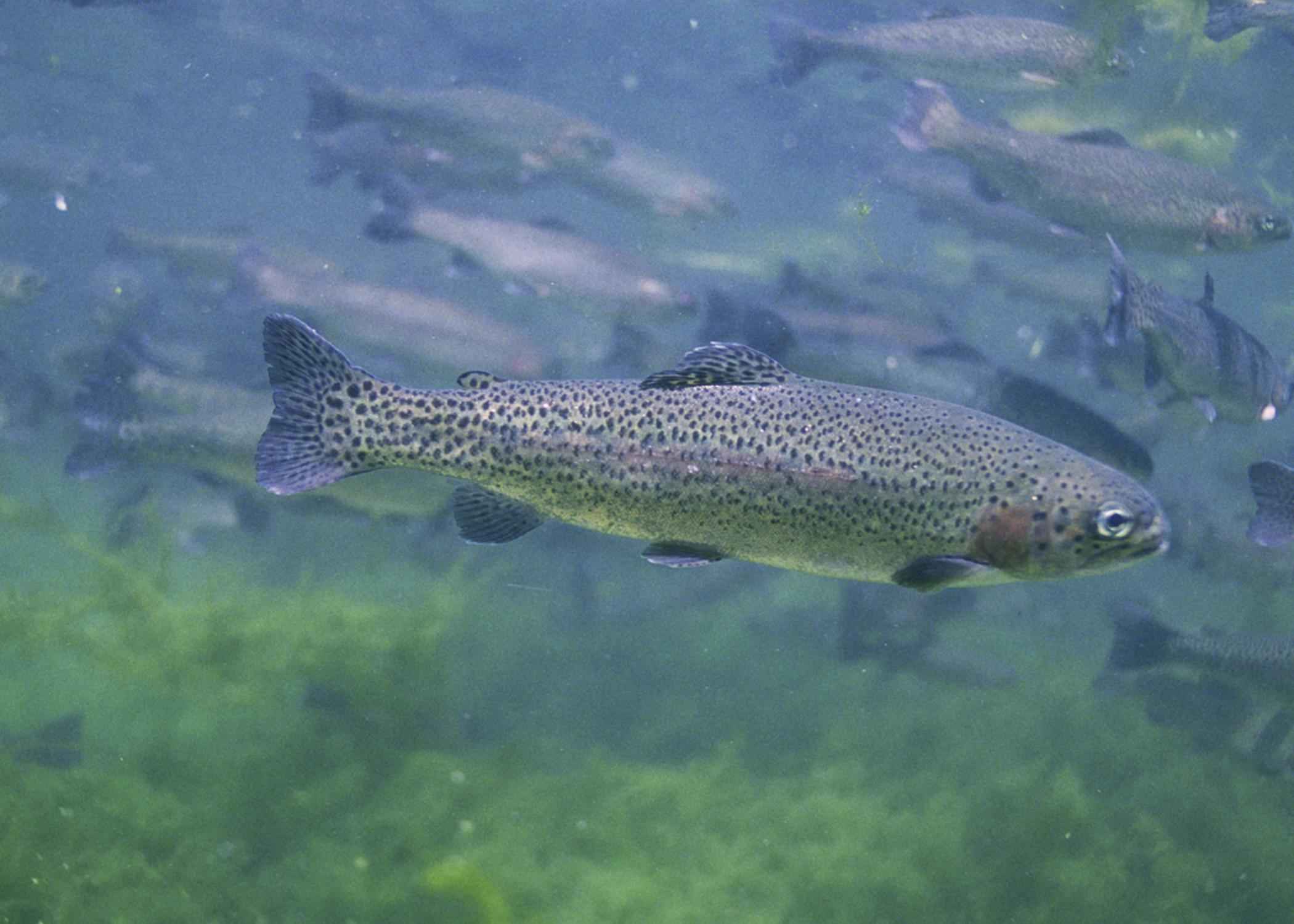
Arizona beginnings, California salmon, Oregon obsession — and how a river that once caught fire taught a transplant not to quit on beauty too early.
There are certain things a boy expects from a river, and certain things he does not.
He expects current. He expects stones, shadows, cold water around the ankles, and the possibility of fish. He expects mystery. He expects the silence that falls over a person who has come to the right place. He expects, if luck and weather and providence are on speaking terms, a rise, a strike, a flash, or the clean electric jolt of a trout taking hold.
What he does not expect from a river is that it should catch fire.
And yet that, in the case of the Cuyahoga River, is precisely what happened.
To say a river caught fire once is strange enough. To say it caught fire repeatedly is the sort of thing that makes a sensible person stop mid-sip and stare into the middle distance as if trying to confirm that civilization has not, in fact, taken leave of its senses. But there it was: a working river in a working age, moving through the industrial heart of Northeast Ohio, carrying not only commerce and confidence but the accumulated sins of a nation in a hurry. The mills ran, the steel poured, the factories produced, the economy marched forward, and the river — poor beast — was treated less as a living thing than as an accomplice too polite to complain.
This is not, however, only a story about a river that burned.
It is a story about a river that came back.
And for me, that story lands with a peculiar force, because I did not grow up here. I came to Northeast Ohio by way of a completely different angling life, one that began in desert country, wandered through mountain trout water, followed salmon and steelhead westward, and only much later found itself astonished by Ohio.
I grew up in Arizona, where water teaches reverence early because there is never enough of it. We fished places like Sedona, the White Mountains, Christopher Creek, Kohl's Ranch, Show Low, Lee's Ferry, and more streams and lakes than I can now name without losing myself entirely in memory. On the drive from Scottsdale up to the Mogollon Rim, we would stop at genuine roadhouses, the kind of places where the grown-ups partook in libations while we kids tore around outside like underfunded rodeo talent — catching snakes, roughhousing in the dust, and waiting for the moment the road would finally climb into the pines.
That ascent into the high country felt like entering another world. Desert gave way to forest. Heat gave way to cool shadow. And somewhere up there were rainbow trout, which we pursued with all the seriousness available to boys carrying Zebco 101s and jars of Pautzke's Balls O' Fire.
One memory has never left me.
I was in the car with my little brother and my mother, heading for the mountains, ready to fish with the full-body urgency known only to children and the incurably afflicted. My mother pulled our late-sixties light blue Ford Futura station wagon over alongside the White River. It was pouring rain. I was barefoot, wearing cut-offs and no shirt, tanned the color of chocolate milk from a summer spent outdoors, my bright blond hair tinged faintly green from too much chlorinated pool water. Before the car had fully settled into stillness, I was out of it with my Zebco 101 in hand, sliding down to the bank through the rain, making one cast, and hooking a beautiful rainbow of maybe ten inches on that very first throw.
I can still feel the scene — the cold rain, the mud, the river, the shock of that fish, and my mother's astonishment from the roadside. It was one of those moments that enters a life permanently and takes up residence there.
A child may not know it then, but a single cast can become biography.
Arizona gave me that sort of beginning.
I remember Sedona before it became Sedona as the world now knows it — when it still felt like a tiny outpost with a lodge, a gas station, a few houses, and a local doctor whom I managed to meet on two memorable occasions. The first came after I broke a leg at Slide Rock. The second followed a headlong run through that gas station in a downpour, where I crashed directly into the little metal table that held the credit-card swiping machine. I caught it right above the eyebrow and bled like a stuck pig. Six stitches later, we were on our way back to Scottsdale. Such incidents, while alarming to adults, contribute tremendously to a boy's conviction that life is meant to be lived outdoors and somewhat recklessly.
There were hikes into meadows and lakes up on the Rim. There was our little cabin in Heber/Overgaard. There was Show Low, a town with the kind of origin story America used to produce in bulk: a mayoral decision settled, as legend has it, by cutting a deck of cards, low card taking the honors. There was even the strange local aura of Fire in the Sky country nearby, where Travis Walton and his logging crew turned an Arizona mountain town into one more place where the ordinary and the impossible had briefly shaken hands.
All of this formed the early grammar of my outdoor life: weather, camp roads, trout streams, family motion, a boy's appetite for water, and the growing realization that whatever this thing was, it mattered more to me than most things did.
Then, as I got a little older, my mother would send me to California to spend summers with my father.
My father was the sort of man who made ordinary categories feel inadequate. He was an avid fly fisherman, software engineer, pilot, skier, dancer, musician, and the owner of a 35-foot Trojan cabin cruiser named Fifth of September, which he took out on San Francisco Bay for salmon. On that boat I got my first real job on salt water: bait boy, apprentice, observer, son. It was the beginning of another education entirely.
I have one image of him from very early on that has stayed with me all my life. He pulled something from his freezer — long, perhaps twenty-five inches, shaped like a trout but somehow more commanding. He told me it was a steelhead. Just like a trout, only bigger, because it goes to the ocean to get big. That sentence lodged itself in me with all the force of myth.
A trout that leaves for the ocean and returns larger, brighter, transformed? It sounded almost unfairly glorious.
Later, in my teens, our tradition was to take a fly-fishing trip on Memorial Day weekend, usually chasing shad on Northern California rivers like the Feather, the American, and the Sacramento. My father, whose own people had come from Indianapolis, would narrate the Indy 500 to me with the authority of a statesman and the enthusiasm of a race engineer. We would listen to it on the radio on the drive home, our mid-seventies Toyota Celica GT liftback often traveling at speeds that attracted the entirely predictable concern of the California Highway Patrol.
These were not merely outings. They were chapters in an apprenticeship — toward fish, toward water, toward my father, and eventually toward myself.
After high school and a three-year stint in the Army, I came out and began my career as a software developer, spending many of those years working alongside my father. The fishing remained. The time together remained. The rivers remained. The hours we spent fishing are not easy to summarize honestly. Wonderful is too small a word. Meaningful is too dry. The truth is that some of those days can only be described by a poet, or perhaps by an old fisherman who has finally admitted that what he loved most in life was not merely the fish, but the company, the weather, the cast, the silence, and the strange holiness of being outdoors with someone who formed him.
Then eventually I started my own family, and we moved to southern Oregon.
If Arizona had given me beginnings, and California had given me steelhead as legend and practice, Oregon gave me obsession. I thought it was the most beautiful place in the world. I still do. In southern Oregon, I could be fishing for steelhead before work, sometimes at lunch, and certainly after work. The possibility of fish became stitched directly into the day. Things went from interest to affliction when I acquired a drift boat. That is when the whole enterprise ceased to be merely a pastime and became a full-blown condition.
My buddies and I once won enough money at a casino out on the coast to buy a new kicker motor, which saved us some rowing when we wanted to get back upstream and run the drift a second or third time. That is the sort of detail that sounds ridiculous until you realize it is perfectly logical to steelheaders, who have never in history allowed practicality to stand in the way of one more pass through a promising run.
So by the time I arrived in Northeast Ohio in 2010, I believed that the steelhead chapter of my life had, if not ended exactly, at least settled into memory. Steelhead belonged to western rivers, western weather, western mythologies of current and distance. Ohio, I assumed, would be another sort of life. Worthwhile, certainly. But not that life.
I had no idea how beautiful Ohio is.
I mean that sincerely and with some surprise still attached. I thought Oregon was the most beautiful place in the world, and I still think that. But I did not know how beautiful Ohio could be — its rivers, its seasons, its understated landscape, and above all its people. Beauty announces itself loudly in the West. In Ohio it often arrives more gradually, through character, through community, through green water and old towns and river corridors that reveal themselves a little at a time.
And then there was the Cuyahoga.
Most Americans know it for the worst reason possible. It caught fire. On paper, the phrase remains almost too symbolic to be believed. A river on fire sounds less like history than like an accusation. But that was the reality. The river had been so abused by the habits of industry — oil, chemical discharge, debris, general disregard — that water itself became something like evidence against the age.
One cannot say this without sadness. The Cuyahoga was not ruined by villains in capes, but by ordinary priorities pursued without enough conscience. The country was growing. Industry was booming. Cleveland and the surrounding region were central to making things, shipping things, building things. But when growth proceeds without regard for the water beneath it, the river becomes the ledger where every hidden cost is finally recorded.
The old anti-pollution campaigns of the era captured some of that awakening. So did the birth of the EPA, and the public realization that rivers are not industrial conveniences but living systems. William Ruckelshaus, the first EPA administrator, was not just a historical figure to me in the abstract. In my family, he was "Billy Ruck," a name connected through older friendships and angling circles, through fathers and grandfathers who understood rivers not as policy topics, but as beloved places. That thread matters. Conservation is often discussed in bureaucratic language, but it frequently begins in inheritance — in being taught to notice, being taught to care, being taught that damage to a fishery is not theoretical.
And so the great American correction began.
Not all at once. Not cleanly. Not romantically.
Rivers do not recover because somebody gives a fine speech about them.
They recover because a thousand unglamorous acts accumulate: regulations, upgrades, treatment plants, sewer projects, enforcement, studies, funding, public meetings, volunteer hours, restoration plans, dam removals, and the stubborn refusal of citizens to accept that disgrace must be permanent.
And slowly, astonishingly, the Cuyahoga began to recover.
By the time I came to know it, the river had already become something the old story could hardly account for. People were paddling it. Floating it. Walking its banks. Fishing it. In places like Kent and Cuyahoga Falls, the river was no longer merely an environmental cautionary tale. It was becoming a genuine civic and recreational asset, something people enjoyed rather than apologized for.
And then, for me, the story changed from admiration to participation.
I became a new member of the Western Reserve chapter of Trout Unlimited just as we helped plant that first batch of trout in the Cuyahoga Falls stretch. It is difficult to overstate what that meant to me. Up until then, the river's recovery had been a moving public story. A hopeful story. A story I respected. But when you stand there and help place fish into water, the thing becomes personal. The abstract becomes immediate. The comeback now has your fingerprints on it, however lightly.
Then came the deeper surprise.
The trout did not simply appear as symbols and disappear as sentiment. Work tracking stocked fish suggested something far more significant: they were surviving. Holding over. Moving through the river. That is where hope stops being public relations and becomes biology. A trout is an incorruptible witness. It does not care how noble our intentions are. If the water is wrong, it tells us so by dying. If it stays, it tells us something even more important: that the river has crossed from aspiration into credibility.
And beyond trout, of course, lies steelhead.
That word still carries the voltage of my whole life in fishing: Arizona beginnings, California summers, Oregon obsession, my father's freezer, drift boats, shad trips, salmon on the bay, and those western rivers where I had assumed the story would remain. Yet here in Ohio, on a river once held up as evidence of national shame, the steelhead story is no fantasy. It is real, growing, and increasingly meaningful. With habitat reconnecting and the river continuing its long recovery, the possibility of the Cuyahoga as true coldwater opportunity becomes less poetic and more concrete every year.
That may be the most moving part of all.
Not simply that the river is cleaner.
Not simply that it is fishable.
But that it has become a rebuke to despair.
It would have been easy to write this river off forever. In fact, most of the country did. Once a place becomes famous for its humiliation, people assume that humiliation is now its permanent identity. But rivers, like people, sometimes refuse the terms handed to them. The Cuyahoga has refused them magnificently.
And the lesson extends well beyond Ohio.
Around the world, rivers and fisheries have suffered for human haste. Habitats have been destroyed. Runs interrupted. Waterways straightened, dammed, poisoned, and dismissed as expendable. One need not become strident to grieve this. Anyone who has loved fish, or current, or the plain beauty of moving water understands the cost instinctively. The sadness is real. The mistakes were real. Our disregard was real.
But so is this recovery.
That is why I do not want to tell the Cuyahoga story as an activist tract. The river deserves something truer than scolding. It deserves witness. It deserves a telling that admits the shame fully without becoming imprisoned by it. Because the Cuyahoga is now one of the country's most improbable examples of what restoration can look like when it is pursued seriously, patiently, and long enough to outlast the cynics.
It is a river that should matter to anglers, conservationists, historians, and anyone who believes a region ought to be known for more than the worst thing that once happened there.
And on a more personal level, it gave me something I did not expect to find when I came to Ohio.
I thought I had left steelhead behind.
Instead, I found a river — and a place, and a people — that taught me not to quit on beauty too early.