Conneaut is the model south-shore steelhead town: a working harbor and rail terminus that added an angling season in the 1980s and 1990s, sized infrastructure appropriately, and kept its pre-fishery identity intact alongside the run.
Conneaut sits at the eastern corner of Ohio, on the Pennsylvania line, where Conneaut Creek meets Lake Erie. By land area it is small. By population it is small. By visible economic activity on a Tuesday afternoon in July it is, at first glance, a quiet lakeside town that does not quite fit any of the categories we use to describe such places — not a tourist resort, not a working port in the active sense, not a commuter suburb. It is, simply, Conneaut. And in October, November, and December, it is one of the busiest steelhead towns on the south shore.
The port
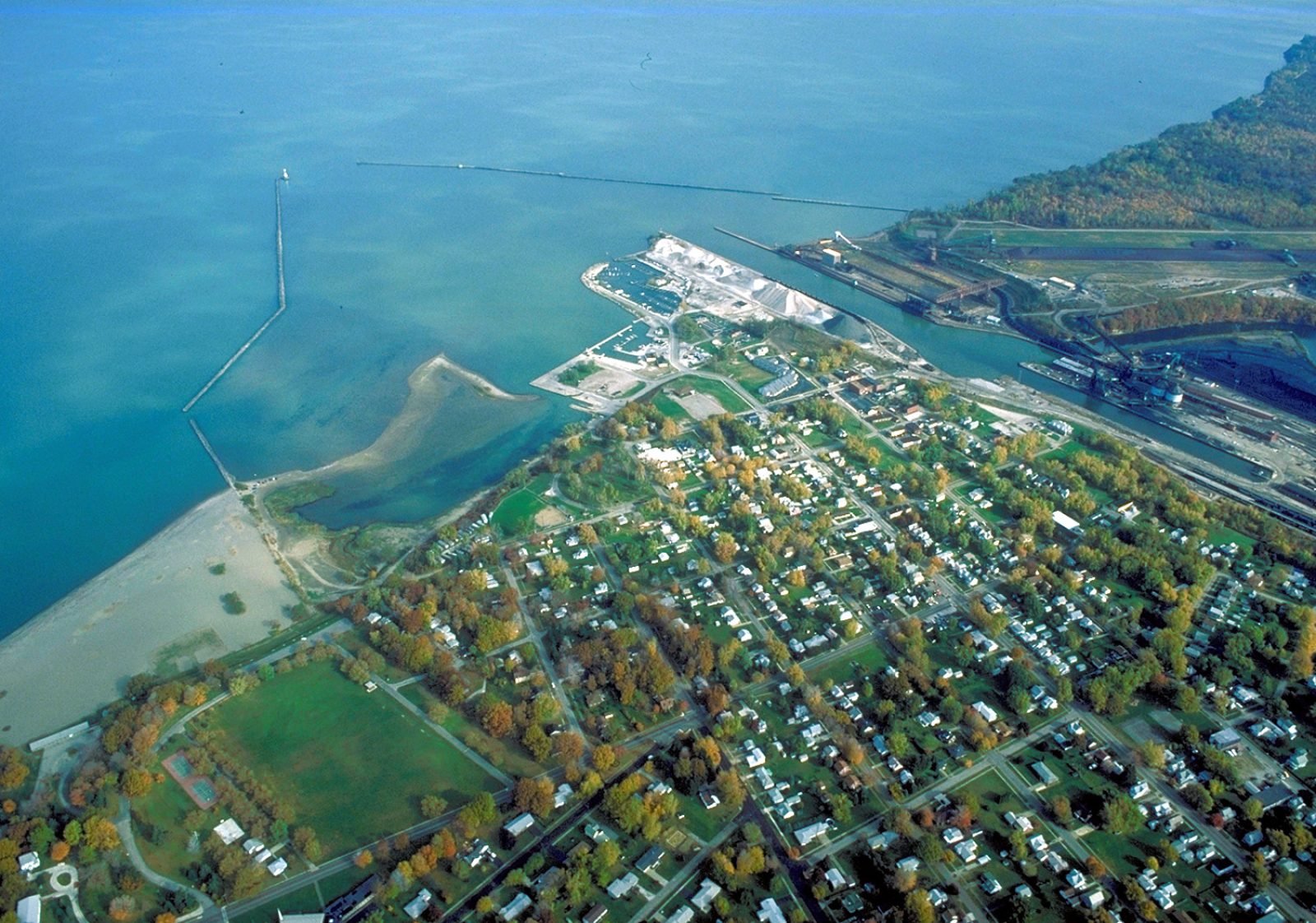
Conneaut's harbor was built in the late nineteenth century as a transshipment point for iron ore arriving from the Mesabi Range and coal moving north from the Appalachian fields. For most of the twentieth century, Conneaut was an industrial harbor first and an angling town a distant second. The Pittsburgh, Shenango & Lake Erie Railroad — later absorbed into Norfolk & Western — terminated at Conneaut, and ore boats unloaded into rail cars headed south. The harbor still functions, in a reduced form, as part of the Bessemer & Lake Erie network.
Anglers who fish Conneaut Creek today park within sight of the harbor's grain elevators and ore-handling structures. The geography that made Conneaut an industrial port — a deep natural harbor on a relatively unshallowed stretch of Lake Erie shoreline — is the same geography that gives the creek its lower-river hold and its winter-staging pools.
The transition
Conneaut's transition from an industrial port to an industrial-port-with-an-angling-economy happened gradually through the 1980s and 1990s. As the steelhead fishery built out and as the Conneaut Creek run developed into one of the most productive tribs in the Ohio program, the town's small-business ecosystem reorganized around it. The diners that had served the rail and harbor workers added "hot coffee, open at 5 a.m." to their winter signage. The motels along Lake Road went from summer-tourist economics to fall-and-winter steelhead-angler economics. The tackle and bait shops — small, stubborn, family-run — became year-round fixtures.
This was not a dramatic transformation in the way Pulaski's was on the Salmon River. Conneaut did not flip from one identity to another; it added a season. The summer beach economy, the lake-charter walleye fishery, and the late-fall and winter steelhead run now stitch together into a multi-season community life that did not exist before the steelhead program.
Conneaut Township Park
The single most important angling-infrastructure asset in town is the Conneaut Township Park system, which anchors a substantial public-access block on the lower creek and along the lakeshore. Township parks of this kind exist all along the south shore, but Conneaut's is unusually well-positioned: it places the angler community directly on the most productive lower-river water with parking, restrooms, and seasonal services that adapt to whatever fishery is running. The park system's quiet competence has been one of the underrated reasons Conneaut Creek's pressure profile is manageable on weekends that would overwhelm a less-organized access regime.
Conneaut did not flip from an industrial port to an angling town. It added a season. And in October, November, and December, the season belongs to the run.
What Conneaut represents
Conneaut is, in a quiet way, the model south-shore steelhead town. It is small enough that the angling community is locally visible without overwhelming the town's other identities. The infrastructure — diners, motels, shops, parking — is sized appropriately to the run rather than scaled up to a destination economy that would push out the working residents. And the town's pre-steelhead identity, as a port and rail terminus, persists alongside the fishery rather than being erased by it.
For visiting Conneaut as a destination — where to eat, where to sleep, what else to see when the river is off — the destination guide at Conneaut, Ohio covers the practical side. This chapter is the layer underneath: how the town got here.