Erie is the only city on the Alley. The hatchery infrastructure, the access network, the angling commerce, and the population that supports them all concentrate here. The Pennsylvania program could not run from a different city.
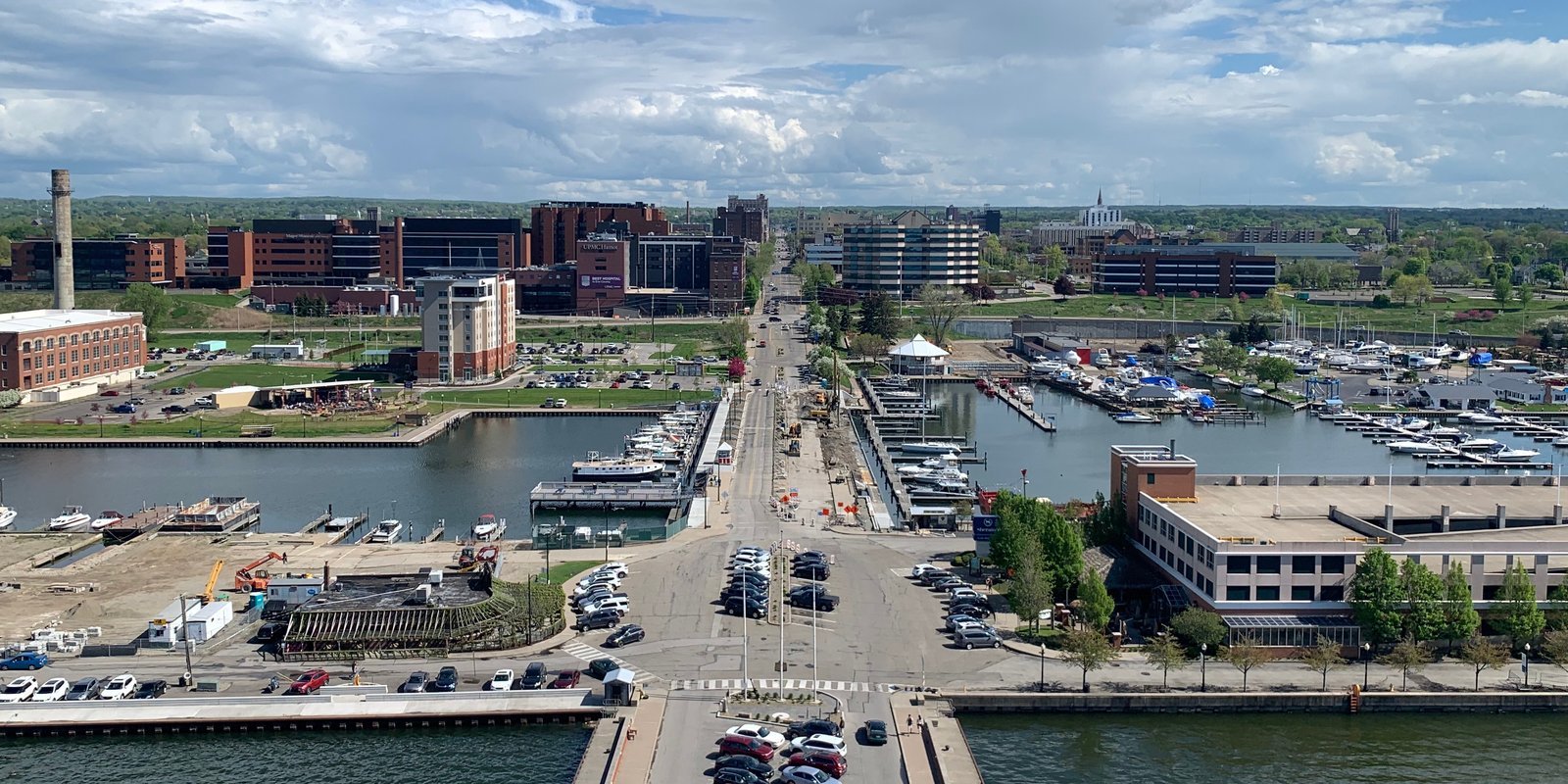
Erie is the only city on the Steelhead Alley that is, by any reasonable definition, a city. Population just under one hundred thousand, with a metropolitan area of roughly a quarter million, Erie sits roughly at the midpoint of Pennsylvania's fifty-one-mile Lake Erie shoreline and serves as the population, commercial, and angling hub for the entire Pennsylvania program. The PFBC's Trout Run weir is a few miles east of the city. The Fairview hatchery is just to the west. The chain of access blocks on Elk, Walnut, Trout, Twentymile, and the smaller creeks all radiate out from Erie. Most of the angling commerce — shops, guides, lodging, food — concentrates in or near the city.
Industrial Erie
Erie's twentieth-century identity was industrial. Heavy manufacturing — General Electric's locomotive plant, the Hammermill Paper works, the Erie Forge & Steel operation — anchored an economy that, at midcentury, supported the population. The decline of that economy through the late twentieth century is a familiar Rust Belt arc, with the city working through the painful adjustments of population loss, shrinking tax base, and reorientation toward smaller-scale industries, services, tourism, and the recreation economy.
The angling fishery is, in the larger Erie economic picture, a modest contributor — but a meaningful one in the specific neighborhoods, businesses, and seasonal industries it touches. The east-side neighborhoods nearest the trib mouths, the small motels along the lake-shore corridor, the bait-and-tackle shops in town and along Buffalo Road have all been measurably reshaped by the steelhead program over the past forty years.
Presque Isle
The geographical fact that distinguishes Erie from every other Alley town is Presque Isle — the long sandy peninsula curving north and west from the city, creating Presque Isle Bay and one of the most distinctive natural features on the Great Lakes south shore. Presque Isle State Park is a major year-round recreational asset; it shelters the bay, defines the city's lake-shore character, and produces, on its own, a small but real bay fishery for steelhead, perch, smallmouth, and other species. The peninsula's beaches in summer support a tourism economy that is distinct from but complementary to the fall and winter steelhead season.
The PFBC's hatchery infrastructure — Trout Run, Fairview, the Lake Erie Research Unit's facilities — is geographically clustered around the city in a way that no other state program duplicates. An angler driving into Erie on Interstate 90 in October is, within a few minutes of any exit, in striking distance of multiple stocked tribs and the hatchery operations that supply them.
The angling commerce
Erie has, more than any other Alley town, supported a continuous community of guide services, tackle shops, and fly-tying operations through the modern fishery's full duration. Some of these businesses date to the 1980s and 1990s — the period when the Pennsylvania program was building out and the angling commerce was finding its footing. Some are second-generation, with founding families having handed shops to children or sold to longtime employees. The continuity is real, and it has produced an angling-community knowledge base that is, by Alley standards, unusually deep.
Erie is the only city on the Alley that is, by any reasonable definition, a city. The hatchery infrastructure, the access network, the angling commerce, and the population that supports them all concentrate here.
What Erie represents
Erie functions, in the broader Alley story, as the structural keystone of the Pennsylvania program. The other PA tribs are the fisheries; Erie is the city those fisheries feed and the city that feeds the angling commerce that keeps them sustainably accessible. The PFBC could not run the program from a different city. The hatchery infrastructure, the broodstock work, the access partnerships, the regional shop network, the lodging stock — all of it is held together by the fact that Erie is large enough to support the supporting cast.
For visiting Erie as a destination — where to eat, where to sleep, the wineries, Presque Isle, what to do when the rivers are blown — the destination guide at Erie, Pennsylvania covers the practical side.