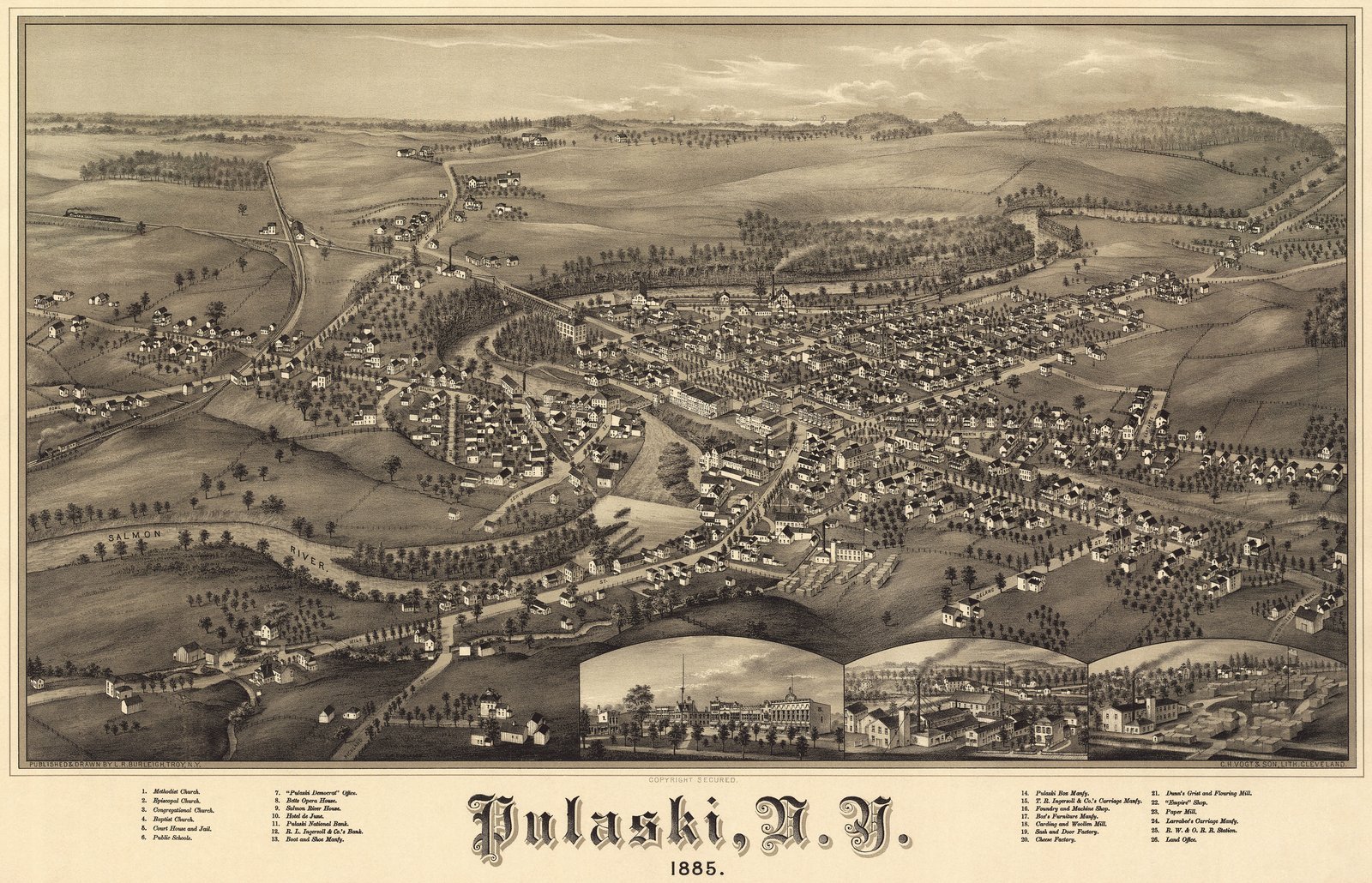
Pulaski before 1968 was a rural village with no notable fishery. Within fifteen years, it had been reorganized economically around one of the most heavily fished trout-and-salmon rivers in North America. The other Alley towns followed the Pulaski model at smaller scales.
Pulaski is the most dramatic town transformation in the Great Lakes salmonid story. A small village in Oswego County, New York — population roughly two thousand — Pulaski sits at the head of the Salmon River, about a dozen miles upstream from the river's mouth at Lake Ontario. Before 1968, Pulaski was a rural agricultural town with no notable fishery. Within fifteen years, it had been reorganized economically around what became one of the most heavily fished trout-and-salmon rivers in North America. The transition is so complete that it is hard, walking through Pulaski today, to imagine the town as it was before the run.
The Pacific-salmon program
The 1960s collapse of Lake Ontario's commercial fishery and the failure of the lake trout to recover under pressure from the sea lamprey created an ecological vacancy that, beginning in the late 1960s and accelerating through the 1970s, NYDEC and the Ontario Ministry of Natural Resources filled with Pacific-salmon and steelhead plants. Lake Ontario's deeper, colder, more stratified water column was better suited to chinook salmon than even Lake Michigan's, and the alewife forage base was abundant.
Stocking was concentrated on the major Lake Ontario tributaries, with the Salmon River — uniquely well-suited because of its size, flow, and gradient — emerging quickly as the centerpiece. By the late 1970s, Salmon River chinook returns were producing fish in the twenty-and-thirty-pound class, and a regional sport-fishing economy was beginning to crystallize around Pulaski.
The hatchery
The Salmon River Fish Hatchery, built in 1980 in Altmar — a few miles upstream from Pulaski — formalized the program. Altmar produces chinook, coho, brown trout, and steelhead at scales sufficient to anchor a continent-class fishery. The hatchery collects broodstock from wild-returning adults at the facility, ensuring the strains continue to adapt to Lake Ontario conditions, and runs as one of the most visible salmonid hatcheries on the Great Lakes — open to the public, well-signposted, and routinely included in angler itineraries.
The Pulaski transformation
Pulaski's reorganization happened fast. The motels along Route 11 and Route 81 multiplied from a handful of roadside operations to dozens, sized to absorb the August-through-November salmon-and-steelhead crowds. The fly shops and tackle outlets — Whitaker's, the Fly Shop at Pulaski, and several others — became destination stops in their own right. Restaurants reorganized hours and menus around an angling clientele that wanted hot food at five a.m. and a place to debrief at six p.m. The river's lower reach, especially the Douglaston Salmon Run private water and the public Pulaski sections, became some of the most heavily fished trout water in the country.
The transformation was not without strain. A small village handling thousands of weekend anglers from August to November stretches infrastructure, parking, and services. Tensions between anglers, residents, and the river's broader ecological health surfaced periodically — most notably around snagging practices in the early years, which were eventually curbed by regulation and angler-community pressure. The Salmon River fishery today is, on balance, a well-managed example of what intensive run-fish stewardship can produce, but the path was not always smooth.
Pulaski before 1968 was a rural village with no notable fishery. Forty-five years later, the village handled more anglers per capita on a fall weekend than any town in the Lower 48. The transformation is the most complete in the Great Lakes salmonid story.
Pulaski's place in the Alley
Pulaski, strictly, is not on the Steelhead Alley as the term is typically used. It sits on Lake Ontario, not Lake Erie. But its inclusion in this archive is deliberate. The Lake Ontario salmonid program is the older sibling of the Lake Erie program; the people who built one knew the people who built the other; the angler communities overlap; and many south-shore Erie regulars make the pilgrimage to the Salmon River at least once for the chinook run, the steelhead winter, or both.
What Pulaski demonstrates, more than any other town in the salmonid corridor, is the magnitude of the economic and cultural change a stocked fishery can produce in a small community when the ecological conditions and the management commitment line up. The Alley towns — Conneaut, Erie, Ashtabula — have followed the Pulaski model, at smaller scales and over longer time horizons.
For visiting Pulaski as a destination, the destination guide at Pulaski, New York covers the practical side of an angling weekend on the Salmon River.