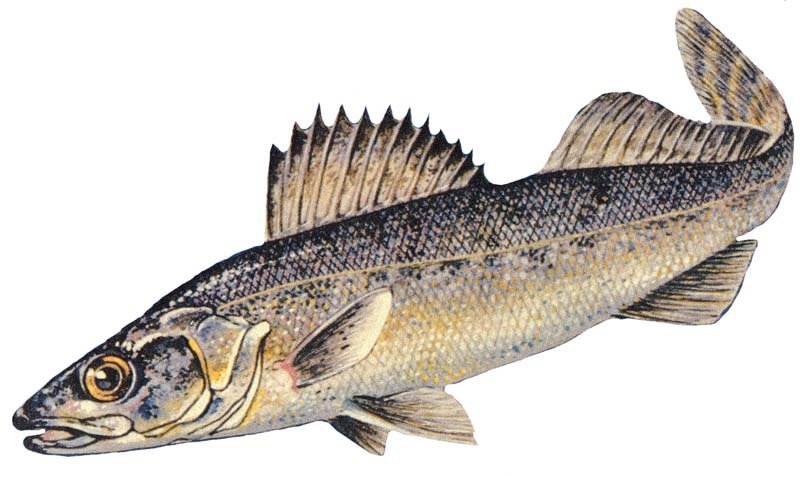
The blue pike was a Lake Erie endemic — a subspecies of walleye occupying the cool deep midwaters of the central basin, found nowhere else on earth. Declared extinct in 1983. The modern fishery, including the steelhead program, is built on the ecological vacancy it left.
The blue pike was a Lake Erie endemic. It was found nowhere else on earth — not in the upper Great Lakes, not in the Mississippi system, not in Canada beyond the Erie basin. It was, in scientific terms, a subspecies or close relative of the walleye, distinguished by its slate-blue back, larger eye, and slimmer profile, and by an ecological niche the walleye did not occupy: the cooler, deeper midwaters of the central basin. Anglers and commercial netters distinguished the two species at a glance. The blue pike sustained, at its peak, a commercial fishery of millions of pounds a year on Lake Erie alone.
The blue pike is extinct. The U.S. Fish and Wildlife Service formally declared Sander vitreus glaucus extinct in 1983, and, despite occasional reports of recovery candidates from various locations, no scientifically credible blue-pike population has been identified since. What was for centuries one of the lake's two most important predator species is gone.
What was lost
The blue pike's collapse was not a slow attrition. Through the 1950s, blue pike commercial harvests on Lake Erie were measured in the millions of pounds annually. By 1958, the catch had crashed by more than ninety-five percent. By the early 1960s, blue pike were essentially absent from the commercial nets. The species had collapsed in less than a decade. Several intersecting causes are usually cited — overharvest, eutrophication, the loss of cold deep-water refugia as the lake warmed and the central basin's hypolimnion thinned, hybridization pressure with the more thermally tolerant walleye, and possibly disease — but the proximate cause of the species' actual disappearance was that, once the population fell below a critical threshold, the remaining individuals could not find each other to spawn, and the genetic distinctiveness that defined the blue pike was absorbed back into the walleye lineage.
The lessons
The blue pike is, in this archive, the cautionary tail of the walleye chapter. The same lake that recovered its walleye fishery did not recover its blue pike. The recovery window for an endemic, narrow-niche species is narrower than the window for a generalist. By the time the management apparatus that would later rebuild the walleye fishery was in place, the blue pike was already past saving.
It is worth saying clearly: the modern Lake Erie sport fishery, including the steelhead program that followed, is built on the ecological vacancy left by the blue pike's disappearance. We have a different lake than the lake that existed in 1900. We have a stocked, salmonid-augmented food web in a basin whose original cool-water apex predator is gone. The fishery is, by any reasonable measure, recovering and productive — but not the same fishery, not the same lake, and not a lake that contains everything it once did.
The lake that recovered its walleye fishery did not recover its blue pike. We have a different lake than the lake that existed in 1900 — productive, recovering, but not the same.
Why the blue pike belongs in this archive
This is a steelhead site. The blue pike was never a steelhead. It was barely a sport fish in the modern sense — it was a commercial-net target with a regional cultural presence in fish-fry traditions, restaurant menus, and town economies. It belongs in this archive for two reasons. First, because the south-shore towns that now host the steelhead fishery were, within living memory, blue-pike towns; the cultural and economic continuity is real and the loss matters. Second, because no honest history of this lake can omit the species we lost while we were not paying enough attention. A working archive that pretends the blue pike was never here would be an unworking archive.
The blue pike has no species profile on this site because the site documents species an angler might target. There is, in this respect, a quiet conservation point: the difference between a profile worth writing and a chapter worth keeping is, sometimes, just timing.