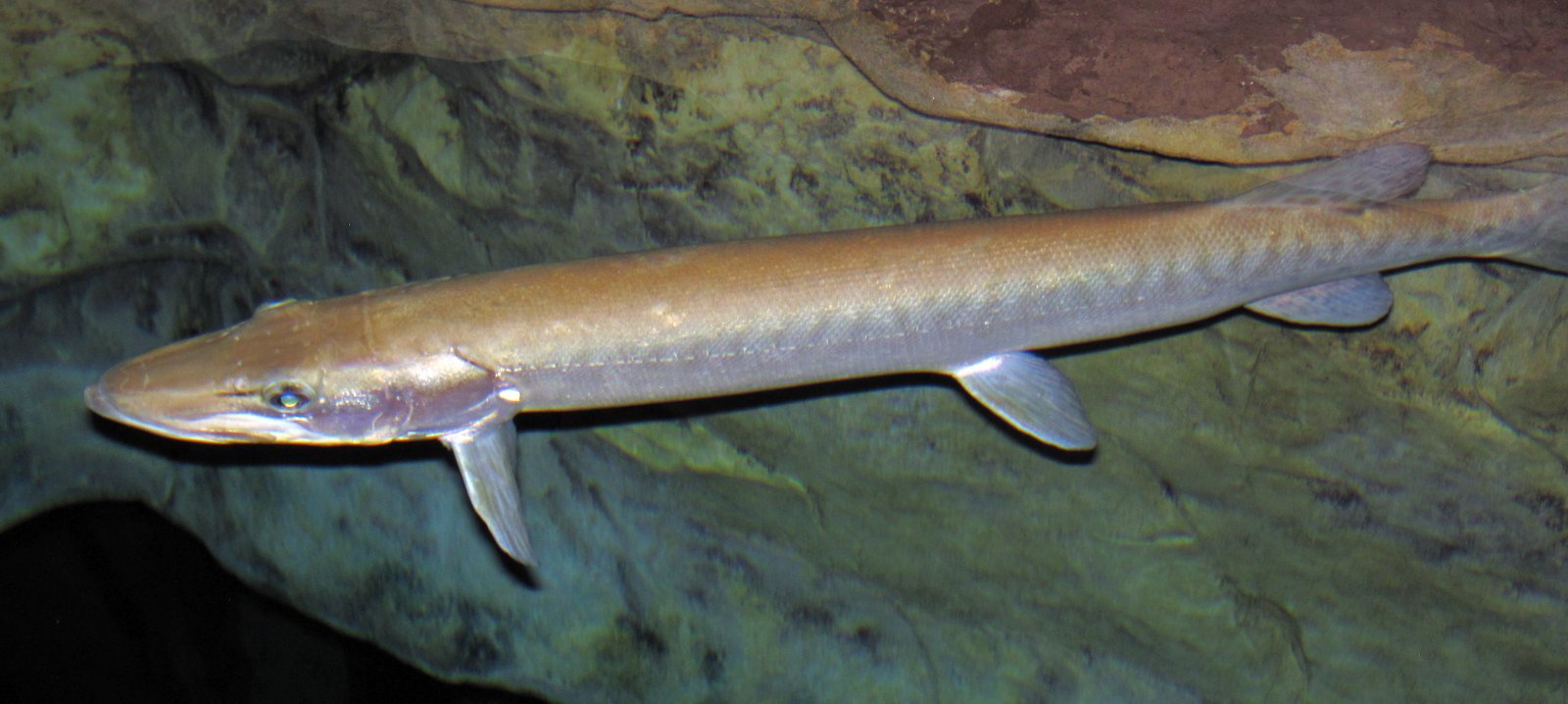
The muskellunge is the Alley's quiet apex predator. It is in the system — sparse, fragile, monitored — but the cultural footprint is small. A working archive of these waters has to register the upper end of the food web, even when most anglers never see it.
The muskellunge is the Alley's quiet apex predator. It is in the system — in some of the lower-river reaches of the larger tribs, in the shoreline weed beds of Lake Erie's south shore, in a few specific places that the dedicated muskie anglers do not advertise — but the population is sparse, the fishery is fragile, and the cultural footprint is small. The steelhead fishery has a thousand voices; the Erie-tributary muskie fishery has, in any given decade, perhaps a few dozen anglers who actually pursue it, a handful of guides who quietly target it, and a population whose status the state agencies monitor more carefully than most of us realize.
Native fish, low population
The muskellunge — Esox masquinongy — is native to the Great Lakes basin and historically reached substantial populations in some of the larger Lake Erie tribs and the lake itself. The mid-century industrial decline that hammered the lake's predator community hit the muskie particularly hard; muskies are slow-growing, low-fecundity, top-of-the-food-chain fish that recover slowly from population pressure. By the late twentieth century, native Lake Erie muskie populations had thinned to remnant levels in most of their historical range.
State agencies in Ohio, Pennsylvania, and New York have, at various times, augmented the native population with hatchery stockings. Ohio's musky stocking program has historically focused on inland reservoirs (West Branch, Salt Fork, Piedmont, Clear Fork) rather than Lake Erie tribs directly, but some of those fish — and natural reproduction — find their way into the lake and the lower tribs. New York's program is broader, with substantial Niagara River muskie work that bleeds into the easternmost Erie tribs.
The Cattaraugus and the lower-trib fishery
The Cattaraugus has, periodically, supported muskie at angler-detectable levels. The Niagara River and its associated upper-Erie waters consistently produce muskie. The Maumee, on the western Ohio end, supports a muskie fishery that gets less press than its walleye sibling. Many of the south-shore creeks have one or two pools that, every few years, give up a sizable muskie to a confused steelhead angler — and then the silence reasserts itself.
Why this matters
An archive of the Alley fishery that does not register the muskie misses the upper end of the food web. The lake we fish is not just a steelhead-and-walleye system; it is a multi-species predator community that includes the muskie at the apex, the smallmouth and the steelhead in the mid-tier, and the alewife and emerald shiner forage species below. A healthier south-shore ecosystem includes a healthier muskie population, and the small constituency of muskie anglers who push for that has, in recent decades, contributed disproportionately to advocacy for habitat protection on the larger tribs.
The steelhead fishery has a thousand voices. The Erie-trib muskie fishery has, in any given decade, perhaps a few dozen anglers who actually pursue it — and a population whose status the state agencies monitor more carefully than most of us realize.
The ethical layer
Muskie are catch-and-release-by-default in most modern serious muskie angling, and the Alley population is fragile enough that any incidental catch — including the occasional muskie taken on heavy steelhead gear — should be handled with appropriate care: minimum air time, careful release, no extended photography. The fish you release this November may, in seven years, be the spawner that produces the next generation. That is a different time horizon than a stocked steelhead fishery, and it asks something different of the angler.
For muskie biology, range, and Alley-context targeting, see the Muskellunge species profile.