Muskellunge are the fish of ten thousand casts, a figure which the genuinely experienced consider conservative. The eastern Lake Ontario watershed holds them in respectable numbers; whether you, personally, will move one is a matter between you and your forearms.
Muskellunge

Identity & ID
Who this fish is, how to ID, world & state records.
The largest member of the pike family. Esox masquinongy grows to lengths and weights pike rarely match. Body color: dark olive to brown back, light sides with dark bars/spots (the inverse of pike's light spots on dark). Three subspecies are recognized but visually similar: clear, barred, and spotted — each common in different waters.
How to tell a muskie from a pike at boat-side:
| Feature | What you see |
|---|---|
| Markings | Dark on light (muskie) vs light on dark (pike). |
| Cheek scales | Only upper half scaled (muskie); fully scaled (pike). |
| Tail | Muskie tail tips are sharper/pointier; pike rounder. |
| Pore counts (definitive) | Muskie 6-9 pores per side on lower jaw; pike 5 or fewer. Anglers use this to settle hybrid debates. |
Sizes: 36 inches is "legal" most places; 42 inches is "great"; 48+ inches is "real"; 50+ is the fish-of-a-lifetime threshold; 55+ is the trophy benchmark in Northern Wisconsin and Minnesota waters; in our region, 50+ inches is genuinely rare and prized.
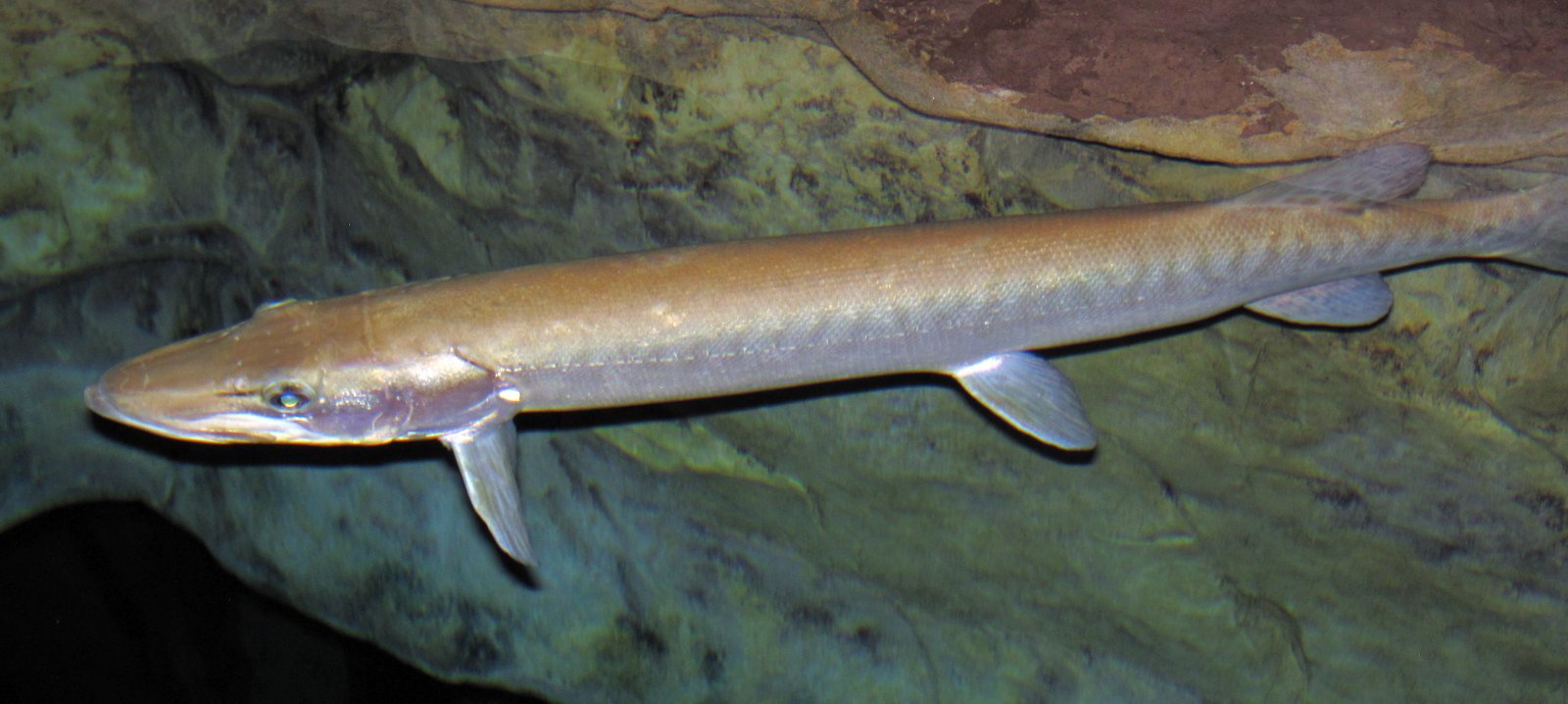
Muskellunge (Esox masquinongy) — dark bars on light, the inverse of pike. — Wikimedia Commons (CC BY-SA)
Muskellunge — the fish of ten thousand casts. — USFWS (Public Domain)
Range & abundance in the Alley
Where in the SHA region they live and where they're best targeted.
Muskie waters in our region are limited but legitimate:
| Region | What it fishes like |
|---|---|
| Chautauqua Lake (NY) | The SHA region's best-known muskie water. Stocked program, regular 50+ inch fish. |
| Niagara River (NY) | Particularly the upper river above the falls. World-class fish in moving water. |
| St. Lawrence River (NY/Ontario) | Beyond Lake Ontario but in the broader region. Trophy water. |
| French Creek (PA) | Wild river muskie. Difficult fishing but real fish present. |
| Allegheny River (PA) | Stocked muskie program. |
| Conneaut Lake (PA) | Historical state record water. |
| West Branch Reservoir (OH) | Ohio's premier muskie water. |
| Cave Run Lake (KY) and Lake of the Woods (MN/Ontario) | Outside our coverage but the marquee Eastern North American waters. |
Seasonal calendar
Month-by-month: when they bite, spawn, hide, or run.
| Month | What is happening |
|---|---|
| April-May | Spawn. Water 50-58°F. Most states close muskie season during spawn (varies by water). Catch and release in open seasons can be high-percentage but ethically debated. |
| June | Post-spawn peak. Hungry fish recovering. Big bucktails, glide baits. |
| July-August | Summer pattern. Fish move to deeper structure / suspended over open basin. Trolling becomes dominant. Topwater windows at dawn/dusk. |
| September | Schools relocating; baitfish migrations trigger feeding. Active casting bite returns. |
| October-November | Fall trophy season. Biggest fish of the year are caught now. Cold-water pattern; heavy slow lures. |
| December-March | Closed season most waters. Niagara River is open; specialized winter fishery. |
Spawning & life cycle
Reproduction biology, age curves, lifespan, behavioral phases.
Muskie are slow growers and late maturers. Females mature at 5-7 years (males at 4-5). Spawn at water 50-58°F over 1-3 ft of vegetated bottom. Egg counts 50,000-200,000 per female. No parental care.
Egg survival is low (1-3%) due to silt deposition, predation, and water temperature variation. Hatchery supplementation is critical to most muskie fisheries — true wild reproduction is limited even in healthy waters.
Growth: females grow faster than males. 30 inches in 4-6 years; 40 inches in 7-10; 48+ inches in 10-15. Females reach maximum sizes; males rarely exceed 42 inches. Lifespan 18-25 years; trophy fish (50+ inches) are 12-18 year-old females.
Diet & forage
What they eat at each life stage; key forage species.
Muskie eat what they want. Adult diet is dominated by:
- Yellow perch (everywhere they overlap)
- Suckers (large white suckers a favorite)
- Cisco/whitefish (in deep clear lakes)
- Walleye (yes — they eat walleye, including 18-inch fish)
- Pike (cannibalism within the family is common)
- Bluegill, crappie, bullheads
- Muskrats, ducks, frogs (occasional surface explosions)
"They eat what fits" extends further with muskie than any other regional species — there are documented cases of 50-inch muskie taking 24-inch suckers. The "go big" lure rule is real here. 8-12 inch bucktails, 10-12 inch jerkbaits, large gliders, and 12-15 inch swimbaits are not unusual for muskie work.
Behavior patterns
Daily rhythm, weather response, water temp tipping points.
Muskie behavior makes them famous and frustrating in equal measure.
| Rule | Detail |
|---|---|
| The follow | Muskie often follow lures to the boat and refuse at the last second. The classic "muskie follow" — a fish appears 6 feet behind your lure for the last 20 feet of the retrieve, lurks, then turns away. Maddening. |
| The figure-8 | The standard counter-move: when you see a follow, do NOT pull the lure out of the water. Drop the rod tip into the water and trace a fast figure-8 alongside the boat for 30+ seconds. Many follows turn into eats during the figure-8. |
| Lunar synchrony | Wikipedia: "Muskellunge feeding behavior is directly synchronized with the lunar cycle." Anglers swear by major/minor solunar windows. Whether this is folk knowledge or real correlation is debated; the muskie community largely respects the lunar tables. |
| Big window, big fish | Muskie feed in concentrated windows — 30-90 minutes of activity, then nothing. Be on the water when the window opens. |
Water temp
| Rule | Detail |
|---|---|
| 50-58°F | Spawn. |
| 58-72°F | Prime. |
| Above 75°F | Heat stress; release fast or switch species. |
Today's conditions read for Muskellunge
Live from the river network. Pulled at page load — refresh for the latest.
Prime water-temp window for Muskellunge is 55–72°F. 5 rivers are sitting in the window — fishable on multiple options today.
Rivers in Muskellunge's prime water-temp window today
| River | Water temp | Flow | Clarity |
|---|---|---|---|
| Elk Creek | 55.6°F | 9 cfs | Clear |
| Twenty Mile Creek | 55.6°F | 15 cfs | Clear |
| Crooked Creek | 55.6°F | 4 cfs | Clear |
| Irondequoit Creek | 70.5°F | 133 cfs | Clear |
| Eighteenmile Creek (Niagara) | 71.6°F | 882 cfs | Muddy |
Alley Index today: 97 (Excellent) · Lake Erie surface: 75.9°F
Habitat preferences
Pool / run / riffle, depth, structure, cover, current speed.
Muskie habitat varies by water type:
| Water type | Why fish hold here |
|---|---|
| Inland lakes | Weed-edge, lily-pad lines, deep weed-line drop-offs. Summer fish move deeper (15-25 ft) and suspend over open basin. |
| Rivers | Slow eddies, deep pools below current breaks, woody structure. The Niagara and French Creek hold river muskie that fish big-water style in moving current. |
| Reservoirs | Submerged timber, creek channels, points. |
How locals fish for it
Editorial — DJ + community on signature presentations.
The big bucktail. 8-10 inch double-bladed bucktail (Mepps Magnum Musky Killer, Bucher Buchertail) in chartreuse-orange or black-and-orange. Workhorse muskie lure. Cast, count down, fast burn retrieve, figure-8 at the boat.
The big jerkbait. 8-10 inch jerkbait — Suick, Bobbie Bait, Believer — twitched aggressively in 4-12 ft. Cold-water muskie lure (October-November).
The glide bait. 7-9 inch hard-plastic gliders (Phantom, Hellhound, Headlock). Side-to-side action triggers strikes from neutral fish.
Trolling. Big crankbaits (Believer, Headlock) trolled at 3-5 mph over deep weed edges. Productive when fish are scattered.
Live-bait suckers. Cold-water muskie technique. A 12-14 inch live sucker on a quick-strike rig, suspended under a balloon, fished slow.
Heavy gear is mandatory. Musky combos: 8-9 ft heavy-action rod, 65-100 lb braid, 12+ inches of 100-130 lb fluoro or wire leader. A boat-side 50-incher will bend a "bass rod" in half and run wire-cutter teeth through 30 lb mono.
Local lore & storied waters
Specific Alley waters, history, ethics, traditions.
Chautauqua Lake (NY) is the SHA region's marquee muskie water. The lake produces multiple 50+ inch fish each season and supports a dedicated guide/charter community out of Bemus Point and Lakewood.
Niagara River (NY) — the upper river above the falls is a muskie kingdom. Big fish, big water, big tackle.
St. Lawrence River — outside the Alley but the closest world-class muskie water to most of our coverage area. The 1957 Lawton fish (claimed 69 lb 15 oz) is still officially the world record but is widely disputed.
French Creek (PA) — small water with big secrets. Wild river muskie in remarkable density alongside smallmouth and pike.
Ethics — these matter
Muskie are slow-growing trophy fish. C&R is the unbreakable rule of the muskie community. Practices:
| Water | Story |
|---|---|
| No fish on the wall | Replica mounts from photos are the standard. There is no socially acceptable case for keeping a muskie outside the rare meat-fish. |
| Wide rubber landing nets only | Crank a fish into a knotted nylon net and you damage gills. |
| Hooks out at the surface or in the net | Don't bring a 48-inch fish into the boat — work from the water. |
| Photo in the water if possible | If you must lift, support horizontally, both hands, no longer than 30 seconds. |
| Revive in current | Hold the fish facing into current until it kicks free under its own power. Can take 2-5 minutes for a big fish. |
| Don't fish water above 75°F | Stop period. |
Regulations & ethics
OH/PA/NY/Ontario regs, slot limits, season dates, C&R.
| Authority | Rules of note |
|---|---|
| Ohio | 30-inch min, 1 daily. |
| Pennsylvania | 40-inch min, 1 daily. |
| New York | 40-inch min, 1 daily; 54-inch min on St. Lawrence River. |
| Ontario | Varies by zone; protect-by-size slot rules common. |
Most experienced muskie anglers practice release of every fish caught regardless of regs. This is the cultural norm; expect to be looked at sideways if you keep one.
From the Archive · Other Species
The Muskie Nobody Talks About
Native apex predator, sparse population, a fishery a few dozen anglers prosecute — and a population the state agencies watch more closely than the rest of us realize.
The muskellunge is the Alley's quiet apex predator. It is in the system — sparse, fragile, monitored — but the cultural footprint is small. A working archive of these waters has to register the upper...
Read the chapter →