Crappie are the fish that politely solves April -- when the steelhead are winding down, the bass haven't quite woken up, and the angler discovers that a small jig in two feet of water can produce a limit before lunch. They are also, briefly, delicious.
Crappie
Identity & ID
Who this fish is, how to ID, world & state records.
Two species in the SHA region:
| Feature | What you see |
|---|---|
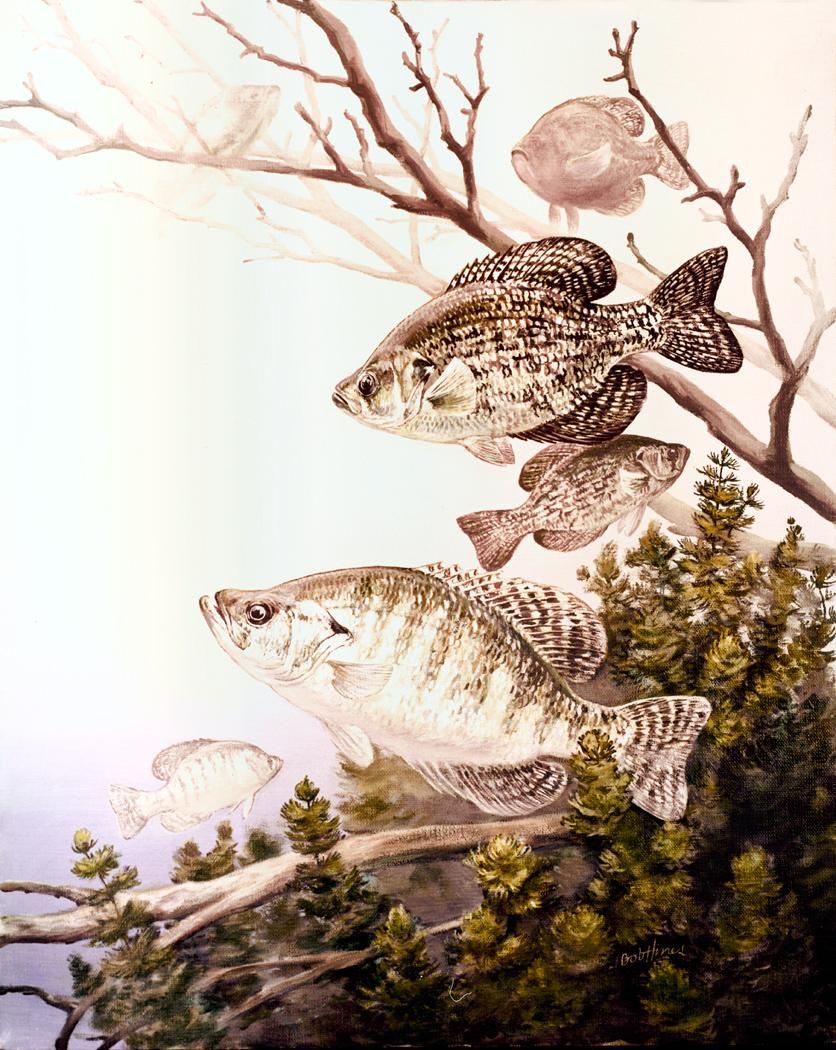
| Black crappie | (Pomoxis nigromaculatus) — speckled-pattern body, dark spots scattered randomly across silver-green sides. 7-8 dorsal spines. |
| White crappie | (Pomoxis annularis) — vertical-bar pattern, more clearly banded sides. 5-6 dorsal spines. |
Both are deep-bodied, compressed (much taller than wide), with large mouths relative to head size and a long dorsal fin. Color shades from silvery to greenish to nearly black depending on water and mood.
"Papermouth" comes from their fragile mouth tissue — a hard hookset rips through the lip. Hookset is a slow steady lift, not a strike.
Sizes: 9-10 inches = "keepers"; 12-13 = "good"; 14+ = "slabs"; 16+ = trophy class.
Crappie — speckled flanks, deeply forked tail, paper-thin mouth. — USFWS · San Luis NWR (Public Domain)
Range & abundance in the Alley
Where in the SHA region they live and where they're best targeted.
Crappie are nearly universal in our coverage area's still waters:
| Region | What it fishes like |
|---|---|
| Inland reservoirs | Pymatuning, Mosquito, Berlin, West Branch, Pleasant Hill, Senecaville, Atwood (OH); Pymatuning, Allegheny Reservoir (PA); Chautauqua, Cassadaga, Findley, the Finger Lakes (NY). |
| Lake Erie marsh + bay systems | Sandusky Bay, Maumee Bay backwaters, marina basins. |
| Backwater rivers | Slow oxbows on the Maumee, Cuyahoga, Allegheny. |
| Farm ponds | Many are stocked with crappie alongside bluegill and bass. |
White crappie tend to dominate larger turbid reservoirs (Pymatuning); black crappie dominate clearer inland lakes. Mixed populations are common.
Seasonal calendar
Month-by-month: when they bite, spawn, hide, or run.
| Month | What is happening |
|---|---|
| March | Pre-spawn staging. Schools moving from deep wintering structure into 12-20 ft staging adjacent to spawning flats. |
| April | Spawn build-up. Fish moving shallower as water warms toward 60°F. |
| May | Spawn peak. Water 60-68°F. Males build saucer nests in 1-6 ft, females visit briefly. Aggressive bite — the year's most-fished window. |
| June | Post-spawn dispersal. Schools moving back to deeper brushpiles and submerged trees. |
| July-August | Summer suspended pattern — schools hold mid-water in 18-25 ft over deeper structure. Cooler dawn/dusk windows produce. |
| September | Schools reorganizing as bait migrates. |
| October | Fall feed. Active second window of the year. Fish concentrated, willing. |
| November-December | Slowing as water cools. Fish moving deeper. |
| January-March | Ice fishing on inland lakes. Tip-ups + small jigs. |
Spawning & life cycle
Reproduction biology, age curves, lifespan, behavioral phases.
Sexual maturity 2-3 years (~7 inches). Spawning at 60-68°F, late April to early June in our region. Males build saucer-shaped nests in 1-6 ft of water near submerged cover (brush, stumps, weeds). Egg counts 8,000-150,000 per fish. Males guard the nest 2-3 weeks through hatch and early fry.
Crappie are year-class boom-and-bust species — strong year classes produce gluts of fish that dominate populations for years; weak classes leave gaps. This is why fishing on a given lake can be sensational one year and slow the next. Population quality tracks year-class strength.
Growth: 8 inches in 2-3 years; 10 inches in 3-5; 12 inches in 4-6; 15+ inches in 6-9. Lifespan 7-9 years.
Diet & forage
What they eat at each life stage; key forage species.
Juveniles feed on zooplankton; adults shift to small fish + invertebrates:
- Small minnows (emerald shiner, fathead, golden shiner) — primary adult food
- Aquatic insect larvae
- Small crayfish
- Fish eggs (especially during their own spawn)
- Threadfin shad and gizzard shad (where present)
The two-inch shiner minnow under a bobber is the most-replicated crappie technique in the country. The 1/16 to 1/8 oz jig in chartreuse, white, or pink is the second.
Behavior patterns
Daily rhythm, weather response, water temp tipping points.
Three behavioral truths:
| Rule | Detail |
|---|---|
| Crappie suspend | Even when relating to bottom structure, they hold mid-water. Use sonar — find the depth, fish exactly that depth. |
| Schools move together | If you catch one slab from a brushpile, fan-cast the whole pile fast. The school will be active for a window of 15-45 minutes, then move. |
| Light triggers | Dawn and dusk are best; bright midday slows the bite. Cloudy days extend the feeding window. |
Water temp
Active 50-72°F; primary spawn 60-68°F.
Today's conditions read for Crappie
Live from the river network. Pulled at page load — refresh for the latest.
Prime water-temp window for Crappie is 55–72°F. 5 rivers are sitting in the window — fishable on multiple options today.
Rivers in Crappie's prime water-temp window today
| River | Water temp | Flow | Clarity |
|---|---|---|---|
| Elk Creek | 55.6°F | 9 cfs | Clear |
| Twenty Mile Creek | 55.6°F | 15 cfs | Clear |
| Crooked Creek | 55.6°F | 4 cfs | Clear |
| Irondequoit Creek | 70.5°F | 133 cfs | Clear |
| Eighteenmile Creek (Niagara) | 71.6°F | 882 cfs | Muddy |
Alley Index today: 97 (Excellent) · Lake Erie surface: 75.9°F
Habitat preferences
Pool / run / riffle, depth, structure, cover, current speed.
Cover-relating fish. Look for:
- Submerged brushpiles (man-made or natural)
- Standing timber in flooded reservoirs
- Dock structure
- Bridge pilings
- Submerged weed edges
- Creek channels intersecting flats
Spring (spawn): 1-6 ft. Summer/fall: 12-25 ft, suspended over deeper structure.
How locals fish for it
Editorial — DJ + community on signature presentations.
The minnow-under-bobber. 2-3 inch shiner on a #4 hook below a small slip-bobber, weighted to suspend at the depth crappie are holding. Fishability test for any pond, dock, or brushpile.
The casting jig. 1/16-1/8 oz jig (Roadrunner, marabou, Bobby Garland Baby Shad) in chartreuse, white, pink, or black-and-chartreuse. Cast, count down, slow steady retrieve. Vary speed and depth to find the bite.
Spider rigging. Multiple long rods (8-12 ft) trolled slowly off the bow with jigs at varied depths. Reservoir tournament technique; covers water fast and locates suspended schools.
Long-pole "dock-shooting." Long fiberglass rod, light line, jig flicked under dock canopy with skip-cast. Spring tournament technique.
Ice fishing. 1/32 oz tungsten jig tipped with waxworm or minnow head, fished mid-water through holes 8-15 ft deep. Inland lakes mid-winter.
Local lore & storied waters
Specific Alley waters, history, ethics, traditions.
Mosquito Lake (OH) and Pymatuning (PA/OH) are the Alley region's crappie capitals. Both produce 14+ inch slabs in spring around shallow brush.
Berlin Reservoir (OH) — strong crappie alongside the more famous walleye fishery.
Allegheny Reservoir (PA) — vast water, big crappie, mostly white crappie. Hammond Lake produces.
Chautauqua Lake (NY) — mixed species, big black crappie in spring weed beds.
The community
Crappie fishing in our region is the most accessible serious fishery — bank anglers, kids with cane poles, retirees in jonboats, and dedicated tournament guys all share the spring spawn. There's a local culture of brushpile placement — anglers sink Christmas trees, brush bundles, and engineered habitat structures in winter to create concentrated fish-holding spots. Find a reservoir's brushpile community and you find the fishery.
Regulations & ethics
OH/PA/NY/Ontario regs, slot limits, season dates, C&R.
| Authority | Rules of note |
|---|---|
| Ohio | Varies by water; commonly 9-inch min, 30 daily. |
| Pennsylvania | 9-inch min, 20 daily on most waters; specific waters may have 10-inch min. |
| New York | 9-inch min, 25 daily on most waters. |
Many anglers self-impose 10-inch minimums and limit harvest in down years. Brushpile placement and habitat work are quasi-formal community efforts.