Steelhead are what happens when a rainbow trout decides it has bigger ambitions and a longer commute. Lake Erie's strain runs into the tributaries from October through April; the entire enterprise rewards anglers who are patient, well-layered, and willing to be wrong about flow numbers.

Identity & ID
Who this fish is, how to ID, world & state records.
Oncorhynchus mykiss is the rainbow trout — but a steelhead is a rainbow trout that has gone to a great body of water (the ocean, or in our case the Great Lakes), grown to several times the size of a stream-resident rainbow, and returned to its natal tributary to spawn. Genetically identical to a creek rainbow. Behaviorally a different animal entirely.
The Lake Erie and Lake Ontario fisheries are not native — Pacific-coast steelhead were stocked through the 20th century by Ohio, Pennsylvania, New York, and Ontario hatchery programs, and they imprinted on the warm shallow tributaries the same way wild steelhead imprint on cold Pacific rivers. Today most fish you'll catch are Manistee strain (Michigan-derived) or Skamania strain (Washington-derived) hatchery progeny, with a percentage of wild-spawned offspring depending on the trib.
How to ID
| Feature | What you see |
|---|---|
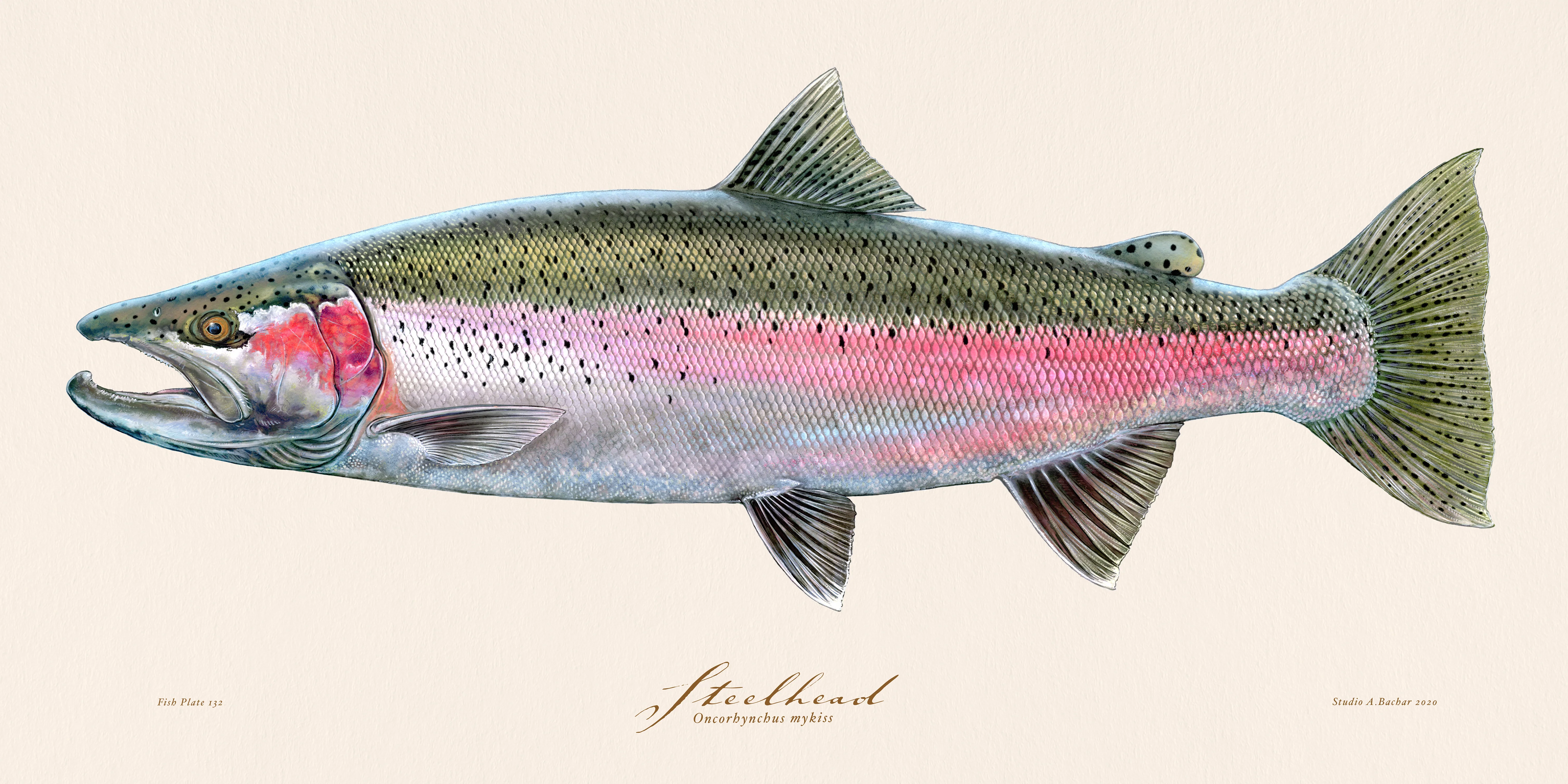
| Body | Torpedo-shaped, fork-tailed. Chrome silver sides on fresh-run fish, transitioning to pink-rose lateral stripe and olive-spotted back as they hold in freshwater. |
| Spots | Dense small black spots on back, dorsal, and tail. The tail is heavily spotted top to bottom — distinguishes from brown trout (mostly clean tail) and from coho salmon (no tail spots, white gums). |
| Mouth | White inside the gum line, NOT black like a chinook salmon. This is the field-ID call: open the mouth, look at the gum line. |
| Adipose fin | The small fleshy fin between dorsal and tail. Hatchery fish often have it clipped; wild fish have it intact. Some states require release of clipped or unclipped depending on year and program. |
Records
The official IGFA all-tackle world record is 48 lb (2009, Saskatchewan), but it was a triploid hatchery escapee — controversial. The wild benchmark is closer to 42 lb. State records: Ohio 20 lb 14 oz (Conneaut Creek), Pennsylvania 20 lb 3 oz (Lake Erie), New York 31 lb 3 oz (Lake Ontario, 2004 — and Lake Ontario steelhead grow noticeably bigger than Erie fish). Tributary anglers will go entire seasons fishing for the high-teens fish that does happen, occasionally.
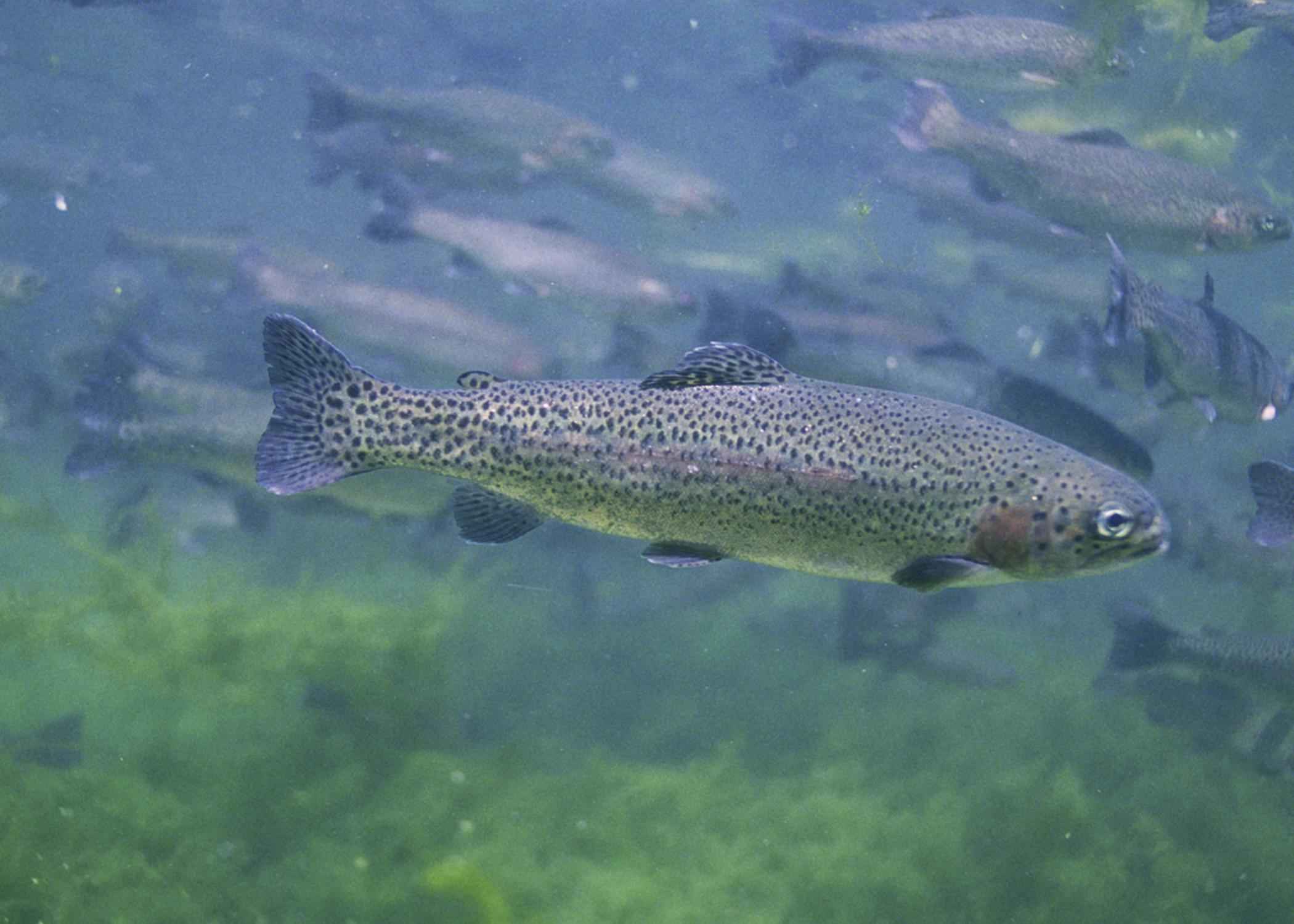
Wild steelhead (Oncorhynchus mykiss). — USFWS (Public Domain)
USFWS reference photo — Oncorhynchus mykiss. Note the heavily-spotted tail, dark-olive back transitioning to chrome flanks, and the pink-rose lateral stripe diagnostic of fresh-run steelhead. — Sam Stukel / USFWS (Public domain)
Angler with a chrome steelhead. — Wikimedia Commons (CC BY-SA)
Range & abundance in the Alley
Where in the SHA region they live and where they're best targeted.
Steelhead in our region run the south shore of Lake Erie from Vermilion, Ohio east through Pennsylvania (Erie county tribs) and across western New York into the eastern basin (Cattaraugus, Buffalo, Eighteenmile creeks). They also run the Lake Ontario tribs of New York — the Salmon River, Genesee, Oak Orchard, and the smaller systems north of Rochester. Each region has its own water style:
| Region | What it fishes like |
|---|---|
| Ohio Steelhead Alley | (Vermilion → Conneaut): clay-bottomed tribs that turn chocolate after rain and clear in days. Heart of the fishery — Rocky, Chagrin, Grand, Conneaut. |
| Pennsylvania Erie tribs | (Elk, Walnut, Crooked, Twenty Mile): smaller, clearer, gin-clear in low water. Centerpin paradise. Walnut and Elk are the most-fished tribs in North America by some measures. |
| New York Lake Erie tribs | (Cattaraugus, Chautauqua, Eighteen Mile, Buffalo): bigger water, more wild-fish %, more remote. |
| Lake Ontario tribs | (Salmon River chief among them): bigger fish, longer runs, higher salmon overlap. Pulaski during the fall is one of the densest fish-per-acre experiences anywhere in freshwater. |
Estimated populations across our covered tribs sit in the millions of returning adults annually when stocking + wild reproduction are combined — these are heavily managed fisheries, but supplemented by holdover and natural recruitment in many systems.
Seasonal calendar
Month-by-month: when they bite, spawn, hide, or run.
Steelhead are available somewhere in the system nine months out of twelve in our region, but the timing varies by trib and weather pattern.
Month-by-month
| Month | What is happening |
|---|---|
| September | First fish stage at trib mouths if there's been an early cool-down. Mostly lake fishing on the eastern basin tribs. |
| October | Fall run starts in earnest. Cool nights drop water temps below 60°F, fish push in on early rains. New fish are aggressive. |
| November | Peak fall run. Fresh chrome, full tribs, water temps 42-52°F. The classic month. |
| December | Run still going strong but pace varies with cold snaps. Slush ice can shut everything down for stretches. |
| January | Holdover fish in deep slow pools. Slow but rewarding fishing if you can stand the cold. Egg patterns and stoneflies on long drifts. |
| February | Mid-winter doldrums. Same holdover game as January. Watch for any thaw — a 50°F day can trigger a movement. |
| March | Spring run begins as water passes 38°F. Fresh fish from the lake mix with holdovers. |
| April | Peak spring run. Spawning activity in upper reaches. Aggressive fish below redds. Often the easiest month for a first steelhead. |
| May | Spawned fish dropping back. Last fish leaving the system. Skinny but still chrome-bright on the way back to the lake. |
| June–August | Tribs warm to lethal levels. Steelhead are lake-bound. Some Salmon River tailwater fishing year-round on the NY side. |
Two windows are absolute: November (best fall) and April (best spring). If you have one weekend, pick one of those two.
Spawning & life cycle
Reproduction biology, age curves, lifespan, behavioral phases.
The steelhead life cycle in the Great Lakes mirrors the Pacific cycle, with one critical difference: there's no true ocean. Lake Erie and Lake Ontario function as the pelagic phase. The biology is otherwise similar.
| Stage<\/th> | What happens |
|---|---|
| Spawn (March–May) | Females (hens) cut redds — saucer-shaped depressions in clean gravel — and deposit 2,000–10,000 eggs depending on size. Males (bucks) fertilize. Both guard the redd briefly, then move off. Most spawning happens in the upper reaches of tribs in fast water 1-3 ft deep with pea-to-walnut gravel. |
| Egg → alevin (April–June) | Eggs hatch in 4-7 weeks. Alevins remain in the gravel feeding off their yolk sac for another 2-3 weeks. |
| Fry → parr (June–year 2) | Tiny trout emerge and feed on aquatic insects in stream margins. Develop "parr marks" — vertical bars along the side. Parr stay in the trib 1-3 years. |
| Smolt (year 2-3) | The transformation. Parr marks fade, sides turn silver, the body slims. The fish migrates downstream to the lake. This is when the trout becomes a steelhead. |
| Lake phase (year 2-5) | Voracious feeding on emerald shiner, alewife, gizzard shad, smelt, gobies. Growth is fast — the lake is full of forage. A wild fish grows 6-10 inches per year. |
| Adult return (year 3-5+) | Fish mature, imprint draws them back to natal tribs (or to stocked tribs for hatchery fish). They run, spawn, and a percentage survive to spawn again — what's called iteroparity. Unlike Pacific salmon, steelhead can spawn 2-4 times in a lifetime. |
The "fall run" fish you catch in October–December are mostly NOT actively spawning — they're in the system to overwinter and spawn the following spring. They feed (limited) and respond to egg-imitation flies because they encounter eggs from current-year spawners. The "spring run" fish entering March-April are racing to spawn within weeks of arrival.
Diet & forage
What they eat at each life stage; key forage species.
The lake phase determines size; the river phase determines what we throw at them.
Lake-phase diet
In Erie: emerald shiner (the keystone forage), round goby (introduced; now a major component), gizzard shad, smelt (in cold pockets), alewife (Erie population is reduced; Ontario has more). In Ontario: alewife is dominant, with rainbow smelt, sculpin, and gobies. This is why spoons (Cleo, Little Cleo, Vibrax #5) and crankbaits work on lake-side casting from piers and breakwalls.
River-phase diet
Once they enter the trib, steelhead feed opportunistically and selectively. The hierarchy of what they eat:
| Food | Why it matters |
|---|---|
| Eggs | from concurrent spawners. Drives the dominance of egg patterns (single eggs, sucker spawn, scrambled-egg sacks). |
| Stoneflies, caddis, mayflies | the trout reflex never leaves them. Hex nymphs, stoneflies, and small caddis pupae produce in winter. |
| Sculpins, dace, baby suckers | protein when bigger fish move out of pools and prowl. Streamers (sculpin patterns) shine in stained water and pre-spawn aggression windows. |
| Worms, leeches, crayfish | opportunistic. A drifted nightcrawler or San Juan worm has saved more than one slow morning. |
Color matters: in clear water, natural egg colors (steelhead-orange, peach, pink-pearl). In stained water, hot pink, chartreuse, or blacker patterns. Hook size scales with water — #14-16 in clear, #8-10 in stained.
Behavior patterns
Daily rhythm, weather response, water temp tipping points.
Three rules:
| Rule | Detail |
|---|---|
| Fresh fish are aggressive | A chromer that pushed in on yesterday's rain will hit nearly anything that drifts past — including streamers and spinners. After 3-4 days in the system they get spooky. |
| Fish in motion are catchable | A pod moving up through a run will eat as it travels; the same pod parked in a deep pool will become very hard to fool. Reading where fish are pushing — and intercepting them in transitional water — is the entire game. |
| Light kills bites in clear water; rain creates them | Bright sun on gin-clear water at low flow is the worst combination. A weather front, falling pressure, and a quarter-inch of overnight rain is the best. |
Water-temp tipping points
| Water temp | What it means |
|---|---|
| Below 34°F | Slack — fish in slowest deepest holes, near-zero feeding. Drift egg sacks slowly through the deepest seam. |
| 34–42°F | Cold but active. Slow presentations, dead-drifted eggs and stoneflies, deep nymphing. |
| 42–55°F | Prime. Fish hold in head-of-pool, riffle-tailouts, and runs. Will respond to swung flies and active presentations. Pre-spawn aggression peaks late in this window. |
| 55–62°F | Late spring window. Fish dropping back; some still moving. Lighter, faster water becomes productive. |
| Above 62°F | Stress zone. Fight quickly, release at depth, leave the trib alone — it's lake-fishing or trout-fishing time. |
Pressure and weather
Falling barometric pressure ahead of a front is the strongest single trigger. Fish feed actively in the 6-12 hours before a system arrives. Rising pressure post-front is the worst — fish go off the bite for a day or two before resuming. Light rain raises water clarity and triggers fresh fish to push in. Heavy blowouts shut everything down for 2-4 days while the trib drops back into shape.
Today's conditions read for Steelhead
Live from the river network. Pulled at page load — refresh for the latest.
Prime water-temp window for Steelhead is 38–55°F. Only 1 rivers are in the window today — narrow your trip plan to those. Lake Erie surface is 75.9°F — warm-water summer pattern in effect.
Rivers in Steelhead's prime water-temp window today
| River | Water temp | Flow | Clarity |
|---|---|---|---|
| Ashtabula River | 54.3°F | 75 cfs | Clear |
Alley Index today: 97 (Excellent) · Lake Erie surface: 75.9°F
Habitat preferences
Pool / run / riffle, depth, structure, cover, current speed.
You're looking for water that does three things: holds the fish, hides them from predators, and delivers food. The best holding water in our tribs:
| Water type | Why fish hold here |
|---|---|
| Tailouts of pools | where flow accelerates as it leaves a slow section. Fish stage here on the edge between cover and current. Highest hookup rate. |
| Heads of pools | where current dumps in. Aggressive fish push to the front of the pool to intercept food. A "bucket" at the head is gold. |
| Long boulder-strewn runs | fish hold behind boulders and along seams. Hard to read but produce when other water doesn't. |
| Deep slow holes in cold water | winter holdover water. 38°F days you'll find every fish in the trib stacked in one or two of these per mile. |
| Clay shelves and bedrock ledges | common in OH/PA tribs. Fish hold tight to the structure, often invisible until you swing through and feel the weight. |
Depth and current speed
Most steelhead in our region hold in 3-7 feet of water at flow speeds that just barely move a tennis ball — fast enough to ride a drift, slow enough that a fish doesn't burn calories. Riffles less than 2 ft are usually transitional; pools deeper than 8 ft are usually only productive in winter.
"If it looks like good steelhead water, it probably is." Develop the eye and trust it.
How locals fish for it
Editorial — DJ + community on signature presentations.
Three techniques have made and broken every Alley angler:
1. Centerpin float fishing
The local religion. A long noodle rod (11-13 ft), a big drag-free pin reel, light line, a balanced float, a small split-shot stack, and an egg-sack or jig at the end. Drift the float at the speed of the current, set hard when it goes down, and hang on. Walnut Creek and the upper Chagrin are pin shrines. The technique requires practice — getting a clean drag-free drift through a 60-foot run takes a season — but it produces more fish than anything else in clear-to-stained water.
2. Nymphing under an indicator
Fly version of the centerpin idea. Indicator (Thingamabobber, Air-Lock, or yarn), a stonefly or egg pattern weighted to ride 6-12 inches off the bottom, and dead drifts through the same water. Easier to learn than pin fishing; nearly as effective in 90% of conditions. The default for every fly angler from October through April.
3. Swung flies
The poetry. A spey or switch rod, a sink-tip line, a Woolly Bugger or articulated leech, swung across a steady run. Way fewer hookups than nymphing but every fish that takes does it on the move and pulls you into the backing. Late fall and spring are the peak swung-fly windows. The Grand and Cattaraugus are classic swing water.
And the underrated:
| Method | Local detail |
|---|---|
| Spinners | Vibrax #4 in copper, blue/silver, or chartreuse. Fan-cast through holding water, slow-roll. Ohio pier and trib mouth specialty. |
| Spoons | Little Cleo or KO Wobblers. Lake-mouth standby in high-bright sun when fly anglers are sulking. |
| Float-and-jig | bobber + 1/64 oz pink jig. Cheap, deadly, and the answer when you can't get a centerpin to behave. The "redneck pin," local affection. |
The most-asked Alley question: "What's working?" The most-honest answer: find moving fish, pick the technique you fish best, get a good drift, and grind through five drifts to every one bite.
Local lore & storied waters
Specific Alley waters, history, ethics, traditions.
Storied waters in our coverage area, in no particular order:
| Water | Story |
|---|---|
| The Grand River | (Lake Erie, OH) — biggest of the Ohio tribs, longest sustained holding water. Fan Falls upstream; Hidden Valley access points; the lower river through Painesville. |
| Walnut Creek (PA) | pound-for-pound the most-fished steelhead trib in North America during the fall. Walnut Creek Access in late October is shoulder-to-shoulder. The fish are stacked. |
| Elk Creek (PA) | Walnut's bigger sister. Wider, more variable, fewer crowds upstream. Folly's End access. |
| The Chagrin River (OH) | Daniel's Park and Gates Mills classic. Spring water that fishes through the dead of winter when other tribs are frozen. |
| Cattaraugus Creek (NY) | wild fish, big water, Seneca Nation reservation requires permit through their tribal office. The Cattaraugus runs late and produces the biggest fish of any Erie trib most years. |
| The Salmon River (NY) | Lake Ontario, Pulaski. Biggest fish, biggest crowds, longest run. Douglaston Salmon Run and the Altmar drift. A pilgrimage. |
Ethics
The Alley fishery is a managed, supplemented, and partially wild resource. Some core etiquette:
- Fish quickly, photograph fast, release in flowing water at depth — especially when water is above 55°F.
- Don't wade through redds in spring. They're saucer-shaped clean spots in the gravel; if you see one, walk around.
- Give people downstream water-room. Steelhead anglers respect drift-rotation in tight runs.
- Pack out tippet, leaders, terminal tackle. Monofilament kills wading birds.
- Kill what you keep, but consider C&R for wild fish (unclipped adipose). Their genetic contribution to the population is real.
Regulations & ethics
OH/PA/NY/Ontario regs, slot limits, season dates, C&R.
Regs change yearly. Always confirm with the state agency before fishing. Quick reference:
| Authority | Rules of note |
|---|---|
| Ohio | (ODNR Division of Wildlife) — Lake Erie tribs: 12-inch min, 2 fish daily limit, year-round season most tribs. Fishing license + Lake Erie permit required. |
| Pennsylvania | (PFBC) — Erie tribs: 15-inch min on Lake Erie tribs, 3 fish daily Sep-Apr, 2 fish daily May-Aug. Trout/salmon permit required in addition to fishing license. Specific tribs (e.g. Walnut Creek Lower) have project area regs. |
| New York | (NYSDEC) — Lake Erie + Lake Ontario tribs: 21-inch min on most tribs, 1 fish daily on most Ontario tribs and 3 fish daily on Erie. Specific seasonal closures on spawning waters. Salmon River has its own management plan. |
| Ontario | different by zone; check Ontario Fishing Regulations Summary annually. |
Catch-and-release best practice
- Use barbless or pinched-barb hooks. Faster release.
- Land fast. The longer the fight, the higher the post-release mortality.
- Net with rubber-bag nets (no knotted nylon). Less slime damage.
- Keep the fish in water. If photographing, hold the fish supported under the belly — DO NOT hold by the gills or jaw.
- Revive in flowing water until it kicks free under its own power.
- Don't fish water above 65°F, period. Switch to lake or quit for the day.