The Cuyahoga River Recovery Story: Sturgeon, Rainbow Trout, and a Watershed That Refuses to Stay Industrial
The Cuyahoga caught fire in 1969. By 2026 it is being actively restocked with lake sturgeon -- a state-endangered fish that hasn't spawned in the watershed in a hundred years -- and with rainbow trout for community angler events at Cuyahoga Falls. Two reintroduction programs, multiple agencies and nonprofits, and a watershed that keeps surprising the people who try to write it off.
TL;DR
What this article is for
The Cuyahoga River fishing guide covers the lake-run steelhead reach below the Gorge Dam in detail. This piece covers the broader recovery story -- the dam removals, the sturgeon reintroduction, and the rainbow trout stockings that together represent one of the more remarkable watershed comeback stories in the SHA-tracked set.
The starting point -- on fire, and then quietly not
The Cuyahoga River famously caught fire on June 22, 1969 -- not for the first time, but for the time everyone remembered. The 1969 fire became the iconic image of an industrial waterway pushed past the limits of its biological function, and it contributed to the political pressure that produced the Clean Water Act in 1972 and the EPA itself.
The fifty years since have been less photogenic but more important. Combined sewer separation, NEORSD wastewater investments, dam removals in the upper watershed, and the gradual return of native species have all moved the river in the same direction. By the mid-2010s the lower river was producing a small but real lake-run steelhead fishery. By 2024 the watershed was deemed biologically ready for lake sturgeon reintroduction trials.
Lake sturgeon -- the headline recovery
Lake sturgeon (Acipenser fulvescens) are the longest-lived freshwater fish in North America -- individuals routinely live a century, and trophy-class fish in restored Great Lakes populations exceed six feet. The species was abundant across the Great Lakes basin pre-1900, including the Cuyahoga and other Lake Erie tributaries, but commercial harvest, water pollution, and dam construction reduced the population to near-zero by the mid-1900s. Lake sturgeon are currently listed as state-endangered in Ohio.
The Cuyahoga reintroduction plan
Per the Tier 1 ODNR Cuyahoga River Lake Sturgeon Reintroduction Plan (a downloadable PDF available via the ODNR Division of Wildlife), the reintroduction is a 20-year program with a target of approximately 1,500 mature spawning adults by 2049. Annual stocking calls for roughly 2,000 fingerlings per year over the 20+ year window.
The partner consortium is unusually wide:
- Ohio Department of Natural Resources, Division of Wildlife (lead state agency)
- U.S. Fish and Wildlife Service (federal recovery work, hatchery support)
- Summit Metro Parks (local park-system partner; access + monitoring)
- Cleveland Metroparks (lower-river park-system partner)
- Cuyahoga Valley National Park (federal park-system partner)
- U.S. Geological Survey (monitoring + telemetry support)
- Northeast Ohio Regional Sewer District (NEORSD, water-quality support)
Where the fish are going
The October 2025 release saw 2,000 lake sturgeon fingerlings released at three Cuyahoga River sites:
- Rivergate Park, Cleveland -- lower-river site.
- Boston Store Trailhead River Access, Cuyahoga Valley National Park -- middle-river site.
- Cascade Valley Metro Park, Akron -- upper-river site, in the Valley View Area.
A 2024 pilot release seeded ~60 juveniles with transmitters so researchers can track movement, survival, and habitat use across the watershed.
What anglers should know
Lake sturgeon are listed as state-endangered in Ohio and are strictly catch-and-release. They are slow-growing, late-maturing (females first spawn around 25 years old), and intolerant of mortality pressure. If you encounter a sturgeon while fishing the Cuyahoga -- and the released fish are PIT-tagged for monitoring -- handle minimally, photograph quickly, and release without delay. ODNR per-cycle guidance is authoritative on handling protocols.
Rainbow trout -- the angler engagement layer
Separately from the sturgeon work, the Cuyahoga at Cuyahoga Falls has been receiving periodic rainbow trout stockings as a community-engagement effort. The lead partners are:
- Ohio Division of Wildlife (ODNR) -- provides the stocked trout (typically hatchery rainbows from the ODNR statewide stocking program).
- Western Reserve chapter of Trout Unlimited -- nonprofit conservation group; coordinates stocking events, community engagement, watershed advocacy. (Common naming confusion: the parent organization is "Trout Unlimited" -- not "Troutman Limited.")
- City of Cuyahoga Falls -- municipal partner; provides access infrastructure + event coordination.
Stockings are typically modest in scale -- on the order of 1,000 fish per release -- and are timed to bring anglers to the recovering river. The Cuyahoga Falls events have included "trout dropping" celebrations that bring families to the riverbank in a way that the post-1969 reputation made unlikely for decades.
How this complements the sturgeon work
The rainbow trout stocking is an above-the-fold story for SHA's angler readers: it puts fish in reach of fly rods and spinning gear, and it gets people physically standing in the river. The lake sturgeon work is a longer game -- generational, slow, and largely invisible to anyone not running an electroshock survey. Together they signal that the Cuyahoga is back to a place where conservation programs can credibly invest in restoration timelines longer than a typical career.
The Free the Falls connection
Both reintroduction efforts depend on the broader watershed-restoration work covered in the SHA Free the Falls update. The Gorge Dam removal (target completion 2030 per current public scheduling) opens upstream habitat that has been off-limits to migratory fish for a century. The dredging, the sewer infrastructure, the dam removals, the stocking programs -- they are all parts of the same recovery story.
What this means for SHA anglers
Categorical implications:
- Lower river -- still primarily a lake-run steelhead fishery (fall through spring) plus warmwater species (smallmouth, walleye, white sucker, drum). See the Cuyahoga River fishing guide for the steelhead-focused treatment.
- Cuyahoga Falls reach -- emerging seasonal trout opportunities at stocking events. Watch ODNR + Western Reserve TU announcements for current-cycle stocking dates.
- Upper river -- ongoing dam removal will progressively open more habitat. Future seasons may see expanded multi-species access.
- Sturgeon -- catch-and-release only, statewide. Reportable encounters (especially of tagged fish) help the monitoring program.
Honest gaps
- No specific stocking dates -- ODNR + TU announcements are authoritative and per-cycle.
- No fish-by-fish PIT-tag detection data -- USGS + ODNR control monitoring datasets.
- No detailed access-point recommendations for stocking events -- these change cycle to cycle.
- No analysis of long-term habitat suitability -- ongoing scientific work, results forthcoming.
- No comprehensive comparison with the Maumee River sturgeon work or the Black River OH program -- separate articles deserve dedicated treatment.
Curator's Picks -- gear shelf for Cuyahoga Falls trout work
Curated for the small-to-mid stocked rainbow scale at Cuyahoga Falls. SHA earns a small commission via Amazon Associates; editorial selection is independent.
@curated-productsFull source list
- Tier 1 -- ODNR Division of Wildlife: Cuyahoga River Lake Sturgeon Reintroduction Plan (PDF) -- authoritative plan document covering targets, partners, and timeline.
- Tier 1 -- U.S. Fish and Wildlife Service: Mapping Lake Sturgeon Habitat in Ohio.
- Tier 1 -- National Park Service: Can the Cuyahoga River Support Rare Wildlife?
- Tier 1 -- Summit Metro Parks: Lake Sturgeon Reclaim the Cuyahoga as Home.
- Tier 1 -- ODNR Trout Stocking Dates -- current cycle stocking calendar.
- Tier 2 -- Spectrum News 1: Lake sturgeon reintroduction to Cuyahoga River underway.
- Tier 2 -- Signal Cleveland: As the Cuyahoga River sees a comeback, lake sturgeon return home.
- Tier 2 -- Ashland Source: Endangered Lake Sturgeon released in 3 Ohio rivers.
- Tier 2 -- WKYC: Rainbow trout return to Cuyahoga River in Cuyahoga Falls.
- Tier 3 -- Animal Diversity Web treatment of Acipenser fulvescens.
Common questions
Can I fish for the stocked rainbow trout?
Yes, at the Cuyahoga Falls stocking sites during open dates. ODNR daily-limit rules apply; check the per-cycle ODNR trout stocking calendar for dates and rules.
Can I keep a lake sturgeon if I catch one?
No. Lake sturgeon are state-endangered in Ohio and strictly catch-and-release. Handle minimally and release without delay; PIT-tag detection on a hooked fish is helpful monitoring data, so a quick photo of the tag area before release is welcome.
How is the rainbow program different from the steelhead stocking on Lake Erie tribs?
The Cuyahoga Falls rainbow stocking is a community-engagement program targeting put-and-take angler events at a non-lake-run reach. The Lake Erie steelhead stocking (ODNR fall steelhead program) is a Lake Erie-wide multi-tributary program targeting a lake-run anadromous fishery in the lower Cuyahoga and elsewhere. Different fish, different programs.
Will lake sturgeon become a fishery in our lifetimes?
Per the ODNR plan, the 1,500-adult spawning population is targeted for 2049 -- so a recreational fishery, if one ever opens, would be a multi-decade horizon at minimum. The current generation of anglers' role is to support the recovery and report tagged-fish encounters.
Where can I learn more about the dam removals?
The Free the Falls June 2026 update on SHA covers the current Phase II sediment-remediation and the 2030 dam-removal target.
Image credits and licensing
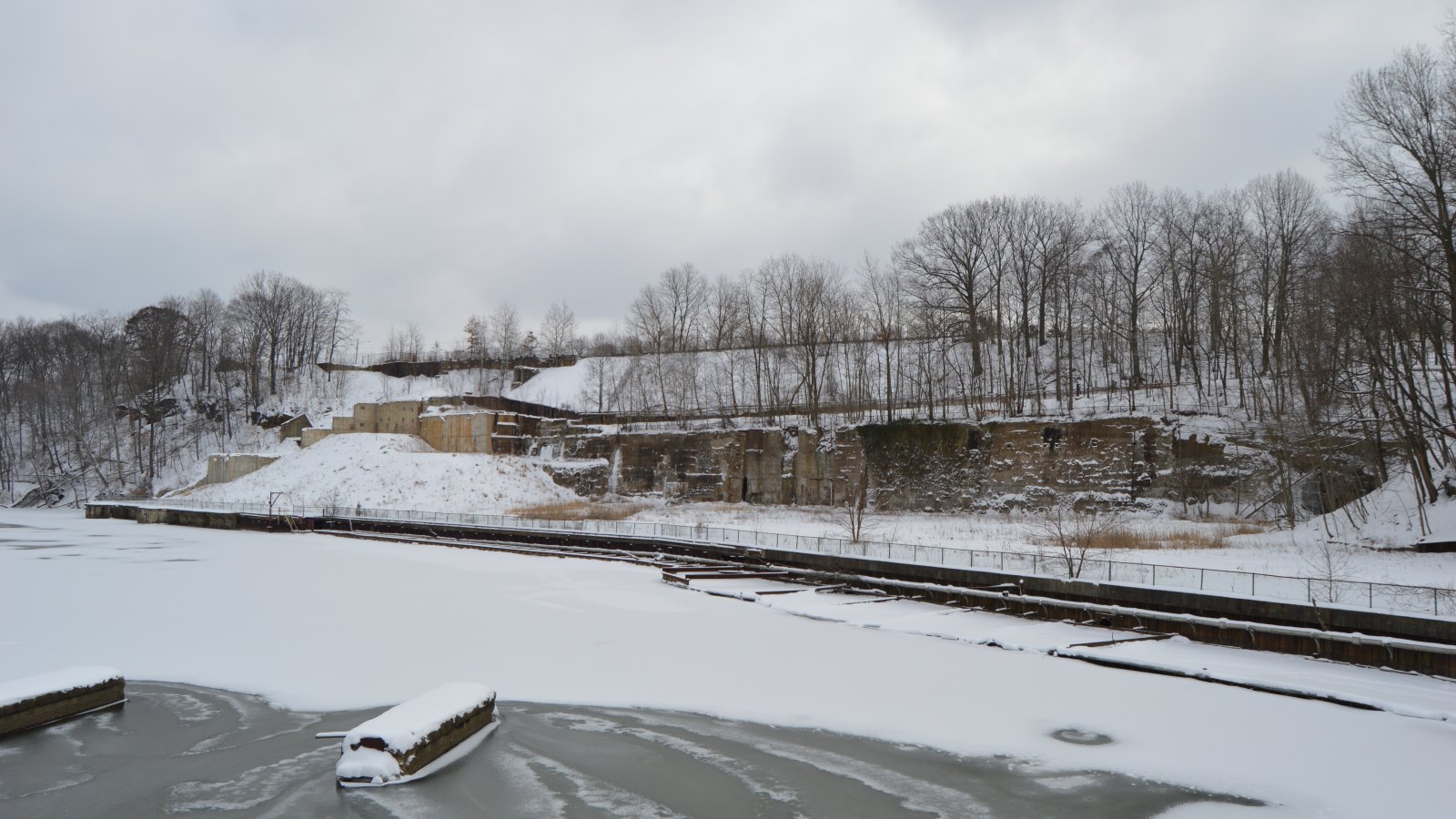
- Inline image: The Chuckery Race site shows how Cuyahoga recovery work is physical infrastructure, not just policy language. Photo: Nyttend / Wikimedia Commons, public domain.
- Hero image: Juvenile lake sturgeon, the long-horizon recovery species at the center of the modern Cuyahoga River comeback story. Photo: USFWS Mountain Prairie / Wikimedia Commons, public domain.
Continue learning
- Cuyahoga River fishing guide -- steelhead-focused pillar for the lake-run reach.
- Free the Falls -- June 2026 update -- the dam-removal context.
- Steelhead Alley Seasonal Calendar.
- Source Discipline + Tier Hierarchy.
- Conservation guide.