What exactly is a hatch?
The fly fishing vocabulary every steelhead and trout angler hears -- hatch, emerger, dun, spinner, nymph, larva, pupa, chironomid, stonefly, mayfly, caddis -- translated from biology to the fly box. Four insect orders matter, and they each play by different lifecycle rules.
TL;DR -- if you only read one block
Walk into a fly shop on the Steelhead Alley and you will hear words flying around without definitions: "Are the BWOs hatching yet?" "Try a Hex emerger." "Chironomid pupae under an indicator." This article is the glossary that closes that gap -- grounding the vocabulary in the actual biology. Where the regional Steelhead Alley record is thin, we will say so honestly rather than fabricate a peak-week calendar.
What is a hatch, exactly?
The word "hatch" is doing two different jobs. In biology, a hatch is the egg-to-larva/nymph event -- a mayfly egg hatches into a mayfly nymph that then lives underwater for months or years. In angler usage, a "hatch" is the emergence event -- when aquatic nymphs (mayflies, stoneflies) or larvae/pupae (caddis, midges) complete their underwater life, rise through the water column or crawl out, and transform into winged adults that fish key on. When an angler says "the hatch is on," they mean emergence.
Emergence matters because it is the brief window when an underwater food item becomes a vulnerable surface food item. Trout (and to a lesser extent steelhead in tributaries) shift from bottom-feeding to surface-feeding when emergence concentrates -- which is the shift fly anglers are constantly trying to be present for.
The four orders that matter
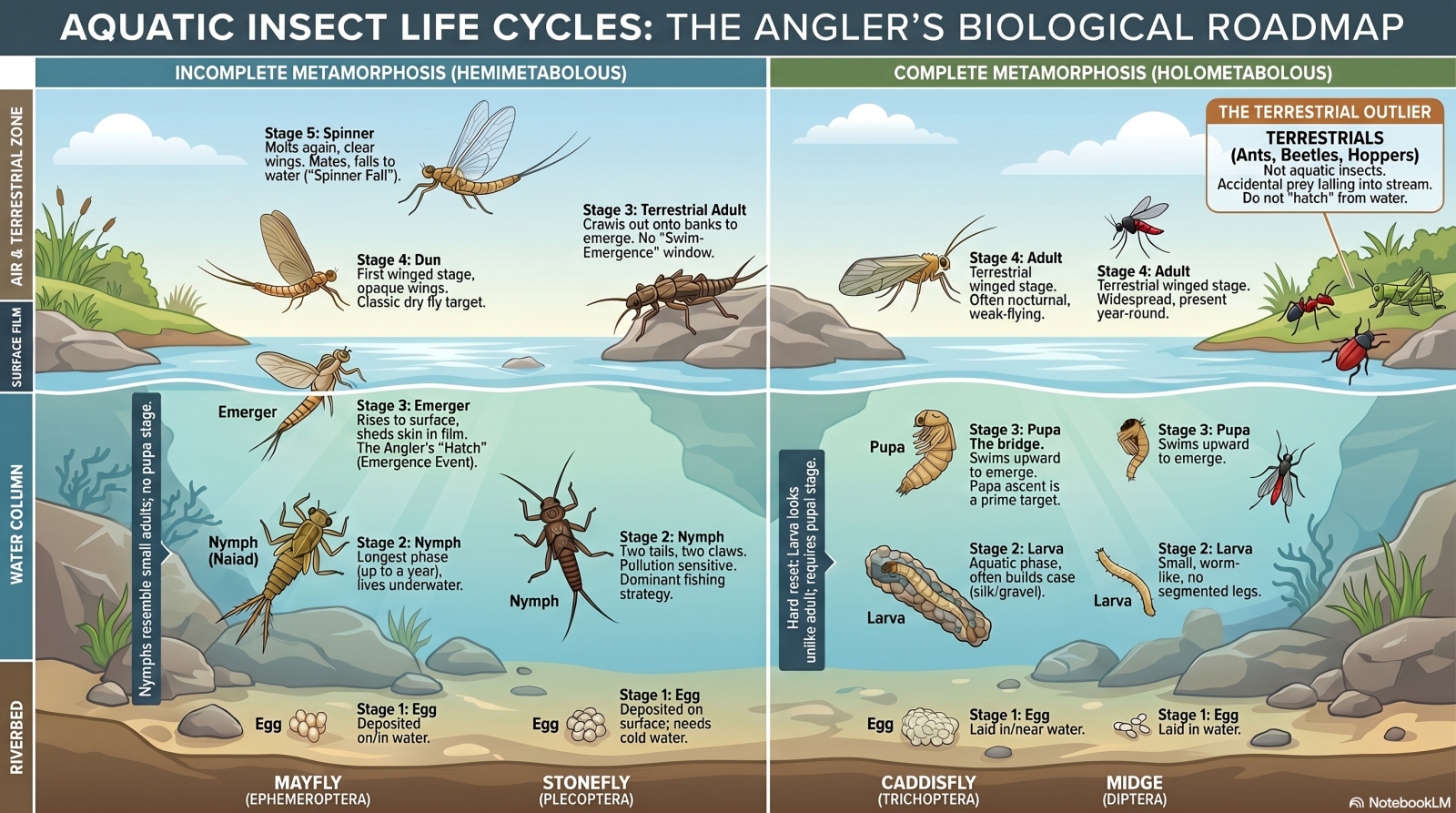
If you internalize the lifecycle rules for four insect orders, you can read 90 percent of trout-stream entomology vocabulary. Per the NC State University ENT 425 academic reference (Tier 2) and macroinvertebrates.org (Tier 2 aquatic bioassessment reference), the four are:
- Ephemeroptera -- mayflies. Incomplete metamorphosis. Egg, aquatic nymph (also called naiad), winged subimago (the angler's "dun"), winged imago (the angler's "spinner"). Two winged stages -- that is unique to mayflies.
- Plecoptera -- stoneflies. Incomplete metamorphosis. Egg, aquatic nymph, terrestrial adult. Only one winged adult stage -- NO dun/spinner two-step.
- Trichoptera -- caddisflies. Complete metamorphosis. Egg, aquatic larva, aquatic pupa, terrestrial adult. The pupa stage is biologically real and is a major angler-target.
- Diptera (family Chironomidae) -- midges. Complete metamorphosis. Egg, aquatic larva, aquatic pupa, terrestrial adult. Same lifecycle script as caddis, but at much smaller body size.
"Incomplete metamorphosis" (hemimetabolous) means immature stages look broadly similar to adults with visible wing pads. "Complete metamorphosis" (holometabolous) means a hard reset -- the larva looks nothing like the adult, and a pupal stage bridges the two body plans. The first three orders combine into the EPT framework used broadly in stream-health bioassessment; the same EPT structure organizes the fly box for stream trout. Chironomidae sits outside EPT because midges span the full pollution-tolerance spectrum.
Sources:
NC State University ENT 425, Order Ephemeroptera -- Tier 2
NC State University ENT 425, Order Plecoptera -- Tier 2
NC State University ENT 425, Order Trichoptera -- Tier 2
NC State University ENT 425, Order Diptera -- Tier 2
macroinvertebrates.org, Order Plecoptera -- Tier 2
macroinvertebrates.org, Family Chironomidae -- Tier 2
The mayfly lifecycle (the angler's roadmap)
Mayflies have the most distinct angler-targetable stages of any aquatic insect order. The full sequence per NC State ENT 425:
- Egg. Deposited on or in water by the spinner-stage female.
- Nymph (or naiad). Aquatic. Mayflies spend the overwhelming majority of their lives here -- often a year or longer. Nymphs cling to rocks, swim through current, or burrow in sediment depending on family. A Pheasant Tail or Hare's Ear imitates this stage.
- Emerger. The transition. The mature nymph rises toward the surface and begins shedding its exoskeleton. The half-out, struggling-in-the-film moment is the emerger window -- a stage trout key on intensely because the insect is vulnerable.
- Dun (subimago). The first winged adult. Wings opaque, dull-colored, often grey or olive. The dun rests on the surface briefly to dry its wings -- the classic "dry fly" stage. A Parachute Adams or CDC Comparadun matches it.
- Spinner (imago). Mayflies are the only insects that molt again AFTER they have wings. The dun's exoskeleton splits one more time, revealing the mature adult with clear glassy wings and longer tails. The spinner mates over the water; spent females fall flat to the surface to die. A Rusty Spinner imitates this final wings-out-flat dead-drift stage.

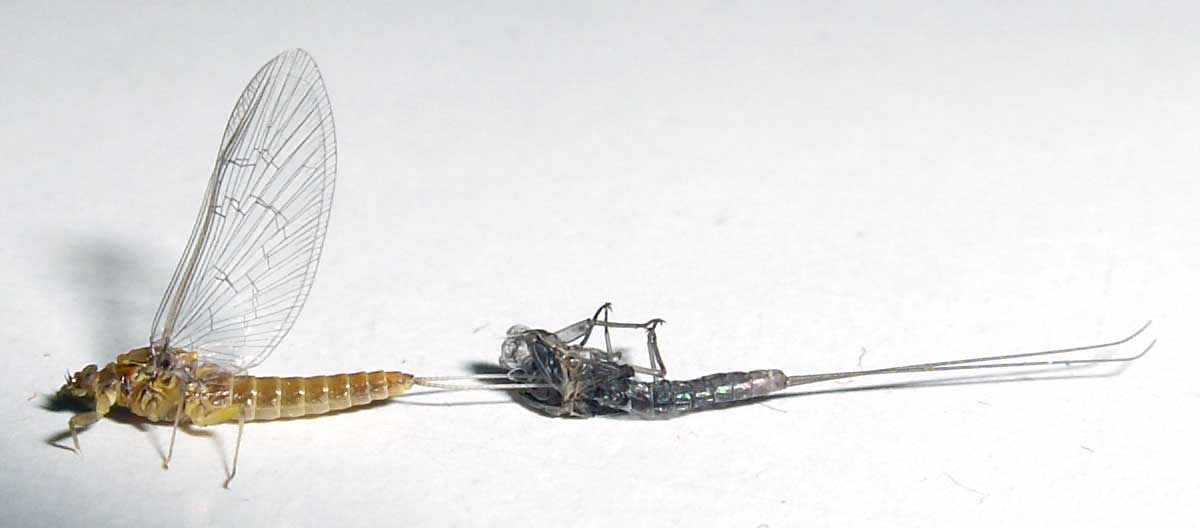
"Subimago" and "imago" are biology words; "dun" and "spinner" are angler words for the same stages. Common mayflies the Alley angler will hear referenced (Steelhead Alley tributary-specific timing for each remains [source-required] at the Tier 1-3 level):
- Blue-Winged Olive (BWO, family Baetidae). Small olive-bodied mayflies, hook 18-22. Multi-brood; Alley timing
[source-required]. - Hendrickson, March Brown, Sulphur, Trico. Each is a different family + size + color combination keyed by the calendar.
- Slate Drake (Isonychia, family Isonychiidae). Larger dark mayfly with strong-swimmer nymph anglers fish swung or stripped. Nymph behavior is family-source-backed (Tier 2 macroinvertebrates.org); regional timing
[source-required]. - Hexagenia (Hex, family Ephemeridae). The marquee Lake Erie giant mayfly. Sediment-burrowing nymph, doppler-radar-visible emergence mid-June through mid-July with peak June 20-30 per Ohio Sea Grant (Tier 2). NOTE: this is an OPEN-WATER lake hatch, NOT a tributary hatch -- the 68 deg F at-depth emergence trigger (Michigan Sea Grant, Tier 2) is at the steelhead/trout thermal stress threshold. Hex is walleye and yellow perch fishing, not steelhead.
Sources for the Hex anchor:
Ohio Sea Grant (OSU), "Small Lake Erie Mayfly Population Points to Low Water Oxygen Levels" (July 2011) -- Tier 2
Michigan Sea Grant, "When will the mayflies arrive?" (March 2024) -- Tier 2
The stonefly lifecycle (different rules)
Stoneflies share incomplete metamorphosis with mayflies (egg, nymph, adult) but the adult stage is structurally different. Per NC State ENT 425 and macroinvertebrates.org (both Tier 2):
- Egg. Deposited on the water surface during oviposition.
- Nymph. Aquatic. Stonefly nymphs are bottom-bound clingers in fast, cold, well-oxygenated water -- "extremely sensitive to pollution" per macroinvertebrates.org and used as indicators of water purity. They breathe through digitiform tracheal gills on the thorax, behind the head, or around the anus. Diagnostic morphology: two tarsal claws per leg and only two tails (versus mayflies' three).
- Adult. Terrestrial. Here is the key difference from mayflies: stonefly adults emerge by CRAWLING OUT of the water onto banks, stones, or vegetation. They do not swim-emerge mid-stream. There is NO dun-to-spinner two-step -- one winged adult stage only. Adults are weak fliers and often have non-functional mouthparts.

The angler vocabulary for stoneflies is family-centric. The families anglers commonly reference:
- Capniidae and Taeniopterygidae (winter "snow stoneflies"). Small dark stoneflies emerging January-March on northern streams -- one of the few aquatic insect groups (alongside midges) active in winter. Small dark nymph patterns (size 14-18) for winter steelhead runs. Lake Erie tributary specifics
[source-required]. - Nemouridae / early Perlodidae (spring stoneflies). March-May emergence.
- Perlidae (golden stones) / Chloroperlidae (yellow sallies). Summer emergence -- overlaps the 68-70 deg F warmwater window, so this is smallmouth fishing on the Alley, not steelhead.
- Pteronarcyidae (salmonflies). Big orange-and-black Western stoneflies; Eastern/Alley applicability structurally limited and
[source-required].
Sources:
NC State University ENT 425, Order Plecoptera -- Tier 2
macroinvertebrates.org, Order Plecoptera -- Tier 2
The caddisfly lifecycle
Caddis change the rules. Per NC State ENT 425 and macroinvertebrates.org, caddisflies undergo COMPLETE metamorphosis -- a true pupal stage between larva and adult that anglers can target directly.
- Egg. Deposited in or near water.
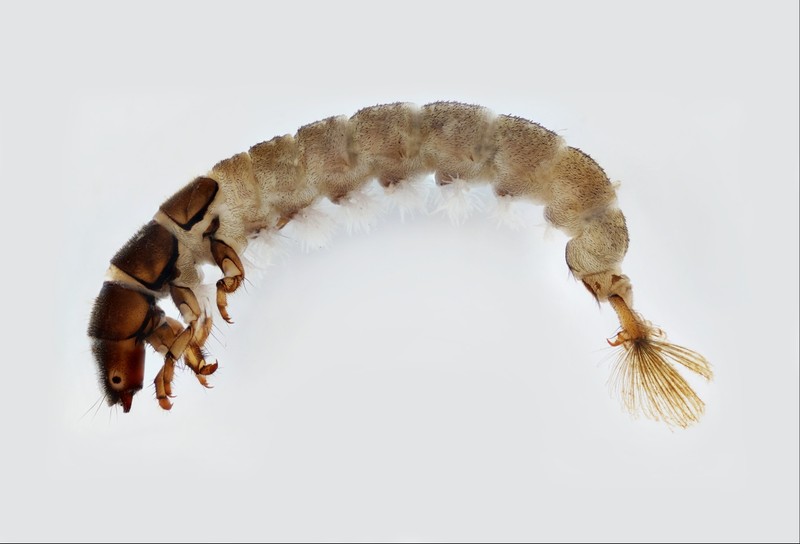
- Larva. Aquatic. Many caddis larvae build protective structures distinctive to family. Some caddis groups carry portable cases of silk and natural materials; the cased-caddis figure below is an illustrative portable-case example, not a Lake Erie tributary presence claim. Net-Spinning Caddis (Hydropsychidae) does NOT carry a case; it builds a stationary silken retreat with a protruding filter net attached to substrate and clings in current -- an obligate lotic clinger with a sclerite-armored thorax. Hydropsychidae family identity is source-backed here; Brachycentridae/Grannom-specific regional presence remains
[source-required]at Tier 1-3. - Pupa. Aquatic. The pupa develops sharp mandibles to cut its way out at emergence (which then degenerate). When ready, it ascends toward the surface, sheds its pupal skin in the film, and emerges. The pupal-ascent window is the angler's prime caddis target. Sparkle Pupa and LaFontaine Emergent Sparkle Pupa imitate this stage.
- Adult. Terrestrial. Nocturnal, weak-flying, often attracted to lights. Elk Hair Caddis and CDC Caddis dries imitate egg-laying flights and drowned-adult drift.

Sources:
NC State University ENT 425, Order Trichoptera -- Tier 2
macroinvertebrates.org, Family Hydropsychidae -- Tier 2
The midge (chironomid) lifecycle
Midges (family Chironomidae, order Diptera) follow the same complete-metamorphosis lifecycle as caddis but at much smaller body size and across a much wider thermal envelope. macroinvertebrates.org calls Chironomidae "the most widespread and often most abundant aquatic insect family," with up to 2,000 estimated North American species. In angler translation, they are the year-round small-insect fallback; Steelhead Alley winter selectivity remains [source-required].
- Egg. Deposited in nearly any aquatic environment.
- Larva. Aquatic. Midge larvae lack segmented legs but have hook-bearing prolegs. They live in mud, sand, gravel, and detritus; some build slender tubes of silk on substrate. Some Chironomus-type larvae carry red hemoglobin pigment -- the "bloodworm." Brassies and red Chironomus patterns imitate the larva.
- Pupa. Pupation occurs on substrate, then the pupa swims upward to emerge. The pupa-swimming-up window is the angler-target stage. Zebra Midge, WD-40, and Disco Midge (hook 18-24) all imitate the rising pupa. This is the dominant midge presentation under indicator.
- Adult. Adults survive only days. Mating swarms over the water; spent adults and clusters fall to the surface. The Griffith's Gnat (hackle-palmered hook 18-22) imitates the bundled mass of a midge cluster, not a single adult.
Chironomidae lifecycle terminology is DIPTERA-CORRECT: larva, pupa, adult. The mayfly words "dun" and "spinner" do NOT apply to midges.

[source-required] at Tier 1-3 -- the GLFC 2004 diet study did not document Chironomidae in top prey items, but its July-September sampling window misses the winter tributary period.
Sources:
macroinvertebrates.org, Family Chironomidae -- Tier 2
NC State University ENT 425, Order Diptera -- Tier 2
Terrestrials -- the honest distinction
"Terrestrial" is angling shorthand for ants, beetles, grasshoppers, crickets, inchworms, and cicadas. They show up in mid-summer through early fall on inland trout streams. But biologically they are different from everything above.
Terrestrials are NOT aquatic insects. Their entire life cycle occurs on land, in soil, or on vegetation. They enter the trout-food chain only when they fall, blow, or drop into streams -- they do not "hatch" in the angler sense at all. Per NC State ENT 425 (Tier 2):
- Ants (Formicidae / Hymenoptera). Holometabolous. Terrestrial nest colonies.
- Beetles (Coleoptera). The largest insect order; holometabolous.
- Grasshoppers and crickets (Orthoptera). Hemimetabolous, jumping hind legs.
- Inchworms (Lepidoptera larvae, Geometridae and related). The "inching" caterpillars that hang from streamside trees on silk threads.
- Cicadas (Cicadidae). Periodic Magicicada broods on 13- and 17-year cycles. Widely-cited but
[source-required]at the Tier 1-3 level per our profile audit.
Sources:
NC State University ENT 425, Order Hymenoptera -- Tier 2
NC State University ENT 425, Order Coleoptera -- Tier 2
NC State University ENT 425, Order Orthoptera -- Tier 2
NC State University ENT 425, Order Lepidoptera -- Tier 2
Why hatch-matching matters (and where it stops)
"Match the hatch" -- match size, color, and stage of what the fish are eating -- is the most-quoted rule in fly fishing.
Size matters most. A trout eating size 18 BWO duns will refuse a size 12 brown drake. Fish lock in on a search image and reject obvious mismatches.
Stage matters second. A fish keying on emerging mayflies will eat an emerger over a fully-floating dun; one keying on rising caddis pupae will refuse an Elk Hair Caddis sitting on top.
Color is a secondary filter. Within the right size and stage, brown/olive/grey covers most mayfly and caddis duns; black/brown/olive covers most nymphs; red/olive/black covers midge larvae.
Where hatch-matching stops on Steelhead Alley: Lake Erie steelhead diet evidence (GLFC 2004 Coldwater Task Group; Tier 1) puts emerald shiner at 47.7% occurrence and 57.71% biomass in West Central Basin steelhead stomachs, with rainbow smelt second. That is a baitfish/forage-fish diet, not an aquatic-insect-hatch diet. Lake Erie tributary steelhead fishing is primarily a streamer + egg + nymph game built around forage species and spawn-run windows, NOT around mayfly hatches the way an inland trout-stream fishery is. The vocabulary still matters -- inland brown trout, headwater brookies, and resident rainbows all live by the hatch-matching rules above -- but on Lake Erie itself, knowing the words is more useful for reading fly-shop talk than for chasing a Hex spinner fall as a steelhead strategy.
Source for the Steelhead Alley caveat: GLFC Coldwater Task Group, "An Analysis of the Diet of Steelhead Trout in Lake Erie" (~2004 final report) -- Tier 1
What this glossary does not yet contain
SHA is building toward a complete Steelhead Alley entomology library. The order-level lifecycle terminology in this article is fully Tier 2 source-backed (NC State ENT 425 + macroinvertebrates.org). Several things you might want -- and that we will not invent -- are still [source-required] at the Tier 1-3 level:
- Specific peak-week hatch dates for named Lake Erie tributaries. Most Slate Drake, BWO, Grannom, and midge timing literature available online is Tier 5 angler-facing and is intentionally not cited as biological baseline here.
- Water-temperature emergence triggers for specific families on Steelhead Alley. Hexagenia has a sourced 68 deg F at-depth trigger (Tier 2 Michigan Sea Grant); the smaller-family triggers do not.
- Quantitative steelhead diet-selectivity on aquatic insects for Lake Erie tributaries. The GLFC 2004 sampling window (July-September lake-resident) misses the winter tributary period when midge and stonefly nymph selectivity would be expected, so the absence in top prey items is a sampling-window mismatch, not evidence of non-selection.
- Lake Erie tributary family-level macroinvertebrate presence records. Order-level EPT bioassessment context does NOT prove specific Isonychiidae or Capniidae or Brachycentridae presence in named Alley tributaries -- a dedicated tributary macroinvertebrate report listing those families would close that gap.
If you have access to studies that close any of these gaps, send them to us. The library grows when source-backed evidence does.
The takeaways
What is a hatch? In angler usage, the emergence event when underwater nymphs (mayflies, stoneflies) or larvae/pupae (caddis, midges) become winged adults and briefly become a vulnerable surface food source.
Four orders matter: Ephemeroptera (mayflies, dun/spinner two-step), Plecoptera (stoneflies, crawl-out adults, nymph-fishing dominant), Trichoptera (caddis, pupal-ascent emergence is the prime target), Diptera/Chironomidae (midges, larva/pupa/adult, the year-round small-insect fallback in angler translation).
Vocabulary discipline: dun and spinner are mayfly-only. Stoneflies have nymph + adult only. Caddis and midges have larva + pupa + adult. Using the wrong terminology for the wrong order is the giveaway that an article is not grounded in biology.
Terrestrials are land insects. They enter the food chain by falling in. They matter for resident-trout fishing in mid-summer through early fall. They are not a Lake Erie steelhead strategy.
For Steelhead Alley specifically: the Lake Erie steelhead diet anchor is shiner-and-smelt forage per GLFC 2004 (Tier 1), not aquatic-insect hatches. Knowing the hatch vocabulary still matters -- it lets you read fishing reports, follow fly-shop talk, and understand the inland-trout and brown-trout fisheries adjacent to the Alley -- but the application to steelhead itself is narrower than the application to an inland mayfly-driven trout stream.
Why we're publishing this
SHA is building toward being the authoritative source for Steelhead Alley entomology and biology. Most fly fishing glossary content blends Tier 5 angler tradition with biology without flagging which is which. This article cites the order-level biology to Tier 2 academic and bioassessment references (NC State ENT 425 + macroinvertebrates.org), keeps the angler-translation vocabulary explicit, and flags every regional-timing or Steelhead-Alley-specific claim that still needs a Tier 1-3 source. That discipline is what we want behind every entomology article on the site.
If you fish Steelhead Alley -- or any of the adjacent inland trout systems -- this is the glossary we'd want in your back pocket when you walk into a fly shop.
Full source list
| Source | Tier | Use |
|---|---|---|
| NC State University ENT 425, Order Ephemeroptera | 2 | Mayfly lifecycle terminology: incomplete metamorphosis, aquatic nymph/naiad, subimago-to-imago molt, angler terms dun/subimago and spinner/imago. |
| NC State University ENT 425, Order Plecoptera | 2 | Stonefly lifecycle: hemimetabolous, egg/aquatic nymph/terrestrial adult, no dun/spinner two-step. Adults crawl out and live near streambanks, not active fliers, often short-lived with non-functional mouthparts. |
| NC State University ENT 425, Order Trichoptera | 2 | Caddisfly lifecycle: complete metamorphosis, aquatic larva/pupa/adult; many cased larvae; pupal mandibles cut through case at emergence then degenerate; adults nocturnal, weak-flying, typically do not feed. |
| NC State University ENT 425, Order Diptera | 2 | Order-level Diptera lifecycle: holometabolous, egg/larva/pupa/adult; all dipteran larvae lack legs; Chironomidae are midges with aquatic larvae usually in mud. |
| macroinvertebrates.org, Order Plecoptera | 2 | Nine North American stonefly families enumerated; diagnostic morphology (two tarsal claws, two cerci); digitiform gills; cold/fast/well-oxygenated lotic habitat; pollution-sensitive. |
| macroinvertebrates.org, Family Isonychiidae | 2 | Slate Drake family identity; monogeneric (Isonychia only); ~15 North American species; nymphs fusiform strong swimmers; nearly-unique foreleg filter-feeding setae; pollution-tolerance 1.9-3.8. |
| macroinvertebrates.org, Family Hydropsychidae | 2 | Net-Spinning Caddis family identity; ~13 US genera within ~47 global; silken retreat with protruding filter net (NOT portable cases); obligate lotic clingers; pollution-tolerance species-variable. |
| macroinvertebrates.org, Family Chironomidae | 2 | Up to 2,000 NA species; most widespread + abundant aquatic insect family; larvae inhabit nearly all aquatic environments; pupation on substrate then swim upward to emerge; adults brief (days); larvae critical food source for predators. |
| Ohio Sea Grant (OSU), Small Lake Erie Mayfly Population (2011) | 2 | Hex peak emergence mid-June through mid-July, max June 20-30; adult lifespan 24-36 hours; canary-in-coal-mine indicator role; food source for walleye + yellow perch. |
| Michigan Sea Grant, When will the mayflies arrive? (2024) | 2 | Hex emergence trigger: water at depth 20 deg C (68 deg F); season can continue June-August through different cohorts/species. |
| GLFC Coldwater Task Group, Diet of Steelhead Trout in Lake Erie (~2004) | 1 | Lake Erie steelhead diet anchor: emerald shiner 47.7%/57.71% West Central; rainbow smelt second; aquatic-insect selectivity NOT in top documented prey items at the July-September sampling window. |
| NC State University ENT 425, Order Hymenoptera | 2 | Ants (Formicidae) holometabolous; grub-like immatures; social insects with wingless workers. Terrestrial. |
| NC State University ENT 425, Order Coleoptera | 2 | Beetles holometabolous; largest insect order (~25,200 NA species); inhabit all terrestrial and freshwater environments. |
| NC State University ENT 425, Order Orthoptera | 2 | Grasshoppers and crickets hemimetabolous; terrestrial herbivores with jumping hind legs; ~1,200 NA species. |
| NC State University ENT 425, Order Lepidoptera | 2 | Moths/butterflies holometabolous; eruciform larvae with up to 5 pairs of abdominal prolegs; inchworms are an angler/common-name term for certain Geometridae larvae. |
Common questions about aquatic insect lifecycles
What is a hatch in fly fishing?
In biology, a hatch is the egg-to-nymph transition. In angler usage, a hatch is the emergence event -- the moment underwater nymphs (mayflies, stoneflies) or larvae/pupae (caddis, midges) finish their aquatic life and transform into winged adults. Trout key on emergence because the insect is briefly vulnerable at the surface.
What is the difference between a mayfly emerger, dun, and spinner?
The emerger is the moment the mature nymph rises through the water column and starts shedding its exoskeleton -- a brief, vulnerable transition window. The dun (biology: subimago) is the first winged adult after emergence; wings are opaque and dull. The spinner (biology: imago) is the second molt that produces clear glassy wings -- mayflies are the only insects that molt again after they have wings. Spent spinners fall flat to the surface to die. Each stage requires a different fly pattern.
What is the difference between a mayfly and a stonefly?
Both have incomplete metamorphosis with aquatic nymphs and terrestrial adults, but stoneflies have only one winged adult stage (no dun/spinner two-step). Stoneflies also crawl out of the water to emerge rather than swim-emerge mid-stream, which is why stonefly nymph fishing dominates while mayflies are often targeted as duns and spinners on the surface.
What is a chironomid?
Chironomid is the technical name for the midge family (Chironomidae, order Diptera). Midges undergo complete metamorphosis: egg, aquatic larva (sometimes called bloodworm when the red Chironomus type is involved), aquatic pupa, terrestrial adult. They are the year-round aquatic insect family with documented adult activity in both winter and high-summer windows.
Are terrestrials aquatic insects?
No. Ants, beetles, grasshoppers, inchworms, and cicadas live their entire life cycle on land. They enter the trout food chain only when they fall, blow, or drop into the water. They do not hatch in the angler sense. Terrestrials peak in mid-summer through early fall and are primarily relevant for resident trout fishing on inland streams, not for Lake Erie steelhead.
Do Lake Erie steelhead eat aquatic insect hatches?
Per the GLFC 2004 Coldwater Task Group steelhead diet study (Tier 1), Lake Erie steelhead diet is dominated by baitfish (emerald shiner 47.7% occurrence and 57.71% biomass, rainbow smelt around 24% biomass, round goby, juvenile yellow perch), not aquatic insect hatches. The GLFC study sampled July-September, so winter midge and stonefly nymph selectivity is not captured. Lake Erie steelhead fishing is a streamer-and-egg game in steelhead-target windows, not a hatch-matching game like inland trout streams.
Image credits and licensing
This article uses a combination of public-domain, Creative Commons, and fair-use educational images. Every image is credited to its source with a link back to the original. Source-cited attribution is part of what we mean by an authoritative library.
- Lifecycle infographic. Original work by SteelHead Addiction. Free to share with attribution.
- Mayfly nymph (Cloeon dipterum, Baetidae). Photo: B. Schoenmakers. Source: Wikimedia Commons. License: CC BY 3.0.
- Mayfly ecdysis (emerger). Photo: User:Stemonitis. Source: Wikimedia Commons. License: CC BY-SA 2.5.
- Stonefly nymph (Houghton Creek, NY). Photo: Dave Huth, Allegany County NY. Source: Wikimedia Commons. License: CC BY 2.0.
- Cased caddis larva (portable-case example). Photo from NC State University ENT 425, Order Trichoptera. Used under fair use for educational purposes with attribution and link-back to source.
- Net-spinning caddis larva (Hydropsyche). Image from macroinvertebrates.org, Family Hydropsychidae. Used under fair use for educational purposes with attribution and link-back to source.
- Chironomidae midge larva (microscopy). Photo: Mikron86. Source: Wikimedia Commons. License: CC BY 4.0.
If you are a rights-holder and believe an image attribution needs correction, contact us at SHA -- we will fix it promptly.
Continue learning
This glossary is the foundation. Specific Steelhead Alley applications are in our other pillar articles:
- Steelhead Alley Forage Briefing -- what Lake Erie steelhead actually eat per the GLFC 2004 Coldwater Task Group diet study. Source-anchored at Tier 1.
- The Goby Takeover -- how the post-1993 round goby invasion rewrote the Lake Erie smallmouth bass diet from 53.5% crayfish to 64% round goby. NYSDEC 2024 + Steinhart 2004 sources.
- Steelhead Alley Summer Biology -- life cycles, coldwater refuges, and what bites when steelhead leave the tributaries.
- The Steelhead Alley Seasonal Calendar -- the month-by-month rhythm that puts every hatch in its calendar context.