Emerald Shiner Life Cycle: The Primary Lake Erie Steelhead Forage
The documented Lake Erie steelhead forage anchor -- 47.7% frequency-of-occurrence and 57.71% dry-weight biomass in West Central Basin steelhead stomachs per the GLFC 2004 Coldwater Task Group diet study. Egg, larva, fry, juvenile, adult -- the lifecycle stages every Steelhead Alley angler should understand before tying on a Clouser, and the honest caveats that come with current decade-low abundance.
TL;DR -- if you only read one block
The Lake Erie steelhead fishery rides on a baitfish, not a hatch. The GLFC Coldwater Task Group sampled 349 steelhead stomachs across Lake Erie basins for their 2004 diet study; 250 stomachs (72%) contained at least one food item, and the dominant prey-fish energy source was emerald shiner. That single sentence puts shiner biology near the top of the priority list for anyone fishing Steelhead Alley with intent. This article walks Notropis atherinoides from egg through Age II+ adult, ties each stage to the angler-translation patterns SHA surfaces in the gear rotation, and is explicit about where Steelhead Alley specifics still need Tier 1-3 anchors.
Why this pillar matters for steelhead anglers
Lake Erie steelhead fishing is built on streamers, eggs, and nymphs around a forage-fish diet. The GLFC 2004 numbers anchor the entire pattern selection logic: emerald shiner at 47.7% frequency-of-occurrence and 57.71% dry-weight biomass (West Central Basin June-October overall species-confirmed). Combined with unidentified Notropis spp. in the same family, the shiner group hits 67.5% frequency and 70.47% biomass. August West Central Basin monthly peak values for the shiner group exceed 76% frequency and 69% biomass -- that is a seasonal concentration peak, not the overall metric, but it tells you when the coupling between steelhead and shiner is at its tightest.
That is the Tier 1 anchor. Everything else in this article is downstream of it: lifecycle stages map to predator-encounter windows, size classes map to hook sizes, color biology maps to fly selection. We label each claim with source-status discipline (source-backed, source-required, heuristic, translation heuristic) so you can see exactly what is anchored to peer-reviewed or state-agency evidence and what is angler-translation on top.
Primary anchor: GLFC Lake Erie Committee Coldwater Task Group, "An Analysis of the Diet of Steelhead Trout in Lake Erie" (~2004 final report) -- Tier 1
Identity
- Common name: Emerald Shiner
- Scientific name: Notropis atherinoides Rafinesque, 1818
- Family: Leuciscidae (per USFWS Ecological Risk Screening Summary, July 2025 / Tier 3 federal authority). Older sources still list Cyprinidae; the Leuciscidae designation is the current federal authority and should be used for any taxonomic claim in user-visible content.
- Native range: Great Lakes basin and Mississippi River basin per USGS NAS species profile (Tier 3 federal species reference).
- Working scope for this article: species-level, Lake Erie focus. Lake Ontario applicability requires separate citation and is not made in this pillar.
- Regional aliases (heuristic): "shiner" (generic; can refer to other Notropis species too), "lake shiner", "emerald minnow".
Identification field marks per USGS NAS and USFWS ERSS: slender silvery body, iridescent emerald-green dorsal line that gives the species its name, large eye, terminal mouth, no dark caudal spot (that is spottail shiner, a closely-related but distinct Notropis species). Adults run 3-5 inches typically; the documented maximum is 13 cm (~5.1 in).
Sources:
USFWS Ecological Risk Screening Summary, Notropis atherinoides Emerald Shiner (June 2025) -- Tier 3
USGS Nonindigenous Aquatic Species, Emerald Shiner species profile (revised 2019) -- Tier 3
Lifecycle stage 1: Egg
Stage summary: Spring spawning event in open water or over gravel/sand substrate; eggs are demersal (sink to bottom) or semi-buoyant depending on environmental conditions; no parental care.
Timing. Notropis atherinoides is a spring-summer broadcast spawner. Reported spawning temperature triggers in the general literature run roughly 68-77 deg F (20-25 deg C), with peak activity in late May through June at southern-range latitudes. [source-required] for Lake Erie tributary specifics -- the timing is reasonable from general Notropis life-history but the exact Lake Erie + Steelhead Alley tributary spawning window has not been anchored to a Tier 1-3 study in our reference set. Treat early-summer spawning as the working assumption; do not invent named dates.
Habitat. Emerald shiner spawn over clear water sand and gravel sediments per USFWS ERSS (Tier 3); the same habitat type that defines adult occurrence. They are not gravel-pit spawners like white sucker -- they are open-water broadcast spawners that release eggs into the water column or over substrate.
Predator encounter notes. Eggs are not a documented Lake Erie steelhead prey item at the GLFC 2004 sampling scope -- the study sampled stomachs primarily July-September, AFTER the spring shiner-spawn window. Egg-stage predation by yellow perch and other panfish is plausible but [source-required] at the Tier 1-3 level for emerald shiner specifically.
Source-status labels for this stage: spawning habitat (sand/gravel substrate) is source-backed via USFWS ERSS; temperature triggers and exact tributary timing are source-required; no-parental-care broadcast-spawning behavior is source-backed via general Notropis life-history references; egg-stage predator selectivity is source-required.
Sources for this stage:
USFWS Ecological Risk Screening Summary, Notropis atherinoides (June 2025) -- Tier 3
Lifecycle stage 2: Larva / fry
Stage summary: Hatched larvae are roughly 3-5 mm; transparent; weak swimmers; drift in nearshore shallows; transition to active feeding on zooplankton (rotifers, copepod nauplii, small cladocerans) within days to weeks.
Size. Hatch-stage larvae are reported at roughly 3-5 mm in general Notropis literature. Larval/post-larval growth is rapid in summer -- USGS NAS reports juveniles (we cover that stage next) at far larger size by autumn of their first year.
Habitat. Larval emerald shiners use nearshore shallows, embayments, and tributary mouths as nursery habitat -- the same general zones where adult shiners aggregate in spring per NYSDEC's smallmouth bass page. USGS NAS specifically documents that in the Upper Niagara River, Notropis atherinoides juveniles are more often found in natural habitat (e.g. marshes) than developed habitat (e.g. seawalls) -- which extends to the larval stage by inference but is [source-required] for Lake Erie tributary marshes specifically.
Predator encounter notes. Larval shiners are below the gape-limit of adult steelhead and are not in the GLFC 2004 documented prey items at the sampling scope. They are vulnerable to yellow perch fry, juvenile smallmouth, and other shallow-water planktivores, but quantitative Lake Erie selectivity is [source-required] at Tier 1-3.
Source-status labels for this stage: larval size + zooplankton-feeding transition is source-backed via general Notropis life-history (Tier 3-5); Lake Erie tributary marsh nursery use is source-required with USGS NAS Upper Niagara as the closest available federal anchor.
Source for this stage:
USGS Nonindigenous Aquatic Species, Emerald Shiner species profile -- Tier 3 (juvenile habitat preference)
Lifecycle stage 3: Juvenile (Age 0 / Age I)
Stage summary: Age 0 young-of-year by autumn of their first summer; Age I shiners by their second summer. This is the size-class transition where predator-prey relationships start to matter intensely.
Size by age class (Atkinson et al. 2015, Tier 3 peer-reviewed Ohio Journal of Science, Western Basin Lake Erie, n=400 individuals):
- Age 0 (YOY): males 15-33 mm TL; females 18-30 mm TL. Roughly 0.6-1.3 in. This is the size class that drives autumn small-baitfish predator activity.
- Age I: males 39-78 mm TL; females 42-78 mm TL. Roughly 1.5-3.1 in. This is the Age I + early Age II band that bridges juveniles into adult forage.
Habitat. Pothoven et al. 2009 (Tier 3 peer-reviewed Journal of Great Lakes Research) sampled emerald shiners in central Lake Erie OFFSHORE May-October 2005, confirming pelagic open-lake presence during the summer. Per the Pothoven study, summer diet shifts toward cladocerans when available. Juvenile shiners participate in the offshore pelagic pool that summers in Central Lake Erie water columns; how much of the Age 0 / Age I population stays nearshore versus shifts offshore varies and is [source-required] for specific Lake Erie sub-basin proportions.
Predator encounter notes. NYSDEC's 2024 bass/perch diet analysis (yellow perch n=41 stomachs, late-summer Eastern Basin) documents emerald shiner as a MINOR diet item in yellow perch; emerald shiner was NOT documented in the 2024 smallmouth bass diet sample (n=25 stomachs late summer Eastern Basin). USGS historical year-class records document YOY walleyes shifting to emerald shiners in fall, and 1959/1960 year-class walleyes feeding on spottail and emerald shiners in spring/summer -- but these are HISTORICAL records; current adult Lake Erie walleye quantitative shiner selectivity is [source-required].
Source-status labels for this stage: size-at-age is source-backed via Atkinson et al. 2015 (Tier 3 peer-reviewed); offshore summer pelagic presence is source-backed via Pothoven et al. 2009 (Tier 3 peer-reviewed); juvenile predator selectivity by walleye is source-backed for historical year-class evidence only; current adult walleye selectivity is source-required.
Sources for this stage:
Atkinson, T., Desrosiers, S., Townsend, T., Simon, T.P. (2015), "Length-weight relationships of the Emerald Shiner (Notropis atherinoides Rafinesque, 1818) in the Western Basin of Lake Erie", Ohio Journal of Science 114(2) -- Tier 3
Pothoven et al. 2009, "Feeding Ecology of Emerald Shiners and Rainbow Smelt in Central Lake Erie", Journal of Great Lakes Research 35(2) -- Tier 3
NYSDEC, "Lake Erie Smallmouth Bass and Yellow Perch Diet Analysis" (March 2024) -- Tier 1
USGS publication, "Food of young-of-the-year walleyes in Lake Erie" (historical) -- Tier 3
USGS publication, "Selective food preferences of walleyes of the 1959 year class in Lake Erie" (historical) -- Tier 3
Lifecycle stage 4: Adult (Age II+ / spawning)
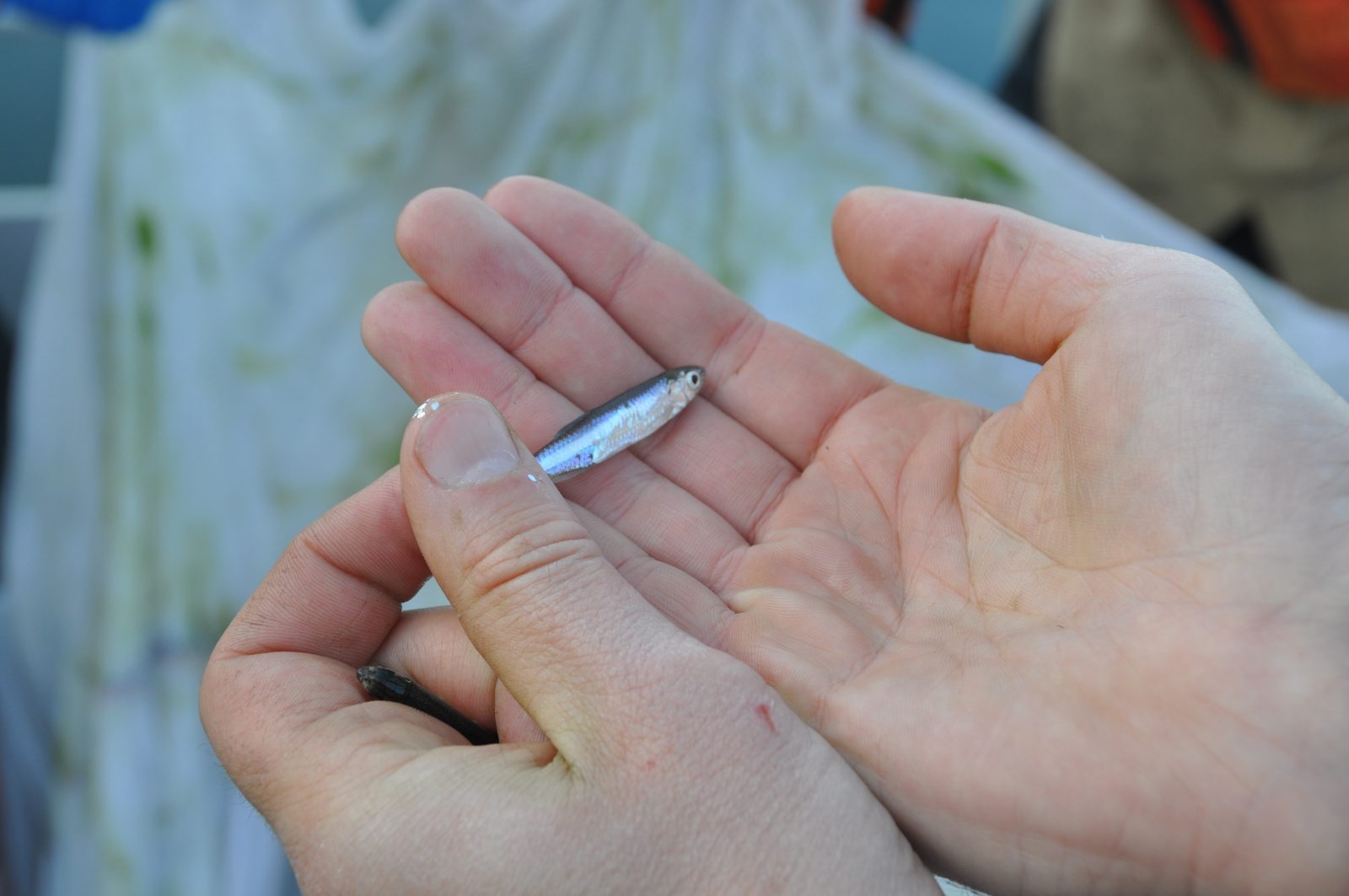
Stage summary: Age II and older. This is the dominant Western Basin size class in Atkinson et al. 2015 and the size class that drives the documented Lake Erie steelhead diet anchor.
Size. Age II+ males 78-111 mm TL; females 81-108 mm TL; combined Age II+ range 78-111 mm (approximately 3.1-4.4 in). Indeterminate growth -- shiners continue to grow throughout life, though slowly past Age II. Maximum recorded length per USGS NAS is 13 cm (~5.1 in). Atkinson et al. 2015 reports strong positive length-weight correlation in both sexes.
Habitat. Adult emerald shiners use both nearshore and offshore Lake Erie habitats seasonally. The two source-backed sub-windows:
- Spring nearshore / tributary / harbor (April-May): source-backed -- NYSDEC documents that emerald shiners move into tributaries and harbor areas in April-May when water temperatures rise faster than the open lake; smallmouth bass actively feed on these shiner schools in nearshore zones. NYSDEC explicitly recommends "woolly buggers and minnow patterns, especially emerald shiner patterns" for fly anglers.
- Summer offshore pelagic (May-October): source-backed -- Pothoven et al. 2009 sampled emerald shiners in central Lake Erie OFFSHORE during this window. The Central Basin epilimnion + hypoxic-line interface is documented summer pelagic habitat.
Two more sub-windows are widely-attested but [source-required] at Tier 1-3 for Lake Erie:
- Fall return to nearshore: source-required -- broadly consistent with the spring/fall nearshore movement pattern of pelagic Great Lakes forage species, but a Lake Erie-specific fall-window citation for emerald shiner has not surfaced in our reference set.
- Year-round Lake Erie open-water presence: source-required -- broadly consistent with GLFC Lake Erie Forage Task Group annual trawl-survey methodology (which pools emerald shiner with rainbow smelt and spottail shiner as "soft-rayed fish"), but the GLFC methodology citation alone is inferential for year-round presence, not direct support.
Predator encounter notes -- the steelhead anchor. GLFC 2004 Coldwater Task Group (Tier 1, n=349 steelhead stomachs, 250 with food): emerald shiner is the major baitfish in Lake Erie steelhead diet. West Central Basin June-October overall species-confirmed emerald shiner = 47.7% frequency-of-occurrence and 57.71% dry-weight biomass. Combined shiner group (emerald shiner + unidentified Notropis spp.) = 67.5% frequency and 70.47% biomass. August West Central monthly-peak shiner-group values exceeded 76% frequency / 69% biomass -- this is a monthly peak, not an overall metric. Use the overall species-confirmed value (47.7% / 57.71%) for general claims; cite the August peak only when discussing seasonal concentration.
Rainbow smelt sits second in the GLFC 2004 anchor at approximately 24% biomass; combined with emerald shiner, the smelt + shiner pool occurred in 82-91% of steelhead stomachs across basins. Round goby and juvenile yellow perch are the other documented prey-fish categories. Aquatic insects (terrestrial moths, beetles, Eurasian lady beetles) showed up by count but were a distant second by biomass -- the diet is fundamentally a baitfish diet.
Source-status labels for this stage: size-class biology is source-backed via Atkinson et al. 2015; spring nearshore movement is source-backed via NYSDEC; summer offshore pelagic presence is source-backed via Pothoven et al. 2009; steelhead diet selectivity is source-backed (Tier 1 GLFC); fall window timing is source-required.
Sources for this stage:
GLFC Coldwater Task Group, "An Analysis of the Diet of Steelhead Trout in Lake Erie" (~2004) -- Tier 1
NYSDEC, "Smallmouth Bass Fishing On Lake Erie" -- Tier 1
Atkinson et al. 2015 Ohio Journal of Science -- Tier 3
How lifecycle stages map to angler patterns
Now the angler-translation. Each stage above carries direct implications for fly + lure selection.
- Egg stage: not a target for shiner-pattern fishing. (Spring sucker spawn fly patterns + glo bugs cover the broader egg-availability translation -- but those are sucker eggs, not shiner eggs. See our white sucker forage profile for that lane.)
- Larva / fry stage: not directly targeted by adult-steelhead anglers; the Lake Erie steelhead gape-limit is far above the 3-5 mm larva size range. Larval shiners enter the food web for the yellow perch / juvenile smallmouth lane (translation heuristic until Lake Erie quantitative data surfaces).
- Juvenile Age 0 (YOY, 0.6-1.3 in): matches micro-streamers, size 8-12 hooks, sparse white/silver dressings. Use this for selective steelhead in clear cold water and when match-the-hatch demands a smaller silhouette.
- Juvenile Age I (1.5-3.1 in): size 6-10 streamers, Clouser-style ties, white/silver/pearl with subtle flash. This is the "small Clouser" / small Sparkle Minnow band.
- Adult Age II+ (3.1-4.4 in): size 2-6 streamers, the dominant Lake Erie steelhead pattern set. White/silver/pearl Clouser, Tigofly Zonker, Articulated Sparkle Minnow. This band carries the GLFC 2004 anchor and is the working default for Lake Erie steelhead streamer fishing.
Presentation maps to seasonal stage as well:
- April-May spring nearshore / tributary window (source-backed): strip-retrieve through tributary mouths and lower-river runs; swing across current breaks at harbor zones. NYSDEC's explicit recommendation is "woolly buggers and minnow patterns, especially emerald shiner patterns" for smallmouth bass -- the steelhead application is direct extension via the GLFC 2004 diet anchor.
- Summer offshore window (source-backed via Pothoven 2009): not a typical tributary-steelhead target window; this is when shiners are out in Central Basin pelagic columns and steelhead are in summer holding patterns.
- August West Central monthly peak (source-backed for the >76% / >69% shiner-group peak): if you can find steelhead in the right thermal window during August, shiner-pattern presentation is at its strongest seasonal coupling -- but tributary access during this thermal-stress window is heavily caveated.
- Fall return to nearshore (source-required): widely-attested in angler practice; treat tributary-specific fall shiner timing as translation heuristic until a Tier 1-3 anchor surfaces.
Color choice: white / silver / pearl is the baseline shiner-imitation profile per the documented silvery body. Chartreuse + flash is the stained-water visibility heuristic; olive back / silver belly is a closer match to the live profile in clearer water. See our angler-translation reference for the broader size-to-hook + color/clarity mappings.
Curator's Picks
Four patterns from our gear set that map directly to the emerald shiner lifecycle stages. Editor context ties each to a specific lifecycle-stage size + color + profile.
- Clouser Minnow (white/silver Pearl). The canonical baitfish streamer. Hook size 2-6 sits in the Age II+ Western Basin 3.1-4.4 in size class exactly (Atkinson et al. 2015). White/silver/pearl colorway matches the documented silvery body profile. This is the GLFC 2004 diet anchor in fly form -- the highest-defensibility shiner-pattern pick for Lake Erie steelhead anglers fishing the spring tributary window per NYSDEC's explicit recommendation.
- Tigofly weighted Zonker streamer. The zonker strip + silver body covers a broader baitfish silhouette than a tight Clouser. Useful for the August West Central monthly-peak shiner-group window (>76% frequency / >69% biomass per GLFC 2004) when seasonal concentration is high and the steelhead is locked on shiner energy density. Weighted for swing presentation through current breaks at tributary mouths.
- Articulated Sparkle Minnow. The larger / flash-heavy variant. Articulation gives wider swim profile and more action than a rigid streamer -- matches the Age II+ 3.1-4.4 in adult class and pairs with the swung-fly + strip-retrieve presentations NYSDEC recommends for spring nearshore / tributary / harbor smallmouth feeding on shiner schools. The flash density helps in stained-water conditions per the angler-translation chartreuse + flash heuristic.
- Brass beadhead glo-bug + assorted nymph kit. The complementary egg-availability bookend. Not a shiner-imitation pattern itself, but the kit gives entry-level coverage for the broader lifecycle-stage education theme: glo bug egg patterns honor the spring egg-availability window (sucker spawn ~50 deg F per PFBC); the beadhead nymph variety covers incidental small-prey cues. Use this kit as the budget on-ramp for new anglers building toward the shiner-pattern streamer rotation.
Honest gaps -- what this pillar cannot yet say at Tier 1-3
SHA is building toward an authoritative Lake Erie forage library. Several things you might want from this article -- and that we will not invent -- are still [source-required] at the Tier 1-3 level:
- Specific Steelhead Alley tributary spawning windows for emerald shiner. Spawning temperature triggers (roughly 68-77 deg F per general Notropis life-history) and peak weeks for Conneaut, Chagrin, Grand, Rocky, Cattaraugus, Elk, Walnut, etc. have not been anchored to a tributary-specific peer-reviewed or state-agency citation in our reference set.
- Microhabitat preferences by river. USGS NAS documents Upper Niagara juveniles favoring natural marsh over developed seawall; that does not extrapolate cleanly to Steelhead Alley tributary substrate / vegetation preferences. Each tributary likely has its own microhabitat profile and we will not invent them.
- Quantitative steelhead size-class selectivity on shiner age classes. The GLFC 2004 study documents 47.7% / 57.71% at the species level; predator size-class to prey age-class pairings (which size steelhead eats which shiner age class) are not extracted from search snippets of GLFC diet tables.
- Tributary-specific fall shiner return timing. Widely-attested in angler practice; treat as translation heuristic.
- Pier and breakwall concentration windows. Real angler-observed phenomenon; would need agency or academic citation to upgrade from translation heuristic.
- Wind-driven nearshore-concentration patterns. Real phenomenon per angler practice; specific shore-zone behavior is
[source-required]for publishable claims. - Brown trout diet selectivity for emerald shiner. The GLFC 2004 study covers steelhead specifically; brown trout extension is translation heuristic until a brown-trout-specific Lake Erie diet study surfaces.
- Current adult Lake Erie walleye quantitative diet selectivity. USGS historical year-class evidence (1959/1960) is source-backed but historical; current adult walleye-on-shiner selectivity needs a contemporary ODNR/GLFC study.
- Population decline mechanism. GLFC documents the decade-low abundance trend but specific mechanisms (mussel filter-feeding zooplankton competition, predation pressure from increasing walleye/perch year classes, water-temperature shifts, etc.) are still under research.
If you have access to studies that close any of these gaps, send them to us. The library grows when source-backed evidence does.
The population caveat -- preserve this framing
This is the honest piece of the article that has to land before any commerce surface promotes shiner-pattern gear. Per the GLFC Lake Erie Forage Task Group's March 2026 report, emerald shiner abundance has remained at decade-low levels. Multi-agency trawl surveys show shiner densities well below historical baselines.
Practical implications for anglers:
- Shiner-pattern flies still produce -- the diet anchor doesn't evaporate because abundance dropped -- but they are no longer a default search pattern. They are one option in a streamer rotation that should include smelt patterns (rainbow smelt at ~24% biomass per GLFC 2004), goby patterns where the goby invasion has rewritten local food-web access (mostly smallmouth-relevant), and egg patterns during sucker-spawn windows.
- If local shiner presence is unconfirmed (no surface flips, no schools visible in clear-water sight-fishing windows), don't assume a shiner imitation will outperform other patterns just because the diet study said it should.
- The GLFC March 2026 report flags emerald shiner, rainbow smelt, and spottail shiner together as the "soft-rayed fish" pool. Pool-level reporting means within-species trends (one shiner up while another down) aren't always immediately visible at the FTG-row level.
Sources for the population caveat:
GLFC Lake Erie Forage Task Group, March 2026 -- Tier 1
The takeaways
What is emerald shiner? Notropis atherinoides (family Leuciscidae per USFWS ERSS 2025) is a small silvery Great Lakes baitfish, native to the Great Lakes basin, with an Age II+ adult range of 3.1-4.4 in (Atkinson et al. 2015 Western Basin) and a maximum of ~5.1 in (USGS NAS).
Why does it matter for steelhead anglers? Per the GLFC 2004 Coldwater Task Group Lake Erie steelhead diet study (Tier 1, n=349 stomachs): emerald shiner is the major baitfish in the diet -- 47.7% frequency / 57.71% biomass species-confirmed West Central Basin June-October overall. Combined shiner group hits 67.5% / 70.47%. August West Central monthly peak exceeds 76% / 69% for the shiner group.
Lifecycle to angler-translation: egg stage isn't shiner-imitation territory; larva / fry stage isn't a steelhead-gape-limit target; Age 0 YOY (0.6-1.3 in) matches micro-streamers in size 8-12; Age I (1.5-3.1 in) matches small Clousers in size 6-10; Age II+ adults (3.1-4.4 in) is the dominant Lake Erie steelhead streamer band -- white/silver/pearl Clouser, Tigofly Zonker, Articulated Sparkle Minnow in size 2-6.
Spring window is the most defensible: April-May tributary / harbor / nearshore movement per NYSDEC (Tier 1), with NYSDEC explicitly recommending shiner-pattern flies for smallmouth bass; steelhead application via GLFC 2004 diet anchor.
Honest caveat: abundance has been at decade lows per GLFC FTG. Shiner imitation is one option in the streamer rotation, not the default. Pair with smelt + goby + egg patterns based on local conditions, water clarity, and confirmed forage presence.
Why we're publishing this
SHA is building toward being the authoritative Lake Erie steelhead biology + forage library. Most fishing content treats emerald shiner as a generic "baitfish" without anchoring the steelhead-diet selectivity to the GLFC 2004 numbers or honoring the decade-low abundance caveat. This pillar cites the size-class data to a Tier 3 peer-reviewed Ohio Journal of Science paper (Atkinson et al. 2015), cites the steelhead diet anchor to the Tier 1 GLFC Coldwater Task Group 2004 study, cites the spring nearshore window to Tier 1 NYSDEC guidance, and is explicit about which lifecycle-stage specifics (tributary spawning windows, microhabitat by river, predator size-class selectivity) still need Tier 1-3 anchors. That discipline is what we want behind every biology pillar on the site.
Full source list
| Source | Tier | Use |
|---|---|---|
| GLFC Coldwater Task Group, "An Analysis of the Diet of Steelhead Trout in Lake Erie" (~2004) | 1 | Steelhead diet anchor: n=349 stomachs, 250 with food, West Central Basin June-October overall species-confirmed emerald shiner = 47.7% frequency-of-occurrence and 57.71% dry-weight biomass; combined shiner group (emerald + Notropis spp.) = 67.5% / 70.47%; August West Central monthly peak for shiner group >76% / >69%; smelt + shiner combined occurred in 82-91% of stomachs across basins. |
| USFWS Ecological Risk Screening Summary, Notropis atherinoides (June 2025) | 3 | Current valid name, Leuciscidae family designation, Great Lakes basin native range, clear-water sand/gravel substrate habitat, common/max length context. |
| USGS Nonindigenous Aquatic Species, Emerald Shiner species profile (revised 2019) | 3 | Native range Great Lakes basin; maximum size 13 cm (5.1 in); Upper Niagara River juveniles favor natural marsh habitat over developed seawall. |
| Atkinson, Desrosiers, Townsend, Simon (2015), Ohio Journal of Science 114(2) | 3 | Western Basin Lake Erie size-at-age: Age 0 males 15-33 mm and females 18-30 mm TL; Age I males 39-78 mm and females 42-78 mm TL; Age II+ males 78-111 mm and females 81-108 mm TL (combined 3.1-4.4 in); strong positive length-weight correlation; indeterminate growth. |
| Pothoven et al. 2009, J. Great Lakes Research 35(2) | 3 | Central Lake Erie offshore pelagic emerald shiner presence May-October 2005; cladoceran-dominated diet when available. |
| GLFC Lake Erie Forage Task Group, March 2026 | 1 | Decade-long emerald shiner low-abundance trend; multi-agency trawl-survey methodology pooling emerald shiner with rainbow smelt + spottail shiner as "soft-rayed fish". |
| NYSDEC, "Smallmouth Bass Fishing On Lake Erie" | 1 | Spring nearshore/tributary/harbor movement window (April-May); smallmouth bass actively feed on shiner schools; NYSDEC explicitly recommends woolly buggers and minnow patterns, especially emerald shiner patterns. |
| NYSDEC, "Lake Erie Smallmouth Bass and Yellow Perch Diet Analysis" (March 2024) | 1 | Late-summer Eastern Basin samples: yellow perch n=41 stomachs (emerald shiner present as minor diet item); smallmouth bass n=25 stomachs (emerald shiner NOT documented in 2024 sample). |
| USGS publication, "Food of young-of-the-year walleyes in Lake Erie" (historical) | 3 | HISTORICAL YOY walleyes in extreme western Lake Erie shifted to emerald shiners in fall after a summer of gizzard shad and alewives. |
| USGS publication, "Selective food preferences of walleyes of the 1959 year class in Lake Erie" (historical) | 3 | HISTORICAL 1959/1960 year-class walleyes fed on spottail + emerald shiners in spring/summer; supports historical-era walleye-on-shiner selectivity, not current adult selectivity. |
Common questions about emerald shiner
What is the primary forage for Lake Erie steelhead?
Per the GLFC Coldwater Task Group 2004 steelhead diet study (Tier 1, n=349 stomachs), emerald shiner is the major baitfish in Lake Erie steelhead diet. West Central Basin June-October overall species-confirmed values are 47.7% frequency-of-occurrence and 57.71% dry-weight biomass. The combined shiner group (emerald shiner + unidentified Notropis spp.) hits 67.5% frequency and 70.47% biomass. Rainbow smelt sits second in the same study at approximately 24% biomass; smelt + shiner combined occurred in 82-91% of steelhead stomachs across basins.
When do emerald shiners spawn in Lake Erie?
Emerald shiner is a spring-summer broadcast spawner over clear-water sand and gravel substrates per USFWS ERSS (Tier 3). Reported temperature triggers in general Notropis life-history literature run roughly 68-77 deg F (20-25 deg C), with peak activity in late May through June at southern-range latitudes. Specific Steelhead Alley tributary spawning windows for emerald shiner are not anchored to a Tier 1-3 study in our reference set -- treat early-summer as the working assumption; do not invent named peak dates.
What size are adult emerald shiners?
Per Atkinson et al. 2015 (Tier 3 peer-reviewed Ohio Journal of Science), Western Basin Lake Erie Age II+ males run 78-111 mm TL and females 81-108 mm TL -- combined Age II+ range 78-111 mm, approximately 3.1-4.4 in. Age I shiners run 39-78 mm (1.5-3.1 in) and Age 0 young-of-year run 15-33 mm (0.6-1.3 in). Maximum recorded length is 13 cm (~5.1 in) per USGS NAS. The dominant adult forage size class for steelhead is the Age II+ 3.1-4.4 in band -- size 2-6 streamers match it.
Why is the emerald shiner population declining?
Per the GLFC Lake Erie Forage Task Group's March 2026 report, emerald shiner abundance has remained at decade-low levels per multi-agency trawl surveys. Specific mechanisms are still under research and are [source-required] in our reference set -- candidate explanations in the broader literature include zooplankton-competition pressure from dreissenid mussel filter-feeding, predation pressure from year-class strength of walleye and yellow perch, and water-temperature regime shifts. Treat the decline as a documented status, not a solved mechanism.
What is the best fly pattern for matching emerald shiner?
White / silver / pearl Clouser Minnow in size 2-6 is the canonical answer for the Age II+ adult class (3.1-4.4 in per Atkinson 2015). Tigofly Zonker streamers and Articulated Sparkle Minnow extend the silhouette into broader baitfish profiles. NYSDEC's Smallmouth Bass Fishing On Lake Erie page (Tier 1) explicitly recommends "woolly buggers and minnow patterns, especially emerald shiner patterns" for fly anglers. Size 6-10 covers Age I shiners (1.5-3.1 in); size 8-12 micro-streamers cover the Age 0 YOY class.
Where do emerald shiners hold in Lake Erie tributaries?
Spring nearshore + tributary mouths + harbor zones (April-May) is the documented source-backed window per NYSDEC (Tier 1) -- shiners move into warmer water faster than the open lake, and smallmouth bass actively feed on the schools. Summer offshore central Lake Erie pelagic (May-October) is source-backed via Pothoven et al. 2009 (Tier 3). Specific Steelhead Alley tributary-mouth aggregation timing for named rivers (Conneaut, Chagrin, Grand, Rocky, Cattaraugus, etc.) is [source-required] at Tier 1-3 -- widely-attested in angler practice but not anchored to peer-reviewed or state-agency citations in our reference set.
Image credits and licensing
This article uses a combination of public-domain federal-source and SHA-original images. Every image is credited to its source with a link back to the original. Source-cited attribution is part of what we mean by an authoritative library.
- Hero / featured image -- Emerald Shiner (Notropis atherinoides). Image from USGS Nonindigenous Aquatic Species, Emerald Shiner species profile. Federal-source public domain.
If you are a rights-holder and believe an image attribution needs correction, contact us at SHA -- we will fix it promptly.
Continue learning
This pillar is one node in the SHA Lake Erie biology library. Continue with these source-anchored pillars:
- Aquatic Insect Life Cycles: What Exactly Is a Hatch? -- the entomology glossary covering mayflies, stoneflies, caddis, midges, and terrestrials at each life stage. Where the angler vocabulary stops on Steelhead Alley and where the shiner-anchored baitfish diet takes over.
- The Goby Takeover -- how the post-1993 round goby invasion rewrote the Lake Erie smallmouth bass diet from 53.5% crayfish to 64% round goby. NYSDEC 2024 + Steinhart 2004 sources. Direct comparison with the emerald shiner anchor for steelhead.
- Steelhead Alley Forage Briefing -- what Lake Erie steelhead actually eat per the GLFC 2004 Coldwater Task Group diet study. Source-anchored at Tier 1. The cross-species briefing that puts emerald shiner alongside rainbow smelt + round goby + juvenile yellow perch as the documented baitfish anchor set.
- The Steelhead Alley Seasonal Calendar -- the annual rhythm placing emerald shiner activity in the year-round forage context.