Lake sturgeon are the freshwater equivalent of a Victorian uncle who shows up at one's wedding -- ancient, distinguished, and frankly larger than the rest of the family had been prepared to acknowledge. They predate the Great Lakes themselves, occasionally exceed two hundred pounds, and are presently being escorted back into the Cuyahoga River one fingerling at a time. Catch-and-release, please.
Identity & ID
Who this fish is, how to ID, world & state records.
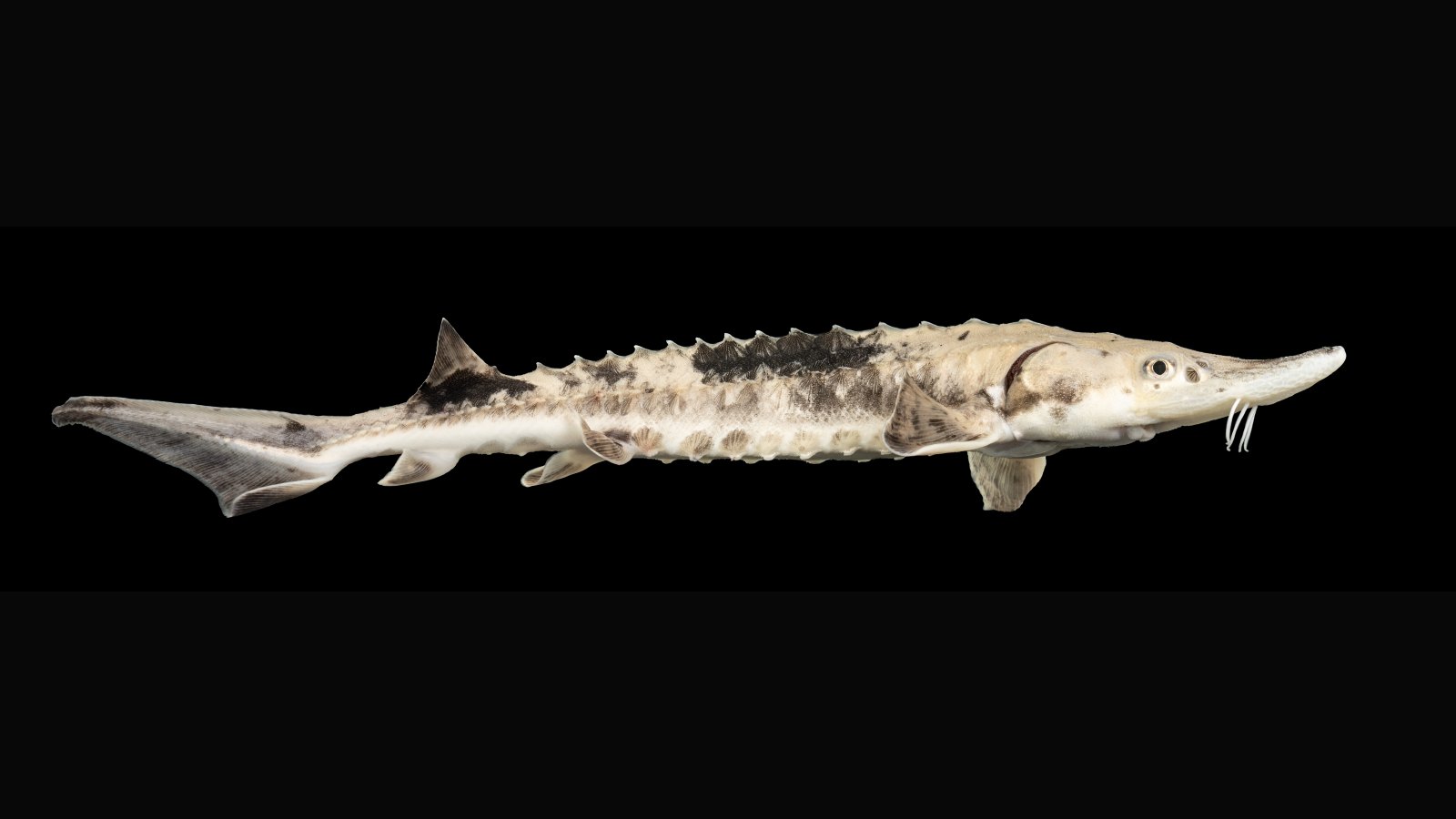
Lake sturgeon (Acipenser fulvescens) are a member of Acipenseridae, the sturgeon family -- a lineage that predates most of the freshwater fish on this site by about 100 million years. They are not, strictly speaking, bony fish in the modern sense; their skeletons are mostly cartilage, and the prominent external structures are five longitudinal rows of bony plates called scutes.
Identification cues, in order of usefulness:
- Heterocercal tail -- the upper lobe is markedly longer than the lower, shark-style. No other Great Lakes fish in the SHA-tracked set has this tail shape.
- Five rows of scutes -- one along the back, two along the sides, two along the belly. Scutes are pronounced on juveniles and soften with age.
- Four barbels in a row in front of the mouth, used for chemoreception.
- Subterminal mouth -- the mouth opens under the chin, oriented downward for benthic feeding. Highly extensible; functions as a vacuum.
- Coloration -- slate gray to olive-bronze on the back, paler underneath. Juveniles often darker and more strongly mottled.
- Cone-shaped snout -- blunt and slightly upturned at the tip.
An adult lake sturgeon looks like no other fish in the watershed. Mistaking it for anything else is unlikely once the heterocercal tail is visible.
Range & abundance in the Alley
Where in the SHA region they live and where they're best targeted.
Lake sturgeon are native to the Great Lakes basin, the Mississippi River drainage, and the Hudson Bay drainage -- effectively all of the inland North American freshwater systems that were once connected through Pleistocene glacial lakes. In the Lake Erie tributary set, lake sturgeon were historically present in the Cuyahoga, Maumee, Sandusky, Black, Ashtabula, Grand (OH), and most of the smaller Erie tribs.
By the early 1900s, three pressures had reduced the Lake Erie sturgeon population to functionally extinct:
- Commercial harvest. Sturgeon were a major Great Lakes commercial fishery from the 1860s onward -- caviar, oil, and smoked meat were all valuable. Harvests peaked above 8 million pounds per year basin-wide before the population collapsed.
- Water pollution. The same industrial-revolution forces that famously set the Cuyahoga on fire in 1969 eliminated water-quality conditions sturgeon required.
- Dams. Spawning runs to upstream gravel were blocked, eliminating successful recruitment for the affected stocks.
The current Lake Erie population is small but slowly rebuilding. Active reintroduction programs operate on the Cuyahoga River (Ohio), Maumee River (Ohio), and select New York Lake Erie tributaries. The Lake Ontario / St. Lawrence population is better established and supports a limited fishery in some Canadian waters.
Outside the Great Lakes, lake sturgeon range extends through Hudson Bay drainages and the Mississippi River system. Wisconsin's Lake Winnebago system holds the largest extant U.S. lake sturgeon population and supports a tightly managed harvest season.
Seasonal calendar
Month-by-month: when they bite, spawn, hide, or run.
| Window | What's happening |
|---|---|
| April-June | Spawning run upstream to gravel and rock bottoms. Triggered by water temps 53-65 degF. Adults migrate sometimes 100+ miles. Most accessible window for encounters. |
| June-August | Post-spawn return to deeper holdover habitat. Adults settle into cool lake bottoms or deep river pools. |
| September-October | Pre-winter feeding. Adults remain in deep habitat; juveniles continue summer growth. |
| November-March | Winter holdover. Minimal movement; sturgeon remain in deep cool habitat. |
Reintroduction stockings on the Cuyahoga have happened in October (per the 2024 pilot and the October 2025 release) -- a deliberate timing choice that lets fingerlings establish in cool early-fall conditions before winter.
Spawning & life cycle
Reproduction biology, age curves, lifespan, behavioral phases.
Lake sturgeon are the slowest-developing freshwater fish in North America. The life-history math:
- Female sexual maturity: approximately 25 years old (varies 20-30 by latitude).
- Male sexual maturity: approximately 15 years old.
- Spawning interval: females spawn every 4-6 years, not annually.
- Eggs per female: 100,000-700,000 -- sticky, attach to rocks or gravel.
- Growth: ~14 inches at age 5, ~40 inches at age 20, ~60 inches at age 50.
- Lifespan: 100+ years routine; documented individuals exceed 150 years.
The implications for management: a sturgeon released today as a 12-inch fingerling will not contribute eggs to the next generation for 25 years. This is why reintroduction plans are scoped over multi-decade horizons. The ODNR Cuyahoga River Lake Sturgeon Reintroduction Plan targets a self-sustaining 1,500-adult spawning population by 2049 -- a 25-year horizon that reflects the species' own developmental timeline.
The corollary: every adult lake sturgeon in the Great Lakes today was either born before the modern conservation era or is the product of a relatively recent reintroduction effort. The species cannot afford the casual mortality that other game fish absorb without notice.
Diet & forage
What they eat at each life stage; key forage species.
Lake sturgeon are benthic invertebrate specialists. The subterminal mouth is highly extensible, functioning as a vacuum that extracts prey from the substrate. Four barbels in front of the mouth detect prey by chemoreception. Lake sturgeon are not primarily piscivorous -- they will take small fish opportunistically but the bulk of the diet is invertebrate.
Common prey items:
| Food | Notes |
|---|---|
| Crayfish | Major component; soft-shell stages especially. |
| Snails and mussels | Benthic mollusks of all sizes; the powerful crushing apparatus handles shells most fish can't. |
| Mayfly and caddisfly larvae | Hex emergence (Hexagenia) on rocky bottoms is a known sturgeon target. |
| Aquatic worms | Including leeches and other soft-bodied invertebrates. |
| Small fish | Opportunistic; gobies, sculpins, juvenile yellow perch, etc. |
| Insect drift | Drifting insect material, especially during emergent windows. |
Active feeding occurs primarily in low-light hours -- dawn, dusk, and overcast days. Lake sturgeon do not generally chase prey; they patrol bottom habitat and vacuum what they encounter.
Behavior patterns
Daily rhythm, weather response, water temp tipping points.
Lake sturgeon behavior is conservative -- the species has invested heavily in longevity rather than productivity, and its behavioral patterns reflect that bet. Day-to-day, sturgeon are slow-moving, sedentary, and predictable in their use of deep cool habitat.
Notable behavioral signatures:
- Spawning migration. The major exception to general sedentary behavior. Adults move upstream substantial distances (sometimes 100+ miles) to access historical gravel/rock spawning habitat.
- Low-light activity. Most feeding occurs at dawn, dusk, and on overcast days. Daylight is mostly rest.
- Repeat use of habitat. Individual sturgeon tend to return to the same holdover and spawning sites year after year, which is one reason habitat disruption is so harmful to local populations.
- Telemetry data on the Cuyahoga pilot (2024 release of ~60 transmitter-tagged juveniles) is informing current understanding of how reintroduced fingerlings use the recovering watershed.
Today's conditions read for Lake Sturgeon
Live from the river network. Pulled at page load — refresh for the latest.
Today's read for Lake Sturgeon is editorial-only — no temp window has been calibrated yet for the dynamic feed.
Alley Index today: 93 (Excellent) · Lake Erie surface: 75.6°F
Habitat preferences
Pool / run / riffle, depth, structure, cover, current speed.
Lake sturgeon habitat requirements are specific and relatively non-negotiable. The species needs:
- Cool water -- preferred range 50-65 degF; sustained temps above 70 degF become stressful.
- Hard bottoms -- gravel, cobble, and bedrock substrate for both adult holdover and spawning. Sand-and-mud benthic habitat does not support successful recruitment.
- Open passage to spawning grounds -- dam blockages eliminate successful spawning runs above the dam.
- Sediment-free spawning gravel -- egg adherence requires clean substrate; sediment burial significantly reduces survival.
- Sufficient depth -- adults use water 15-30+ feet deep for daily holdover.
The Cuyahoga reintroduction sites were selected for habitat suitability across each river reach:
- Rivergate Park, Cleveland -- lower-river deep-channel habitat near the harbor; provides immediate connectivity to Lake Erie for adult dispersal.
- Boston Store Trailhead, Cuyahoga Valley NP -- middle-river protected habitat within the National Park system.
- Cascade Valley Metro Park, Akron -- upper-river site below the Gorge Dam (whose removal is in progress per the Free the Falls work).
How locals fish for it
Editorial — DJ + community on signature presentations.
Cuyahoga River, Ohio. Active reintroduction program (see the Cuyahoga Recovery Story for full treatment). 2024 pilot, October 2025 release of 2,000 fingerlings at three sites, 20-year plan targeting a self-sustaining population by 2049.
Maumee River, Ohio. Lake Erie's largest sturgeon historic stronghold; active recovery work continues. The Maumee population is the foundation of the species' Lake Erie comeback.
Niagara River, NY/Ontario. Native population persists at small numbers; spawning surveys ongoing.
Lake Winnebago, Wisconsin. Not a SHA tracked water, but the relevant out-of-region reference -- this is the largest extant U.S. lake sturgeon population and supports a tightly-managed sport harvest under DNR oversight. The Winnebago model has informed management thinking across the basin.
Lake Ontario / St. Lawrence River. The eastern Lake Ontario population is in better shape than the Lake Erie population. NYSDEC operates recovery work in cooperation with Canadian agencies. A limited St. Lawrence permit-only sport fishery exists.
Reportable lake sturgeon encounters -- especially of PIT-tagged fish from the Cuyahoga and Maumee programs -- contribute meaningfully to monitoring datasets. Photo the tag if possible, note the location and date, and release without delay.
Local lore & storied waters
Specific Alley waters, history, ethics, traditions.
Lake sturgeon are the Great Lakes' oldest residents in two senses. First, the species predates the Pleistocene glaciations that carved out the lakes -- sturgeon as a family have existed on Earth for roughly 200 million years, longer than the trout, perch, walleye, salmon, or any other modern Great Lakes resident. Second, individual lake sturgeon outlive every other freshwater fish on the continent; documented individuals exceed 150 years.
The cultural relationship:
- Indigenous Great Lakes peoples -- including the Ojibwe, Menominee, Haudenosaunee, and others -- have deep cultural ties to lake sturgeon, including ceremonial harvest, traditional management, and place-based knowledge that has informed modern recovery work.
- The 1860-1900 commercial-harvest era -- Sturgeon were initially considered a nuisance bycatch in the commercial whitefish + walleye fisheries, then rediscovered as caviar and oil sources. The basin-wide harvest peaked above 8 million lbs/year and collapsed the population within forty years.
- The 1969 Cuyahoga fire -- The same watershed that hosted the iconic image of industrial pollution is now hosting the iconic story of reintroduction. The story-arc is hard to miss.
- "The original Great Lakes fish." -- Among conservation biologists, lake sturgeon are commonly framed as the keystone species whose presence (or absence) indicates whether a watershed has truly recovered.
If you encounter a lake sturgeon in any SHA-tracked water, you are seeing a fish whose ancestors saw the glaciers retreat. Act accordingly.
Regulations & ethics
OH/PA/NY/Ontario regs, slot limits, season dates, C&R.
| Authority | Rules of note |
|---|---|
| Ohio (ODNR) | STATE-ENDANGERED. Strictly catch-and-release. Possession is illegal. Any incidental catch must be released immediately and unharmed. PIT-tagged fish from the Cuyahoga + Maumee reintroduction programs should ideally be photographed and reported to ODNR. |
| Pennsylvania (PFBC) | State-endangered. Strictly catch-and-release; possession illegal. |
| New York (NYSDEC) | Threatened. Lake Erie-strain population strictly protected. A limited St. Lawrence River sport fishery operates under special permit; Lake Erie waters are catch-and-release only. |
| Ontario (MNRF) | Varies by Fisheries Management Zone; consult Ontario regulations. Some Canadian waters allow a tightly-managed harvest under tag-and-permit systems. |
| Wisconsin (Lake Winnebago) | For reference: WI operates a tightly-managed Lake Winnebago harvest with a permit system. Not applicable to Lake Erie waters but useful comparative context. |
The catch-and-release protocol when incidental catch occurs:
- Do not lift the fish vertically. Heavy bodies + cartilaginous skeletons are vulnerable to internal damage.
- Keep the fish in the water. Photograph quickly, with the fish supported horizontally if possible.
- Photograph any visible PIT tag for monitoring contribution.
- Release without delay.
- Report the encounter to ODNR (Ohio) or NYSDEC (New York), especially if a tag is visible.