Walleye are the polite ghosts of the Great Lakes basin -- present in numbers that anglers find genuinely consoling, active mostly at dawn, dusk, and the sort of overcast afternoons one mistakenly identifies as unfishable. Bring your most reasonable jig and a low-light tolerance.
Walleye


Identity & ID
Who this fish is, how to ID, world & state records.
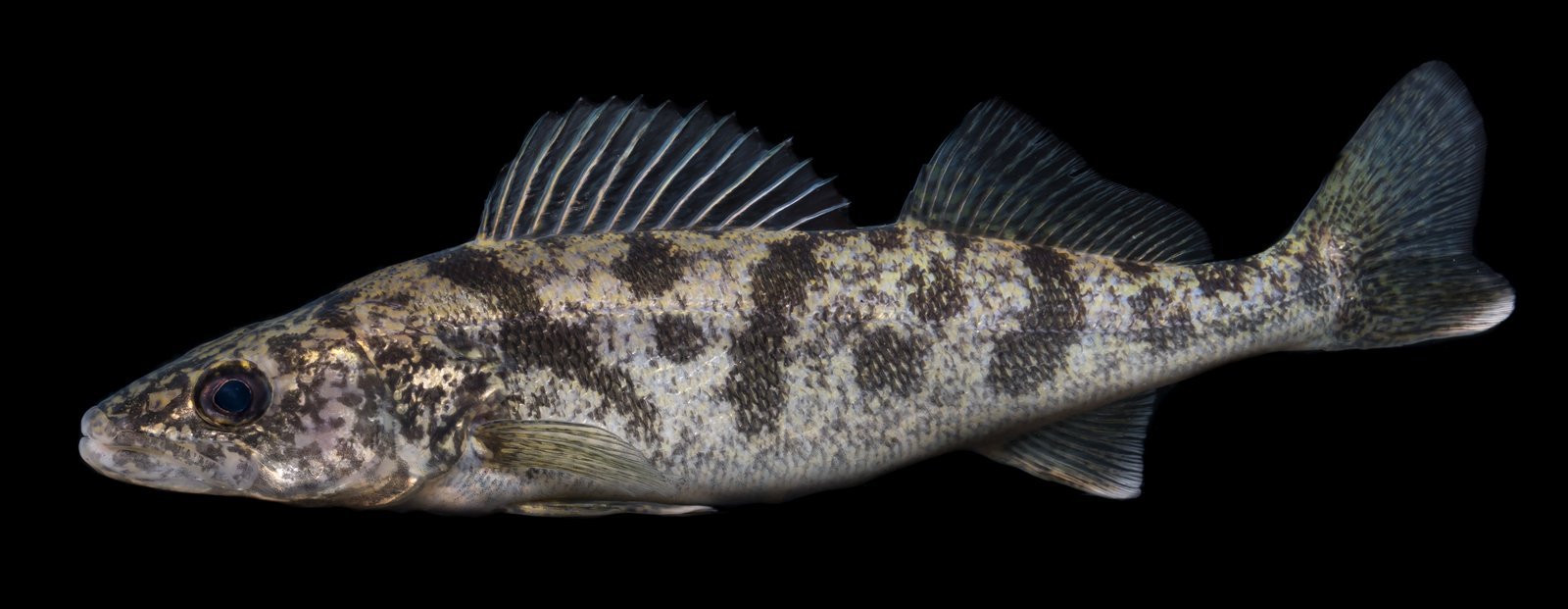
Sander vitreus — the largest member of the perch family. Olive-gold sides shading to white belly, a dark-spotted dorsal with a bold black blotch on the rear of the first dorsal, and the trademark tapetum lucidum: that reflective layer in the eye that lets walleye see in low light and gives them their name. Walleye eyes are spooky to look at — they shine like cat eyes in a flashlight beam.
Distinguishing walleye from sauger (the smaller cousin): walleye have white tips on the lower lobe of the tail and anal fin; saugers have spotted dorsals throughout (not just the rear blotch). Hybrids exist where ranges overlap; in Erie they're rare.
Size: 15-inch fish are common; 20+ inches "good"; 28+ inches is a wall fish; 30+ inches is a serious trophy. Most Lake Erie limit-class fish are 18-24 inches.
Walleye (Sander vitreus) — the milky tapetum lucidum is the namesake. — Sam Stukel, USFWS · Gavins Point National Fish Hatchery (Public Domain)
Range & abundance in the Alley
Where in the SHA region they live and where they're best targeted.
Lake Erie is the engine. The lake supports the largest walleye population on Earth — recent estimates put adult biomass at over 100 million fish. The western basin (Toledo to Sandusky, plus the islands) is shallow, warm, productive, and produces the spring tributary spawning runs. The central basin (Sandusky to Erie, PA) is deeper and the summer drift-fishing zone. The eastern basin (Erie, PA → Buffalo, NY) is the deepest and produces fewer but often larger fish through summer and fall.
Lake Ontario walleye numbers are an order of magnitude lower; significant fisheries on Bay of Quinte, Niagara River below the falls, and tributaries (Black River, Salmon River system).
Inland: Pymatuning Lake (PA/OH border), Mosquito Lake (OH), Berlin Reservoir (OH), Chautauqua Lake (NY), Pleasant Hill Lake (OH), and the Allegheny River system.
Tributary spawning runs dominate spring news cycles: Maumee River (OH) is the headline run — millions of walleye stage and run during March-April. Sandusky River (OH) is a close second.
Seasonal calendar
Month-by-month: when they bite, spawn, hide, or run.
| Month | What is happening |
|---|---|
| March | Pre-spawn staging. Fish move into trib mouths and lower river miles. Maumee River run begins as water hits 38-40°F. Ice-out fishing on Erie's western basin. |
| April | Spawn peak. Maumee, Sandusky, Cuyahoga, and Ontario tribs run hot. Jig + minnow combos rule. Erie western basin trolling begins as fish drop back. |
| May | Post-spawn recovery. Fish disperse onto reef structure. Crawler harness season opens. |
| June | Western basin reef fishing. Best for double-hook crawler-harness rigs trolled at 1.0-1.4 mph over 18-32 ft of water. |
| July | Central basin focus shifts. Fish suspend over deep mud bottoms (45-65 ft) chasing emerald shiner. Trolling crankbaits behind planer boards is the play. |
| August | Same central-basin pattern, slightly deeper. Hot, calm, often fantastic. |
| September | Schools begin to relocate. Bait migrations trigger feeding. Mid-depth (35-50 ft) trolling. |
| October | Fall move. Fish push into eastern basin and onto rock structure. Big-fish window. |
| November | Trophy season. 10-14 lb fish caught from shore on jerkbaits and through ice in eastern basin. Casting from piers (Lorain, Huron, Erie PA). |
| December–February | Ice fishing on the western basin (when ice is safe — variable). Niagara River below falls is open year-round, hot in winter. |
Spawning & life cycle
Reproduction biology, age curves, lifespan, behavioral phases.
Sexual maturity: females 4-5 years, males 3-4. Spawning: water temp 42-50°F. Migration to gravel/rock-bottomed shoreline or trib runs. Females broadcast eggs over rock or gravel; no parental care. A single 10 lb female can release 500,000 eggs. Hatch in 12-18 days depending on temp.
Fry feed on copepods → adult walleye are piscivorous within 60 days, primarily on yellow perch, emerald shiner, and (in our region) round goby. Lake Erie walleye grow rapidly — 12 inches in 2 years, 20 inches in 5-6 years, 28+ inches in 8-10 years. Lifespan 15-20 years for females; males rarely exceed 12. The trophy fish in Erie are almost all 8+ year-old females.
Diet & forage
What they eat at each life stage; key forage species.
Adult walleye are obligate piscivores — they eat fish, period. In Lake Erie:
| Food | Why it matters |
|---|---|
| Emerald shiner | The foundation forage. Walleye reproduction success in Erie tracks emerald shiner abundance. |
| Yellow perch | Large component of the diet, especially of adult walleye 18+ inches. |
| Round goby | Invasive, now a major forage. Goby-imitating crankbaits explode walleye fishing in 2010s. |
| Gizzard shad | Central basin schools. |
| alewifeAlewife | Lake Ontario component, less prominent in Erie. |
| White suckers, smelt | Secondary. |
Color matters in stained water (chartreuse, orange, fire-tiger) and natural patterns shine in clear water (purple, gold-and-black, perch). Walleye's tapetum lucidum lets them see better than any other game fish in low-light and stained water — they win in conditions that disadvantage their prey.
Behavior patterns
Daily rhythm, weather response, water temp tipping points.
Walleye are crepuscular — most active at dawn, dusk, and through the night. The classic Erie walleye angler fishes the "walleye chop" (15-mph wind, choppy 2-3 ft seas) on overcast afternoons because the broken light + suspended particulate puts walleye on the feed all day. Glass-calm bluebird days collapse the bite to a 90-min dawn window.
Water temp tipping points
| Rule | Detail |
|---|---|
| 32-42°F | Pre-spawn staging. Slow vertical jigging. |
| 42-50°F | Spawn. Aggressive bite in tribs. |
| 50-60°F | Post-spawn recovery → reef season. |
| 60-72°F | Prime summer. Crawler harness, trolling, deep crankbaits. |
| 72-78°F | Deeper structure (mud bottom basin), thermocline trolling. |
| Above 78°F | Hot summer; fish go deep and lethargic except dawn/dusk. |
Pressure
Falling pressure ahead of fronts triggers some of the best bites of the year. Stable high pressure with clear skies = grind it out at dawn or after dark.
Today's conditions read for Walleye
Live from the river network. Pulled at page load — refresh for the latest.
Prime water-temp window for Walleye is 50–70°F. 4 rivers are sitting in the window — fishable on multiple options today. Lake Erie surface is 75.9°F — warm-water summer pattern in effect.
Rivers in Walleye's prime water-temp window today
| River | Water temp | Flow | Clarity |
|---|---|---|---|
| Ashtabula River | 54.3°F | 75 cfs | Clear |
| Elk Creek | 55.6°F | 9 cfs | Clear |
| Twenty Mile Creek | 55.6°F | 15 cfs | Clear |
| Crooked Creek | 55.6°F | 4 cfs | Clear |
Alley Index today: 97 (Excellent) · Lake Erie surface: 75.9°F
Habitat preferences
Pool / run / riffle, depth, structure, cover, current speed.
Three structure types dominate Erie walleye fishing:
| Water type | Why fish hold here |
|---|---|
| Rock reefs and shoals | Pre-spawn and post-spawn (April-June). Fish use rocks for spawning + ambush points. |
| Mud-bottom open basin | Summer-through-fall (June-October). Fish suspend over depth chasing pelagic baitfish. |
| Trib mouths and lower rivers | Spawn (March-April) and fall stage (October-November). |
In the central and eastern basins, walleye relate strongly to thermocline depth in summer — find the thermocline (usually 40-65 ft), troll just above it, get bit.
How locals fish for it
Editorial — DJ + community on signature presentations.
Maumee River jig run. Late March to mid-April. Drift a chartreuse twister-tail jig (1/2 oz) tipped with a 4-inch shiner through the run. Crowd-shoulder fishing — public access at Side Cut Metropark, Buttonwood, and Orleans Park. The fish are stacked.
Crawler harness trolling. Erie summer staple. Two-hook harness with a Colorado or willow blade in the 3-5 size, behind a bottom-bouncer (1-3 oz depending on depth), trolled at 1.0-1.4 mph. Live nightcrawlers nose-hooked. Cover water until you find a school.
Deep-diving crankbaits. Reef Runner 800, Bandit Walleye Deep, Berkley Flicker Minnow — trolled behind planer boards in the central basin July-September at 1.8-2.2 mph at depths from 25-65 ft. Goby and perch patterns dominate.
Casting jerkbaits from shore. Late October to December — Lorain, Huron, Erie PA piers. Husky Jerk, Rogue, X-Rap. Twitch-pause cadence, nights and overcast days.
Jigging through ice. Western Erie reefs when safe ice forms (variable). Jigging Rapalas, Buckshot Rattle Spoons, perch-pattern lures. Bring a flasher.
Local lore & storied waters
Specific Alley waters, history, ethics, traditions.
Maumee Bay and the river's lower 20 miles host the most concentrated freshwater walleye spawn run in North America. April weekends look like a parade — boats stacked at Buttonwood, anglers shoulder-to-shoulder at Side Cut.
Bass Islands (South Bass / Put-in-Bay) are the hub of the world-class summer walleye fishery. Charter boats run from Catawba, Port Clinton, and Lakeside.
Pymatuning Reservoir (PA/OH) is an inland walleye factory — produces some of PA's best ice fishing.
Niagara River below the falls (NY) is winter-open year-round and produces big fish in cold water through Feb-April.
Ethics
Walleye are commercial-grade table fish, and the bag-limit conversation is real. Most regulations encourage keeping smaller eaters and releasing trophies — a 28+ inch female releases 500,000 eggs annually; she's a population bank. The "slot" concept (release fish in the trophy slot) is conservation in action.
Regulations & ethics
OH/PA/NY/Ontario regs, slot limits, season dates, C&R.
| Authority | Rules of note |
|---|---|
| Ohio Lake Erie | 15-inch minimum, 6 fish daily, year-round. (Limits adjusted annually based on Lake Erie Committee assessment — confirm.) |
| Pennsylvania Lake Erie | 15-inch min, 6 daily, year-round. |
| New York Lake Erie | 15-inch min, 6 daily, year-round. |
| Ohio inland | Varies; commonly 15-inch min, 4-6 daily; closed seasons on some waters. |
| PA inland | 15-inch min, 6 daily; closed season Mar 15 - first Saturday in May. |
| NY inland | 15-inch min, 5 daily; closed season Mar 16 - first Saturday in May. |
Maumee River + Sandusky River walleye runs have special regulations during the spawning season (typically March 1 - May 1) — single hook only, no possession of females during peak spawn periods, etc. Always check ODNR before fishing the Maumee run.
From the Archive · Other Species
The Walleye Story
Erie's economic engine before it was anyone's sport fishery — and the management apparatus that survived its collapse and now sustains the steelhead.
Before there was a steelhead fishery, there was a walleye fishery — the largest freshwater walleye industry in North America. The lakeside towns now full of charter boats and tackle shops were, two ge...
Read the chapter →