Alewife Life Cycle: The Lake Erie Forage That Isn't
Alewife (Alosa pseudoharengus) is the iconic Great Lakes baitfish in Lake Michigan and Lake Ontario salmonid literature -- in those systems it is the documented forage anchor for trout and salmon. In Lake Erie, the GLFC 2004 Coldwater Task Group steelhead diet study reached a different conclusion: "Conspicuous was the lack of alewife in steelhead diets." This pillar walks alewife egg through adult, explains why the species is iconic in the upper lakes but not in Erie, and is explicit that surfacing alewife-specific commerce on a Steelhead Alley site would not honor the source-evidence.
TL;DR -- if you only read one block
What this pillar is for
This is an honest-education pillar, not a buy-this-pattern pillar. SHA is building toward an authoritative Lake Erie steelhead forage library, and that library has to honor what the source-evidence actually says -- including when it says a species is absent. Alewife is iconic in Great Lakes salmonid literature. Anglers who fish Lake Ontario tributaries (Salmon River, Genesee, Oak Orchard, Sandy Creek) and anglers who fish the Lake Michigan / Lake Huron salmon fishery hear about alewife constantly: it is the documented forage that built those fisheries. Anglers who come to Lake Erie carrying that vocabulary often assume the same coupling applies here. It does not.
The GLFC 2004 Coldwater Task Group sampled 349 steelhead stomachs across Lake Erie basins for their diet study; 250 stomachs (72%) contained at least one food item. The dominant prey-fish energy source was emerald shiner at 47.7% frequency / 57.71% biomass in West Central Basin June-October (overall species-confirmed). Combined with unidentified Notropis spp. in the same family, the shiner group hit 67.5% frequency / 70.47% biomass. Rainbow smelt sat second at approximately 24% biomass. Round goby and juvenile yellow perch filled the remainder of the documented prey-fish set. Alewife was effectively absent. The report's direct Lake Erie wording -- preserved here verbatim -- is: "Conspicuous was the lack of alewife in steelhead diets." Alewife is "not a key component" of Lake Erie steelhead diets at the documented sampling scope.
That single finding is the load-bearing claim for everything below. The rest of this article is biology, history, and the honest framing of why a fish that is established in Lake Erie for nearly a century, that boomed to record highs in 2024, and that anglers know from upper-lakes literature, is nevertheless not a commerce-surface-worthy forage target for Steelhead Alley.
Primary anchor: GLFC Lake Erie Committee Coldwater Task Group, "An Analysis of the Diet of Steelhead Trout in Lake Erie" (~2004 final report) -- Tier 1
Identity
- Common name: Alewife (plural: alewives). Atlantic anadromous range also uses "river herring", "sawbelly", "gaspereau". Great Lakes context is generally just "alewife".
- Scientific name: Alosa pseudoharengus (Wilson, 1811). Formerly classified as Pomolobus pseudoharengus.
- Family: Clupeidae (herrings) per USFWS / USGS NAS / Virginia DWR consensus. Some modern taxonomic treatments place Alosa in family Alosidae (river herrings + shads); Clupeidae remains the dominant federal-source classification.
- Order: Clupeiformes.
- USGS NAS SpeciesID: 490.
- Native range: Atlantic Coast Red Bay Labrador to South Carolina, plus many landlocked populations. Great Lakes populations are introduced.
- Great Lakes introduction history: Lake Ontario 1873, Lake Erie 1931, Lake Huron 1933, Lake Michigan 1949, Lake Superior 1954.
- Working scope for this article: species-level, Lake Erie focus. Lake Ontario applicability (where alewife is far more abundant and a documented salmonid forage anchor) requires separate citation and is explicitly OUT OF SCOPE here.
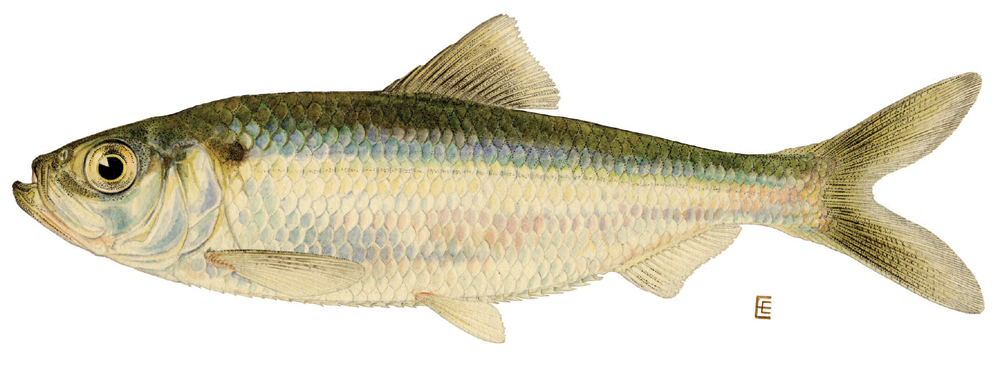
Identification field marks per USGS NAS: silvery sides with a greenish back -- the classic clupeid profile. Large eye. Single dorsal fin. Deeply-forked tail. Body laterally compressed (sawbelly origin). The Lake Erie inland landlocked size class typically stays under 25 cm (9.84 in / 250 mm); the marine maximum reaches 38 cm (14.9 in / 380 mm).
Sources:
USGS Nonindigenous Aquatic Species, Alewife (Alosa pseudoharengus) species profile, SpeciesID 490 -- Tier 3
USFWS Ecological Risk Screening Summary, Alosa pseudoharengus (July 2025) -- Tier 3
Lifecycle stage 1: Egg
Stage summary: Open-water broadcast spawning when surface water temperatures exceed approximately 15 deg C (59 deg F); demersal eggs (sink to bottom); no parental care; 10,000-360,000 eggs per female (typically lower end of that range).
Timing. Per USGS NAS, alewife spawn for approximately one month when water temperatures exceed about 15 deg C (59 deg F). In Lake Erie that thermal trigger generally lines up with late spring through early summer (May into June) in the basin -- but note that 59 deg F is also right at the warmwater-transition threshold where steelhead and trout targeting yields to warmwater species. Alewife spawning concentrates in a thermal window where coldwater anglers have largely shifted off the lake. [source-required] for specific Lake Erie tributary-mouth alewife spawning dates by named river; the USGS NAS spawning description is general to the species.
Habitat. This is the load-bearing distinction. Per USGS NAS, alewife "spread out across a lake staying in warmer waters above the thermocline; disperse shoreward at night to spawn near the surface of open lake shores, bays, harbors, and lower reaches of rivers." Read that geography carefully: open lake shores, bays, harbors, and lower reaches of rivers. The only river-adjacent language is "lower reaches" -- the area near the lake mouth, not the upstream mainstem where steelhead concentrate. This is not the Atlantic-coast anadromous alewife model where massive spring runs push miles into freshwater tributaries. Lake Erie landlocked alewife stay in or very near the lake.
The contrast with Atlantic anadromous alewife. Atlantic-coast alewife runs are a documented spring phenomenon -- dense schools push into freshwater tributaries to spawn, and that biomass injection drives a whole spring fishing culture along the Eastern Seaboard. That model does NOT transfer to Lake Erie landlocked populations. The Steelhead Alley tributaries (Conneaut, Chagrin, Rocky, Grand, Vermilion, Cattaraugus, Elk, Walnut, etc.) do not host documented alewife runs at any Tier 1-3 source surfaced in our reference set.
Predator encounter notes. Eggs are demersal and broadcast over open-lake substrates. They are not in the documented Lake Erie steelhead prey set per GLFC 2004. Egg-stage predation by yellow perch and other nearshore panfish is plausible but [source-required] at the Tier 1-3 level for alewife specifically.
Source-status labels for this stage: spawning temperature trigger (>15 deg C) is source-backed via USGS NAS; spawning habitat (open lake shores / bays / harbors / lower river reaches) is source-backed via USGS NAS; egg counts (10,000-360,000) are source-backed via USGS NAS; specific Lake Erie tributary spawning dates are source-required; egg-stage predator selectivity is source-required.
Source for this stage:
USGS Nonindigenous Aquatic Species, Alewife species profile -- Tier 3
Lifecycle stage 2: Larva / hatch
Stage summary: Hatched larvae are roughly 3.8 mm average; transparent; weak swimmers; drift in nearshore shallows; transition to zooplankton feeding within days to weeks.
Size. USGS NAS reports larval hatch size at approximately 3.8 mm average. Larval / post-larval growth is rapid in summer -- by autumn of their first year, age-0 alewife are large enough to dominate clupeid abundance metrics in trawl surveys.
Habitat. Larval alewife use nearshore shallows and embayment nursery zones as initial habitat. As they grow into the juvenile stage, they begin participating in the broader pelagic vertical-migration pattern that defines alewife behavior.
Predator encounter notes. Larval alewife are below the gape limit of adult steelhead and are not in the GLFC 2004 documented prey items at the Lake Erie sampling scope. They are vulnerable to yellow perch fry, juvenile smallmouth, and other shallow-water planktivores. Quantitative Lake Erie selectivity is [source-required] at Tier 1-3.
Source-status labels for this stage: larval hatch size (3.8 mm) is source-backed via USGS NAS; zooplankton-feeding transition is source-backed via general clupeid life-history; Lake Erie tributary-mouth larval nursery use is source-required; larval predator selectivity is source-required.
Source for this stage:
USGS Nonindigenous Aquatic Species, Alewife species profile -- Tier 3
Lifecycle stage 3: Juvenile (Age 0 / Age I)
Stage summary: Age 0 young-of-year by autumn of their first summer. Age I by their second summer. In Lake Erie, this is the size class that drives clupeid abundance metrics -- and the size class that crashed in 2025.
The 2024 / 2025 inflection. Per the GLFC Lake Erie Forage Task Group March 2025 report (Tier 1, covering 2024 data): in 2024, age-0 alewife accounted for 94% of NY clupeid abundance and 99% of Ontario clupeid abundance. That is an enormous YOY pulse -- second highest in the Ontario time series, highest in the NY time series. Per GLFC FTG March 2026 (Tier 1, covering 2025 data): the next year, 2025 alewife age-0 and age-1+ abundance declined drastically; West Basin 2025 surveys captured NONE. The 2025 collapse is attributed to a major winter die-off. This is the kind of volatility that makes long-term diet-selectivity analysis hard to anchor.
Habitat. Per USGS NAS, alewife show a seasonal vertical-migration pattern that is characteristic of the species:
- Spring: littoral zone (nearshore shallows, in the spawning thermal window).
- Summer: epilimnion (upper warm layer above the thermocline).
- Winter: profundal zone (deeper, colder waters).
That vertical-migration profile puts alewife in the upper warm water for most of the open-water season -- which structurally separates them from the coldwater pelagic zones where Lake Erie steelhead concentrate in summer holding patterns. The thermal mismatch is part of why alewife and Lake Erie steelhead occupy different water columns most of the year.
Substrate preference. Per USGS NAS, alewife prefer rocky substrates over sandy when nearshore.
Predator encounter notes. Historical USGS year-class records (1959 / 1960) document YOY walleyes in extreme western Lake Erie feeding on gizzard shad and alewives in summer, with young alewives dominant in fall walleye diet. These are historical-era observations; current adult Lake Erie walleye quantitative alewife selectivity is [source-required]. For steelhead, even at the 94%-of-NY-clupeids 2024 pulse, alewife did not register as a significant Lake Erie steelhead diet item per the GLFC 2004 baseline -- and there is no published update to the 2004 diet study that we can cite as an alewife-specific update.
Source-status labels for this stage: 2024 age-0 dominance (94% NY, 99% Ontario) is source-backed via GLFC FTG March 2025; 2025 West Basin zero-capture is source-backed via GLFC FTG March 2026; vertical-migration pattern is source-backed via USGS NAS; historical YOY walleye-on-alewife is source-backed via USGS publications 1000477 + 1000480; current adult walleye / steelhead alewife selectivity is source-required.
Sources for this stage:
GLFC Lake Erie Forage Task Group, March 2025 (covering 2024 data) -- Tier 1
GLFC Lake Erie Forage Task Group, March 2026 (covering 2025 data) -- Tier 1
USGS Nonindigenous Aquatic Species, Alewife species profile -- Tier 3
USGS publication, "Food of young-of-the-year walleyes in Lake Erie" (historical) -- Tier 3
USGS publication, "Selective food preferences of walleyes of the 1959 year class in Lake Erie" (historical) -- Tier 3
Lifecycle stage 4: Adult
Stage summary: Adult Lake Erie alewife are inland-form landlocked clupeids, typically less than 25 cm (9.84 in). They participate in the seasonal vertical migration: littoral spring spawning, epilimnion summer, profundal winter.
Size. Per USGS NAS:
- Marine maximum: 38 cm (14.9 in / 380 mm).
- Inland populations (including Lake Erie): typically less than 25 cm (9.84 in / 250 mm). Lake Erie alewife stays in this smaller landlocked range.
For predator-encounter context the relevant Lake Erie size band is roughly 2-9 in (YOY through landlocked adult). That overlaps the same band as emerald shiner and rainbow smelt -- which is exactly why a generic baitfish streamer pattern covers all three species visually, and why a dedicated alewife-specific pattern does not add anything to the rotation that the shiner + smelt commerce hook does not already cover.
Habitat. Adult alewife in Lake Erie occupy the same seasonal vertical-migration pattern as juveniles: littoral spring (spawning thermal window >15 deg C), epilimnion summer, profundal winter. Substrate preference when nearshore is rocky over sandy. Open-lake presence is documented in NY and Ontario waters per GLFC FTG trawl surveys; West Basin presence is highly volatile (2024 boom -> 2025 zero).
Predator encounter notes -- the Lake Erie absence. Per the GLFC 2004 Coldwater Task Group steelhead diet study (Tier 1, n=349 steelhead stomachs, 250 with food), the direct Lake Erie conclusion is preserved verbatim: "Conspicuous was the lack of alewife in steelhead diets." Alewife is "not a key component" of Lake Erie steelhead diets at the documented sampling scope. The shiner-dominated forage assemblage (emerald shiner + Notropis spp. at 67.5% frequency / 70.47% biomass overall), rainbow smelt at approximately 24% biomass, and round goby + juvenile yellow perch as secondary items fill the documented Lake Erie steelhead diet.
This is the load-bearing finding for the entire pillar. Alewife is established in Lake Erie. It can be extremely abundant (2024 record high). It is part of the broader pelagic forage assemblage at the population-survey level. And it is absent / negligible in steelhead stomachs at the GLFC 2004 sampling scope. Those three facts are not in contradiction -- they describe a species that exists in the lake but does not couple meaningfully with the documented Lake Erie steelhead diet.
Source-status labels for this stage: size class is source-backed via USGS NAS; vertical-migration pattern is source-backed via USGS NAS; Lake Erie steelhead diet absence is source-backed (Tier 1 GLFC 2004); Lake Ontario salmonid coupling is OUT OF SCOPE for this pillar; brown trout, lake trout, and current-adult walleye selectivity for alewife in Lake Erie are all source-required.
Sources for this stage:
GLFC Coldwater Task Group, "An Analysis of the Diet of Steelhead Trout in Lake Erie" (~2004) -- Tier 1
USGS Nonindigenous Aquatic Species, Alewife species profile -- Tier 3
The Lake Erie absence -- preserve this framing
This is the section that has to land before any commerce surface or downstream content treats alewife as a Lake Erie steelhead pattern target. The GLFC 2004 Coldwater Task Group report is the only Tier 1 Lake Erie steelhead diet study in our reference set, and it is direct about alewife:
-- GLFC Lake Erie Committee Coldwater Task Group, "An Analysis of the Diet of Steelhead Trout in Lake Erie" (~2004), n=349 steelhead stomachs, 250 with food, Lake Erie basins
The report goes further -- alewife is described as "not a key component" of Lake Erie steelhead diets. This is not a "minor diet item" qualification. It is an absence call. The Lake Erie steelhead diet at the 2004 sampling scope was anchored on shiners and smelt, not alewife.
An earlier draft of the alewife forage profile cited a "less than 10-20% biomass" framing for alewife in Lake Erie steelhead diet. A Tier 1 codex audit on 2026-06-23 caught the error: that "less than 10-20%" framing was a Lake Ontario / inter-study comparison that the GLFC 2004 report itself explicitly excludes from Lake Erie. The corrected Lake Erie statement is the verbatim "Conspicuous was the lack of alewife in steelhead diets" wording, preserved above. This pillar is anchored on that corrected reading.
Why the upper-lakes contrast matters. In Lake Michigan, USGS NAS documents that alewife historically dominated the pelagic forage base at 70-90% fish weight in some periods. In Lake Ontario, alewife is the well-documented salmonid forage anchor that built the Pacific salmon stocking fishery and the brown trout / lake trout / steelhead fisheries. Anglers fishing those systems have been trained -- correctly -- to think of alewife as the forage. When they come to Lake Erie carrying that framework, they assume the same coupling applies here. It does not. Lake Erie alewife has historically been smaller in population and has not registered in the documented Lake Erie steelhead diet.
Lake Ontario applicability is OUT OF SCOPE for this pillar. SHA content covering Lake Ontario tributaries (Salmon River, Genesee, Oak Orchard, Sandy Creek systems) should treat alewife with its OWN sourcing, not extrapolate from this Lake Erie article. The Lake Ontario alewife-steelhead coupling is documented in separate literature that we have not surfaced for this profile.
Population volatility -- the 2024 boom and 2025 die-off
Even setting aside the steelhead diet finding, Lake Erie alewife population dynamics are volatile enough on their own to make any forward-looking forage claim difficult.
2024: Per GLFC Lake Erie Forage Task Group March 2025 report (Tier 1), clupeid (Gizzard Shad + Alewife) abundance in Lake Erie was the highest in the NY time series and the second highest in the Ontario time series. Age-0 alewife accounted for 94% of NY clupeid abundance and 99% of Ontario clupeid abundance. That is an enormous YOY pulse -- the kind of pulse that, in Lake Michigan or Lake Ontario, would have shown up in salmonid diet within months.
2025: Per GLFC Lake Erie Forage Task Group March 2026 report (Tier 1), 2025 alewife age-0 and age-1+ abundance declined drastically across NY and Ontario time series. After two years of high alewife abundance (2023-2024), NONE were captured in 2025 West Basin surveys. The 2025 collapse is attributed to a major winter die-off. GLFC notes that alewife die-offs are common in certain Great Lakes areas with severity tied to lake bathymetry, winter weather, and overall abundance -- the Lake Erie shallow West Basin is the type of environment where these die-offs concentrate.
Why this matters for the pillar. Lake Erie alewife is a boom-bust species. Even if a future Tier 1-3 study were to document some steelhead-on-alewife coupling in a high-abundance year like 2024, the next year's collapse would invalidate any pattern-mapping built on that single pulse. SHA content does not surface alewife-specific commerce because the abundance signal is too volatile to anchor a stable commerce hook, and because the GLFC 2004 baseline diet finding (the only Tier 1 Lake Erie steelhead diet study we have) says the coupling did not exist at the documented sampling scope.
Sources for the volatility section:
GLFC Lake Erie Forage Task Group, March 2025 (2024 data) -- Tier 1
GLFC Lake Erie Forage Task Group, March 2026 (2025 data) -- Tier 1
Why this matters for Steelhead Alley anglers
Knowing what alewife is, and knowing what alewife is NOT in Lake Erie, is part of becoming a better-informed Steelhead Alley angler. The practical implications:
- The species exists in the lake. Alewife has been established in Lake Erie since 1931. You may encounter dead alewife along the shore during a die-off year (the spring "alewife on the beach" event in some Great Lakes regions). You may catch alewife as a bycatch on bait rigs. Knowing what they are is part of basic Lake Erie literacy.
- The species is NOT a documented Lake Erie steelhead forage. Per GLFC 2004, alewife was absent / negligible in 349-stomach steelhead diet sampling. The documented Lake Erie steelhead forage is the shiner + smelt + round goby + juvenile yellow perch assemblage. Build your streamer rotation on those species, not on alewife.
- SHA does NOT surface alewife-specific commerce. The existing emerald-shiner and rainbow-smelt commerce hooks cover the Lake Erie baitfish pattern set with Tier 1 source-evidence. Adding an alewife-specific pattern surface would mostly duplicate those entries while adding lower-confidence weight on a less-documented forage. We make that choice explicitly, and this article documents the reasoning.
- If you fish Lake Ontario tributaries, the rules are different. Lake Ontario alewife coupling with steelhead, brown trout, and lake trout is documented separately and is out of scope for this Steelhead Alley pillar. Do not import this pillar's "alewife absence" framing into Lake Ontario content.
- Population status is volatile and changes year-to-year. If a future GLFC FTG report shows another record-high pulse, or a future Lake Erie steelhead diet study updates the 2004 baseline, this pillar will be updated. Until then, treat alewife as an editorial / context entity for Lake Erie food-web discussion, not a commerce-surfaced pattern target.
Curator's Picks
Four patterns from our gear set are included here for forage-assemblage context only -- they are NOT recommended dedicated alewife-pattern targets. The same patterns appear in our emerald-shiner and rainbow-smelt pillars where they ARE source-anchored to documented Lake Erie steelhead diet. The editor context below honors the honest-gap framing.
- Clouser Minnow (white/silver Pearl). Editor context for the alewife pillar: not a recommended dedicated alewife-pattern target. The white/silver/pearl colorway does overlap the silvery clupeid body profile that alewife share with emerald shiner and rainbow smelt, so the same pattern visually covers all three species in the angler's eye. But the GLFC 2004 Lake Erie steelhead diet study (Tier 1) anchors this pattern's relevance to emerald shiner at 47.7% / 57.71%, not to alewife. Surface this product for the documented shiner-imitation work, not as an alewife-specific search.
- Tigofly weighted Zonker streamer. Editor context for the alewife pillar: alewife coloring (silvery sides, greenish back) overlaps the same shiner + smelt visual space that the zonker already covers. There is no dedicated alewife pattern requirement on top of what the shiner + smelt commerce hook already does. Included here for forage-assemblage context only -- the documented Lake Erie steelhead diet anchor for this pattern remains the emerald shiner + Notropis spp. + rainbow smelt cluster per GLFC 2004.
- Articulated Sparkle Minnow. Editor context for the alewife pillar: Lake Erie inland alewife typically run under 25 cm (9.84 in / approximately 9 in max) per USGS NAS, smaller than the marine 38 cm form. If alewife were a documented Lake Erie steelhead forage, this size-class pattern would map to the adult band -- but per GLFC 2004 alewife is "not a key component" of Lake Erie steelhead diet. Surface this pattern for the documented shiner / smelt commerce hook, not as an alewife search.
- Brass beadhead glo-bug + assorted nymph kit. Editor context for the alewife pillar: alewife are clupeid broadcast spawners (10,000-360,000 demersal eggs per female per USGS NAS) in open lake shores, bays, and harbors -- NOT in Steelhead Alley tributaries in any documented sense. There is no egg-pattern-fishing translation for alewife eggs the way sucker spawn drives spring egg patterns in Steelhead Alley tributaries. Included for forage-assemblage entry-level coverage only.
Honest gaps -- what this pillar cannot yet say at Tier 1-3
SHA is building toward an authoritative Lake Erie forage library and is explicit about which claims are NOT yet source-anchored:
- Long-term Lake Erie alewife diet selectivity for steelhead. The GLFC 2004 baseline says alewife is absent / negligible. There has been no subsequent Tier 1 Lake Erie steelhead diet study published in our reference set. Whether 2024-era abundance pulses changed the diet coupling -- temporarily or otherwise -- is not documented.
- Specific Steelhead Alley tributary alewife presence. No Tier 1-3 source surfaced in our audit ties alewife to Conneaut, Chagrin, Rocky, Grand, Vermilion, Cattaraugus, Elk, Walnut, or any other named Lake Erie tributary mainstem use beyond the generic "lower reaches of rivers" USGS NAS spawning-habitat language.
- Brown trout selectivity for alewife in Lake Erie. The GLFC 2004 study covers steelhead specifically. Brown trout extension is
[source-required]. - Lake trout selectivity for alewife in Lake Erie. Lake Ontario lake trout / alewife coupling is well-documented; Lake Erie applicability needs separate citation.
- Current adult Lake Erie walleye quantitative alewife selectivity. Historical 1959-1960 year-class evidence is source-backed but historical. Current adult walleye selectivity needs a contemporary ODNR / GLFC study.
- Predator size-class selectivity. Which predator size targets which alewife age class is not extracted.
- Reproductive aggregation timing at Steelhead Alley tributary mouths. Likely insignificant per USGS NAS open-lake spawning, but no Tier 1-3 negative confirmation exists either.
- Mechanism behind the 2025 die-off. GLFC FTG cites a "major winter die-off" but the specific severity / weather / bathymetric drivers are not parsed.
- Lake Ontario applicability. Explicitly OUT OF SCOPE for this pillar.
- Pattern_match_ref is intentionally NULL. No commerce mapping is declared for alewife in the SHA forage-pattern map. The emerald-shiner and rainbow-smelt mappings cover the Lake Erie baitfish commerce hook with stronger Tier 1 anchors.
If you have access to studies that close any of these gaps, send them to us. The library grows when source-backed evidence does.
Image credits and licensing
This article uses public-domain federal-source imagery. Every image is credited to its source with a link back to the original. Source-cited attribution is part of what we mean by an authoritative library.
- Hero / featured image -- Alewife (Alosa pseudoharengus). Image from USGS Nonindigenous Aquatic Species, Alewife species profile, SpeciesID 490. Federal-source public domain.
If you are a rights-holder and believe an image attribution needs correction, contact us at SHA -- we will fix it promptly.
Full source list
| Source | Tier | Use |
|---|---|---|
| GLFC Coldwater Task Group, "An Analysis of the Diet of Steelhead Trout in Lake Erie" (~2004) | 1 | Load-bearing Lake Erie steelhead diet finding: "Conspicuous was the lack of alewife in steelhead diets" / alewife is "not a key component". n=349 stomachs, 250 with food, all Lake Erie basins. Shiner-dominated diet (67.5% frequency / 70.47% biomass for shiner group) is the documented anchor, not alewife. |
| USGS Nonindigenous Aquatic Species, Alewife (Alosa pseudoharengus) species profile, SpeciesID 490 | 3 | Identity, taxonomy, native range, Great Lakes introduction dates (Lake Erie 1931), marine 38 cm max, inland less than 25 cm, larval hatch 3.8 mm, 10,000-360,000 eggs per female, spawning at >15 deg C, vertical-migration pattern (littoral spring / epilimnion summer / profundal winter), substrate preference, lower Great Lakes population declines from peak abundances throughout 1900s. |
| USFWS Ecological Risk Screening Summary, Alosa pseudoharengus (July 2025) | 3 | Federal species-status risk screening reference. PDF binary; cite for federal Tier 3 species reference context only. |
| GLFC Lake Erie Forage Task Group, March 2025 (covering 2024 data) | 1 | 2024 clupeid (Gizzard Shad + Alewife) abundance highest in NY time series and second highest in Ontario time series; age-0 alewife accounted for 94% of NY clupeid abundance and 99% of Ontario clupeid abundance in 2024. |
| GLFC Lake Erie Forage Task Group, March 2026 (covering 2025 data) | 1 | 2025 alewife age-0 and age-1+ abundance declined drastically in NY and Ontario time series after record-high 2023-2024; West Basin 2025 surveys captured NONE; collapse attributed to major winter die-off; clupeid abundance well below average; alewife die-offs are common in certain Great Lakes areas with severity tied to lake bathymetry, winter weather, and overall abundance. |
| USGS publication, "Food of young-of-the-year walleyes in Lake Erie" (historical) | 3 | HISTORICAL YOY walleyes in extreme western Lake Erie fed primarily on gizzard shad and alewives in summer + shifted to emerald shiners in fall. Historical-era observation; current adult walleye selectivity not transferable. |
| USGS publication, "Selective food preferences of walleyes of the 1959 year class in Lake Erie" (historical) | 3 | HISTORICAL 1960 walleyes fed mostly on yearling spottail + emerald shiners in spring/summer with young alewives dominant in fall walleye diet. Historical-era observation only. |
Common questions about alewife and Lake Erie steelhead
Do Lake Erie steelhead eat alewives?
Per the GLFC Lake Erie Committee Coldwater Task Group 2004 steelhead diet study (Tier 1, n=349 stomachs, 250 with food across Lake Erie basins), the direct conclusion is: "Conspicuous was the lack of alewife in steelhead diets." Alewife is described as "not a key component" of Lake Erie steelhead diets at the documented sampling scope. This is not a "minor diet item" qualification -- it is an absence call. The documented Lake Erie steelhead diet anchor is the shiner-dominated forage assemblage (67.5% frequency / 70.47% biomass for the shiner group), rainbow smelt at approximately 24% biomass, plus round goby and juvenile yellow perch. Lake Ontario applicability is OUT OF SCOPE -- alewife coupling with Lake Ontario steelhead is documented separately and does not transfer to Lake Erie.
Are alewives native to Lake Erie?
No. Alewife (Alosa pseudoharengus) is native to the Atlantic Coast from Red Bay Labrador to South Carolina, with many landlocked populations in the native range. All Great Lakes populations are introduced. Per USGS NAS (Tier 3, SpeciesID 490), alewife introductions ran Lake Ontario 1873, Lake Erie 1931, Lake Huron 1933, Lake Michigan 1949, and Lake Superior 1954.
When did alewives arrive in Lake Erie?
1931, per USGS Nonindigenous Aquatic Species (Tier 3). Alewife has been established in Lake Erie for nearly a century. The species is not new to the lake -- so the GLFC 2004 finding that alewife is absent / negligible in Lake Erie steelhead diet is not a "they haven't arrived yet" story. It is a documented absence at the predator-prey coupling level despite long-term species presence in the lake.
What's the alewife population in Lake Erie?
Extremely volatile. Per GLFC Lake Erie Forage Task Group March 2025 report (Tier 1, covering 2024 data), 2024 clupeid (Gizzard Shad + Alewife) abundance was the highest in the NY time series and second highest in the Ontario time series, with age-0 alewife accounting for 94% of NY clupeid abundance and 99% of Ontario clupeid abundance. Per GLFC FTG March 2026 (Tier 1, covering 2025 data), 2025 abundance declined drastically -- West Basin 2025 surveys captured NONE, with a major winter die-off cited as the mechanism. Lake Erie alewife is boom-bust on a year-to-year cadence. Current 2026+ status requires checking the next FTG report.
Why are alewives important in Lake Ontario but not Lake Erie?
Lake Ontario and Lake Michigan have historically supported much larger alewife populations than Lake Erie. Per USGS NAS, alewife dominated the Lake Michigan pelagic forage base at 70-90% fish weight in some periods, and Lake Ontario alewife is the well-documented forage anchor for the Pacific salmon stocking fishery and the brown trout / lake trout / steelhead fisheries there. Lake Erie alewife has historically been a smaller population with high volatility, and the GLFC 2004 Lake Erie steelhead diet study directly concluded that alewife is "not a key component" of Lake Erie steelhead diet -- the documented Lake Erie steelhead forage is the shiner + smelt + round goby + juvenile yellow perch assemblage. Lake Ontario applicability is explicitly OUT OF SCOPE for this Steelhead Alley pillar. Do not extrapolate this pillar's findings to Lake Ontario tributaries.
Do alewives spawn in Steelhead Alley tributaries?
Not in any documented Tier 1-3 sense. Per USGS NAS, alewife spawn at water temperatures above approximately 15 deg C (59 deg F) for about one month, dispersing shoreward at night to spawn near the surface of "open lake shores, bays, harbors, and lower reaches of rivers". The only river-adjacent language is "lower reaches" -- the area near the lake mouth, not the upstream mainstem where Lake Erie steelhead concentrate. This is NOT the Atlantic-coast anadromous alewife model where massive spring runs push miles into freshwater tributaries. No Tier 1-3 source surfaced in our audit ties alewife to named Steelhead Alley tributaries (Conneaut, Chagrin, Rocky, Grand, Vermilion, Cattaraugus, Elk, Walnut, etc.) for spawning runs comparable to the Atlantic anadromous or Lake Ontario landlocked models. Spawning thermal trigger also falls at the warmwater-transition threshold where coldwater steelhead targeting yields to warmwater species.
Continue learning
This pillar is one node in the SHA Lake Erie biology library. Continue with these source-anchored pillars:
- Emerald Shiner Life Cycle: The Primary Lake Erie Steelhead Forage -- the documented Lake Erie steelhead forage anchor per GLFC 2004 Coldwater Task Group: 47.7% frequency / 57.71% biomass species-confirmed in West Central Basin steelhead stomachs. This is the pattern-set commerce hook that alewife does NOT replace.
- Rainbow Smelt Life Cycle -- the documented Lake Erie steelhead secondary baitfish anchor per GLFC 2004 at approximately 24% biomass. Combined with the shiner group, smelt + shiner occurred in 82-91% of steelhead stomachs across basins. The second leg of the documented Lake Erie baitfish forage set.
- Steelhead Alley Forage Briefing -- what Lake Erie steelhead actually eat per the GLFC 2004 Coldwater Task Group diet study. Source-anchored at Tier 1. Cross-species briefing that places emerald shiner, rainbow smelt, round goby, and juvenile yellow perch alongside the alewife absence as the documented Lake Erie steelhead forage picture.
- The Steelhead Alley Seasonal Calendar -- the annual rhythm placing alewife activity in seasonal forage context.