Blacknose Dace Life Cycle: The Small-Stream Specialist in the SHA Inland Trout Forage Base
Blacknose dace (Rhinichthys atratulus) are the smaller and more habitat-flexible cousin of longnose dace -- a native cyprinid distributed across nearly every quality stream in the SHA region. Particularly important to brook trout fisheries; routinely consumed by brown trout where the two species overlap.
TL;DR
Identity
Blacknose dace (Rhinichthys atratulus) share genus with longnose dace and similar body plan, but differ in size, snout proportions, coloration, and habitat preferences:
- Body size: mature adults typically 2-3 inches; uncommon individuals to 4 inches.
- Snout: short, less overhanging than longnose dace. Mouth more terminal.
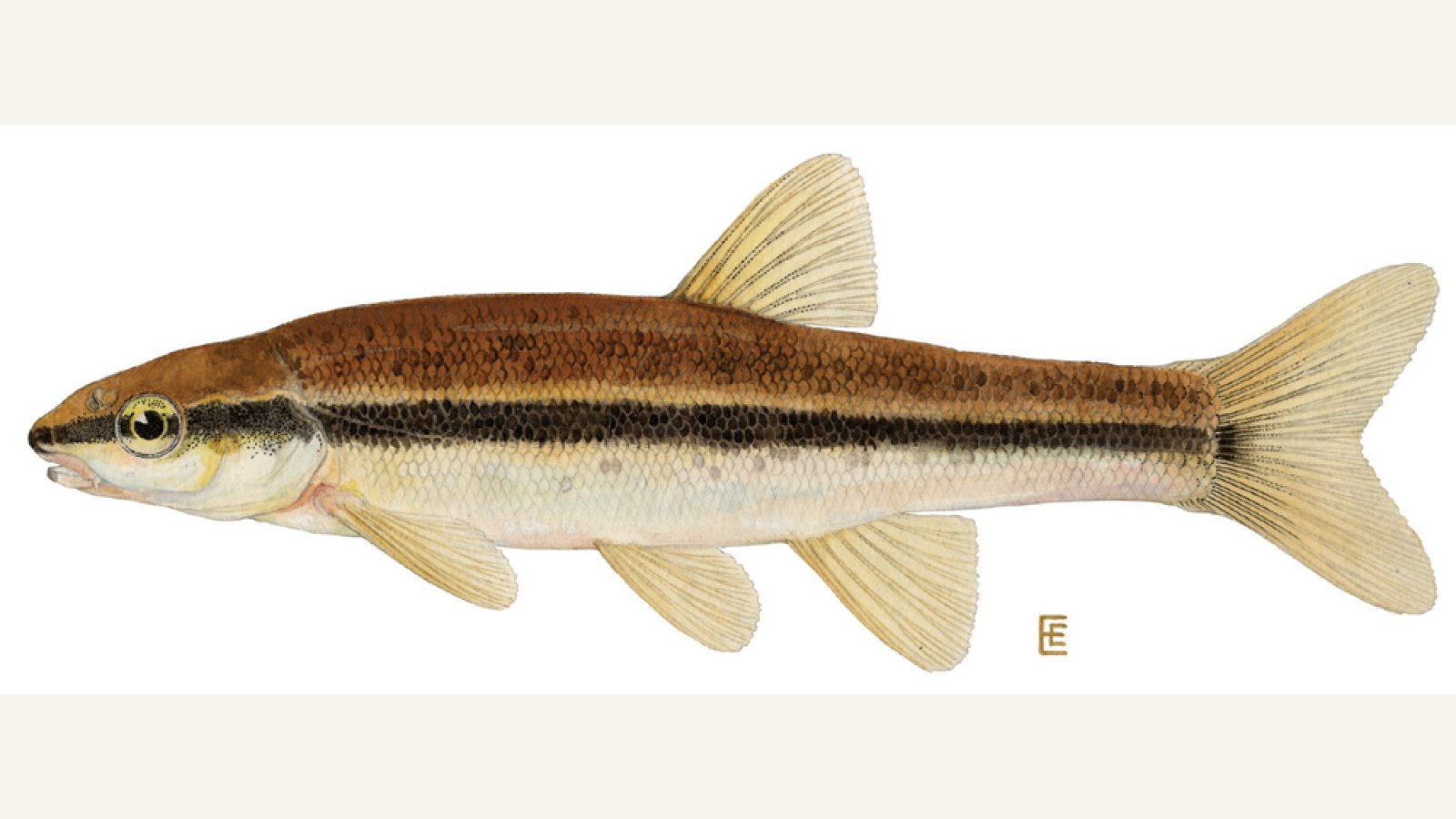
- Dark lateral stripe: the diagnostic feature -- a prominent dark stripe from snout through the eye along the body.
- Body shape: stout for the size; less elongated than longnose dace.
- Coloration: slate-brown to olive on the back; pale belly; the lateral stripe stands out against the lighter flanks.
- Habitat: small streams + headwater habitat + the slower-water margins of larger streams. Tolerates warmer + lower-oxygen water than longnose dace.
Range
Blacknose dace are widely distributed across eastern North America -- the Great Lakes basin, the Mississippi River basin, the Atlantic coastal drainages. In the SHA region they are essentially universal in quality streams and persist in many degraded streams where longnose dace cannot survive.
Life cycle + spawning
- Spawning: May through June; water temperatures 50-65 deg F. Adults migrate to clean gravel.
- Eggs: females deposit several hundred eggs over a single spawning season. Eggs adhere to gravel.
- Hatching: 7-10 days at spawning temperatures.
- Larvae + juveniles: drift downstream briefly, then settle into shallow pool + run nursery habitat. Juvenile habitat overlaps with adult habitat more closely than longnose dace.
- Sexual maturity: typically age 1-2 (1.5-2.5 inches).
- Lifespan: 2-3 years; uncommon individuals to 4 years.
Diet + ecology
Blacknose dace feed on benthic invertebrates similarly to longnose dace -- aquatic insect larvae, small crustaceans, occasional plant material. They are generalist invertivores at a smaller scale than longnose. The species' tolerance of degraded conditions makes blacknose dace one of the more reliable indicator species: presence suggests at least minimal water quality; absence suggests serious problems.
Why this matters for trout anglers
The angler implications differ from longnose dace because of size + habitat overlap:
- Brook trout streams: blacknose dace are often the primary or only forage baitfish species. Native brook trout in headwater streams eat blacknose dace at sustained rates.
- Brown trout streams: larger wild brown trout prefer the larger longnose dace; blacknose are a secondary forage. Small wild browns + stocked browns will eat blacknose dace readily.
- Small-stream brook trout streamer fishing: small wooly buggers + small Clouser Minnows + small mickey finns sized 10-14 imitate blacknose dace effectively.
- Dropper-fly applications: small streamer + nymph dropper rigs work for brook trout in headwater streams; the streamer doubles as a dace imitation.
Productive patterns
- Small Clouser Minnow -- size 10-12, olive or chartreuse over white.
- Small wooly bugger -- size 10-12, olive or black.
- Mickey Finn -- the historical bucktail streamer that imitates dace and small forage baitfish generally. Size 10-12.
- Soft-hackle wet flies -- the soft-hackle wet fly tradition predates modern streamer fishing and produces brook trout on small streams; effectively imitates emerging insects and small baitfish in motion.
Honest gaps
- No quantitative dietary studies specific to SHA-region brook trout populations.
- Identification at distance (in stream observation) is difficult; the dark lateral stripe is the key feature.
- Hybrid identification (blacknose x longnose, blacknose x river chub) is occasional and not addressed here.
Curator's Picks -- small-stream streamer kit
Curated for headwater + small-stream streamer fishing. SHA earns a small commission via Amazon Associates; editorial selection is independent.
@curated-productsFull source list
- Tier 3 -- Animal Diversity Web: Rhinichthys atratulus.
- Tier 3 -- FishBase: Blacknose dace.
- Tier 1 -- PFBC + NYSDEC + ODNR -- state agency native fish references.
Common questions
How do I tell blacknose from longnose dace?
Blacknose are smaller (2-3 in vs 3-5 in), have a more terminal mouth (less overhanging snout), carry a prominent dark lateral stripe, and tolerate warmer + slower water. See the longnose dace lifecycle for comparison.
Is blacknose dace a good indicator species?
Yes -- the species' tolerance of moderately degraded conditions makes presence a baseline indicator of at least minimal water quality. Absence in a previously documented stream suggests serious problems.
Do brook trout actually prefer blacknose dace?
In small headwater streams where blacknose dace are the primary or only available baitfish, yes. The species is the size class brook trout naturally key on.
Image credits and licensing
- Inline image: The black lateral stripe is the fast field mark that separates blacknose dace from other small riffle minnows. Illustration: Ellen Edmonson / Wikimedia Commons, public domain.
- Hero image: Photo: Brian Gratwicke / Wikimedia Commons, CC BY 2.0.