Brook Trout Headwaters Near Steelhead Alley: Native Char Streams in OH / PA / NY Within 2 Hours
Native brook trout are the only native char of the SHA-tracked region and the angler's most fragile coldwater opportunity. They persist in headwater streams across northwest Pennsylvania (Allegheny National Forest), western New York (state land in the Allegany region), and the eastern hill country of Ohio. This pillar covers where the native populations remain, how to identify wild brook trout, the catch-and-release ethics they deserve, and the gentle stewardship that keeps the populations alive.
TL;DR
What this pillar covers
The brook trout (Salvelinus fontinalis) is the only native char of the eastern Great Lakes region. Pre-1900 brook trout occupied virtually every coldwater stream across northeast Ohio, northwest Pennsylvania, and western New York. Habitat loss, water-quality degradation, dam construction, and (most importantly) the introduction of brown trout + rainbow trout reduced the native brook trout range to small headwater refugia by 1950, where it has more or less remained.
The remaining native populations are concentrated in:
- Allegheny National Forest (PA) -- Forest County, Elk County, McKean County, Warren County. Multiple tributary streams hold native populations under Forest Service management.
- NY State Land Allegany Region -- Cattaraugus + Allegany counties. Smaller fragmented populations in headwater streams.
- Ohio eastern hill country -- Geauga, Trumbull, Mahoning, Columbiana counties. Very small remnant populations; ODNR maintains some genetic-conservation interest.
- Wyoming County NY (Wiscoy Creek headwaters) -- limited.
This pillar is anchored on the SHA inland trout vertical scope: water within roughly two hours of Cleveland, Erie, or Buffalo. The famous Adirondack brook trout fishery + Vermont's Northeast Kingdom + the New England native-fish revival are all genuine destinations but outside the SHA scope.
Identification: wild vs stocked vs hybrid
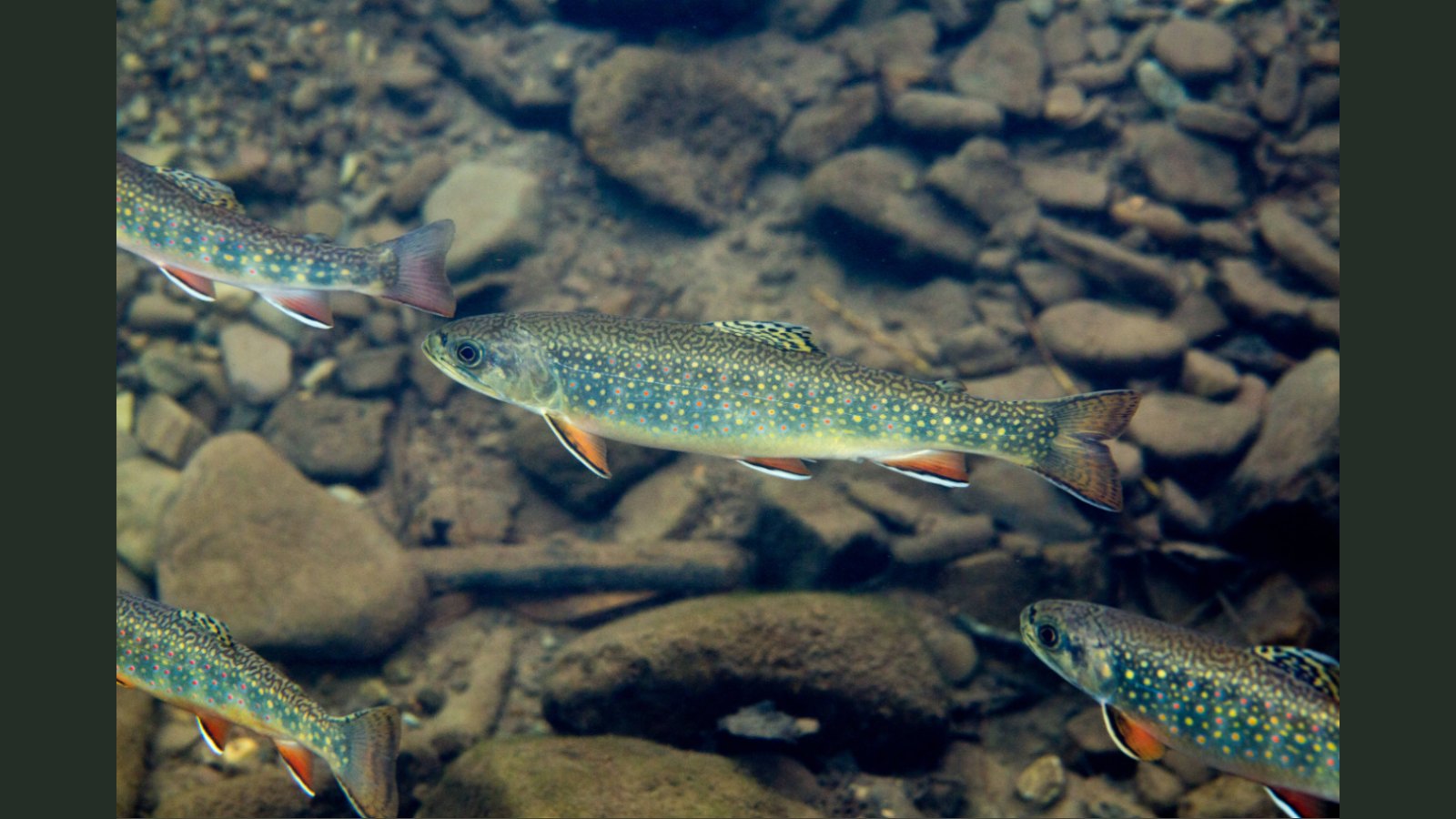
Wild brook trout in headwater streams show distinct characteristics:
- Vermiculations on the back -- the wavy worm-track patterns are the species' signature. Stocked hatchery fish often have less-defined or rubbed-off markings.
- Red spots with blue halos on the flanks -- prominent and well-defined on wild fish.
- White-edged fins -- pectoral + pelvic + anal fins have white leading edges. This is consistent across both wild and stocked fish.
- Body coloration -- wild fish are generally smaller (4-9 inches typical in headwater streams), more brilliantly colored, with smaller heads relative to body. Stocked fish in put-and-take water are usually 10-12 inches with hatchery-pale coloration.
- Behavior -- wild brook trout in headwater streams are skittish, hold in deep cover, and are first-cast fish. Stocked fish are concentrated in pools, willing to hit attractors repeatedly.
Tiger trout (S. fontinalis x S. trutta hybrid) are occasionally encountered in mixed-stock streams; they have a distinctive maze-like pattern across the body. Sterile, conservation-friendly in the right context.
Where to find native brook trout populations
Allegheny National Forest (PA)
The ANF is the most accessible wild brook trout fishery in the SHA region. Multiple tributary streams across Warren, Forest, McKean, and Elk counties hold native populations. Per Tier 1 PFBC + USFS sources, the ANF maintains wild brook trout in headwater streams through cool-water habitat management and limited harvest pressure.
SHA does not publish per-stream access details; the ethic in native brook trout country is to learn the water locally + protect specific access through discreet sharing. PFBC's Class A wild trout designation list + the Wilderness Trout Stream designation give starting categorical reference.
NY State Land Allegany Region
Cattaraugus + Allegany county state land hold fragmented brook trout populations in headwater streams. NYSDEC native brook trout management focuses on habitat protection + targeted harvest restrictions. The same access ethic applies: small fragile populations + general locations rather than specific GPS coordinates.
Ohio eastern hill country
Ohio's brook trout populations are vestigial -- ODNR maintains genetic-conservation interest in small headwater remnants in Geauga, Trumbull, Mahoning, and Columbiana counties. These are not recreational fisheries in the destination sense; they are conservation populations that the careful angler may encounter incidentally.
The pragmatic SHA-Ohio brook trout angler should treat any wild fish encountered as effectively unfishable: catch-and-release with extreme care, no targeted fishing, no public location-sharing.
Catch-and-release ethics
Native brook trout populations are categorically more vulnerable than the rest of the SHA-tracked fish base. The conservation framework:
- Use barbless hooks. Pinch barbs; reduce damage from removal.
- Wet hands before handling. Reduces protective slime removal.
- Keep fish in water during photographs. Above-water handling under 15 seconds is the rule.
- Single-fly rigs reduce handling. Dropper rigs can produce two-fish catches that compound stress.
- Stop fishing if temperatures exceed 65 deg F. Native brook trout above 65 deg F are at survival-stress thresholds; angler-induced mortality climbs rapidly.
- Respect spawning closures. Late September through October are spawning months; some waters carry seasonal closures.
- Don't share specific GPS locations publicly. The native populations are small enough that elevated pressure can cause real damage. This is the consensus brook trout conservation ethic.
Tackle + tactics for headwater brook trout
Headwater brook trout fishing rewards minimalism. The water is small + shallow + clear + heavily-vegetated; the fish are small + skittish + opportunistic.
- Rod: 2-4 weight, 7-8 ft, slow to moderate action. Glass and bamboo work; carbon-fiber budget rods work too.
- Line: floating line; 4X-6X tippet.
- Tenkara: small headwater streams are ideal tenkara water. The fixed-line rig handles brush + tight casting positions well.
- Approach: stay low, cast short, fish small. Dry-dropper rigs with a high-floating attractor + a small nymph dropper produce.
- Flies: small Adams + elk hair caddis + parachute hopper for dries; pheasant tail + hare's ear + small midge nymphs for droppers. Brook trout are not selective at this scale; presentation matters more than pattern.
- Streamers (in deeper holding pools): small wooly buggers + small Clouser minnows + sculpin patterns for the larger fish.
Seasonal windows for headwater brook trout
Brook trout activity tracks water temperature closely. Per the SHA inland trout seasonal calendar:
- April - June: peak fishability. Water temperatures 45-65 deg F; full hatch progression; wild fish actively feeding.
- July - August: low water + warm temps. Fish accessible in headwater spring-fed sections only; freestone-only water often too warm for ethical fishing.
- September - October: second prime window. Cool temperatures + pre-spawn aggression + fall hatches; respect spawning closures.
- November - March: mostly off-season. Cold water + reduced activity + holiday access restrictions on some land.
Honest gaps
- No per-stream specifics -- intentionally. Native brook trout streams in this region are best discovered locally + protected through discreet stewardship.
- No comprehensive native-population status assessment -- ODNR, PFBC, and NYSDEC publish their own native-brook-trout work; consult per-agency reports.
- No coverage of Adirondack, Catskill, or New England fisheries -- out of SHA's 2-hour radius scope.
- No specific genetic-conservation population identifications -- conservation-sensitive information.
Curator's Picks -- headwater brook trout kit
Curated for small-stream brook trout fishing. SHA earns a small commission via Amazon Associates; editorial selection is independent.
@curated-productsFull source list
- Tier 1 -- Pennsylvania Fish and Boat Commission -- Class A wild trout designations + Wilderness Trout Stream framework + ANF management partnership.
- Tier 1 -- U.S. Forest Service: Allegheny National Forest -- federal management of brook trout habitat.
- Tier 1 -- New York State Department of Environmental Conservation -- state land management + native brook trout conservation.
- Tier 1 -- Ohio Department of Natural Resources -- vestigial Ohio brook trout population management.
- Tier 2 -- Trout Unlimited -- Eastern Brook Trout Joint Venture (EBTJV); largest collaborative brook trout conservation initiative in North America.
- Tier 3 -- Animal Diversity Web: Salvelinus fontinalis.
- Tier 3 -- USFWS species profile for brook trout.
Common questions about native brook trout
Are brook trout actually trout?
No -- brook trout are char (genus Salvelinus), not true trout (Salmo or Oncorhynchus). The common name is historical; the biology is closer to lake trout + arctic char than to brown or rainbow trout.
Why don't you list specific streams?
Native brook trout populations are small enough that publicized GPS coordinates measurably increase pressure + harm the populations. This is the consensus conservation ethic across PFBC, NYSDEC, and the Eastern Brook Trout Joint Venture. Learn locally through your TU chapter; share discreetly.
What's the largest wild brook trout I'll catch?
SHA-region headwater streams: 4-9 inches typical, 12 inches exceptional. The state records are larger (Pennsylvania record 7 lbs from Allegheny tribs decades ago) but those came from spring-fed reservoirs + lake outflows, not the headwater streams covered here.
Can I keep a brook trout legally?
Per state regulations, yes (with size + bag limits). But the strong editorial recommendation is catch-and-release on native populations; harvest hatchery-stocked fish if you want fresh fish for the table.
What's the Eastern Brook Trout Joint Venture?
A multi-state conservation partnership (EBTJV) coordinated through Trout Unlimited that works on habitat restoration, population assessment, and angler outreach for native brook trout across the species' historical range. Worth supporting if you fish brookies.
Image credits and licensing
- Inline image: Young brook trout over clean gravel and cold water, the habitat signature of quality headwater streams. Photo: Ryan Hagerty / USFWS, public domain.
- Hero image: Minister Creek in Allegheny National Forest. Photo: Alexvallejo / Wikimedia Commons, CC BY-SA 3.0.
Continue learning
- Inland Trout Seasonal Calendar -- month-by-month fishability.
- Inland Trout Near Steelhead Alley -- the broader access map.
- Inland Trout vs Steelhead -- what changes when you step off the Alley.
- PA Class A Wild Trout Fundamentals.
- Brook Trout Lifecycle -- biology + life history.
- Brook Trout Entomology Reference.
- Wading Safety.
- Source Discipline + Tier Hierarchy.