Inland Trout Seasonal Calendar: A Month-by-Month Guide Within 2 Hours of Steelhead Alley
The complete inland trout calendar for the SHA-tracked region -- stocked openers, wild-trout windows, hatch progressions, terrestrial summer, fall pre-spawn, and the cold-weather midge fishing that keeps a fly rod earning its keep through the off-steelhead months. Anchored on water within roughly two hours of Cleveland, Erie, or Buffalo.
TL;DR
What this calendar covers
The same way the SHA Steelhead Alley Seasonal Calendar covers Lake Erie tributary steelhead month by month, this pillar covers inland trout the same way -- but for a different fish in different water on a different rhythm. Inland trout fishing is the steelhead angler's adjacent expertise: same casting habits, same observation skills, smaller water and different bugs.
Scope: water within roughly two hours of Cleveland, Erie, or Buffalo. That covers PA Class A wild trout streams in the SHA-adjacent region, Allegheny National Forest small streams, Oil Creek + French Creek, Ohio's Mohican corridor, NY's Wiscoy Creek and Genesee headwaters. Famous Central PA limestone water (Spring Creek, Penns Creek, Bald Eagle) is out of scope -- it's the same fish at four hours from Erie, and SHA leaves that water to writers anchored on it.
January -- midges, holdover, layered clothing
Stocked-stream holdover fish are catchable through January for the angler willing to fish small. The hatch is midges (Chironomidae); the technique is small nymphs or midge dries in slack water. Wild-trout streams are usually too cold for active feeding, though brook trout in spring-fed water occasionally surprise the patient angler.
- Target water: stocked-stream tail-outs, spring-fed reaches, dam tailwaters.
- Bugs: midges (sizes 18-24), small black stoneflies on bright days.
- Approach: slow drifts, light tippets (6X-7X), patience.
- Species notes: rainbow trout most catchable; brown trout sluggish; brook trout dormant in non-spring water.
February -- the same, with hope
February is essentially January with longer days and warmer afternoons. The midge fishing continues; on the warmest afternoons, blue-winged olives begin to appear on overcast days. Stocked rainbows that survived winter are concentrated in deep slow water; the angler willing to fish slow can catch.
March -- opening days, stocked-trout pressure peaks
March is the social high point of the inland trout calendar -- both Pennsylvania (PFBC) and Ohio (ODNR) open trout seasons in March on most stocked water. The first two weekends bring genuine crowds. New York's general inland trout season opens April 1.
| PA opening day | Statewide opener: first Saturday in April for most waters; PFBC mentored youth day earlier. Confirm per-cycle PFBC schedule. |
| OH opening day | Last Saturday in March for most stocked Ohio trout water; ODNR schedule authoritative. |
| NY opening day | April 1 statewide general inland trout season. |
March hatches: blue-winged olives, early black stoneflies, midges. Stocked-stream techniques: power bait + spinners + bead rigs + small streamers. Wild-trout streams (Class A water) remain cold; mid-month dry-fly action on BWO emergers is the first genuine wild-trout window.
April -- early hatches arrive; wild trout wake up
April is when inland trout fishing starts to feel real. Water temperatures rise toward 50 deg F; aquatic insects begin substantial emergences. The headline hatches:
- Hendricksons (Ephemerella subvaria) -- mid-to-late April, water around 50-55 deg F. The classic eastern dark-bodied mayfly.
- March browns (Maccaffertium vicarium) -- late April into May. Larger, mottled, important on freestone water.
- Quill gordons (Epeorus pleuralis) -- mid-April. Smaller, slate-bodied, classically PA + NY.
- Caddis (multiple families) -- emergence builds; spot-and-stalk fishing improves dramatically.
By late April, wild brown trout on Class A water are feeding actively; brook trout in headwaters are catchable on dry-dropper rigs; stocked rainbows are still concentrated and willing.
May -- the prime month
If you had to pick one month for inland trout, May is the answer. Water temperatures in the 55-65 deg F range; full hatches; wild fish active; stocked fish dispersed; stream flows moderating from spring high water.
Key hatches:
- Sulphurs (Ephemerella invaria + E. dorothea) -- the May icon. Yellow-bodied mayflies in evening windows.
- Hendricksons continue through early May.
- March browns continue.
- Caddis at peak intensity -- spot-and-stalk wild fish on dry caddis.
- Light cahills (Stenacron interpunctatum) -- evening cream-bodied mayflies.
This is the month to target Wiscoy Creek (NY Class A), Oil Creek + French Creek (PA), the Mohican corridor (OH), and Allegheny National Forest small streams. The angler with one week off in May should take it.
June -- transition; terrestrials begin
June water temperatures begin pushing into the upper end of trout tolerance (65-70 deg F on freestone water). Hatches taper; terrestrials begin (ants + beetles); wild-trout fishing shifts to early-morning + evening windows. Stocked fish that survived the spring pressure are in deeper holdover pools.
- Sulphurs continue evenings; late-evening spinner falls.
- Slate drakes (Isonychia bicolor) -- late June through summer; large-bodied swimmer mayflies, important on freestone water.
- Terrestrials begin: ants in trees + on banks; small beetles.
- Brown trout in deeper colder pools; rainbow trout in faster oxygenated water.
July -- terrestrials peak; low water; technical fishing
July is when the technical side of inland trout fishing earns its reputation. Water is low + clear; wild fish are skittish; stocked fish are concentrated in deep cold pools (where they remain). Terrestrials dominate the menu:
- Ants -- the most important July terrestrial. Fish ant patterns under shade lines.
- Beetles -- Japanese beetles + various ground beetles. High-floating foam patterns.
- Hoppers -- emerging July through August. Larger patterns on meadow streams.
- Trico spinners (Tricorythodes) -- early-morning spinner falls; size 22-26 patterns; some of the most technical fishing in the inland calendar.
Wild-trout fishing in July requires early-morning + late-evening windows. Brook trout in mountain headwaters remain accessible (cold spring water). Brown trout get harder; rainbow trout most cooperative.
August -- low water continues; pre-spawn cues
August is essentially July with shorter days and the first cues of fall. Tricos remain important; terrestrials peak; the first hint of fall Isonychia spinners + late-season BWOs begins. Brown trout begin showing early pre-spawn aggression in deeper pools.
- Tricos -- continue through mid-August.
- Terrestrials -- ants + beetles + hoppers; peak fishability.
- Stream temperatures -- carefully avoid water above 68 deg F where possible.
- Streamer fishing -- early-morning streamer work in deep pools for brown trout begins to produce.
September -- fall returns; brown trout aggression; BWO again
September brings cooling water temperatures + the second prime window of the inland trout year. Wild fish wake back up; brown trout enter pre-spawn aggression; BWO mayflies return; trout streamer fishing reaches peak intensity.
- Blue-winged olives (Baetis spp.) -- fall BWO returns; mid-day hatches on cool overcast days.
- Iso (slate drakes) -- continue through September on freestone water.
- Brown trout streamer fishing -- pre-spawn brown trout aggression peaks; large streamers produce.
- Brook trout coloration -- pre-spawn brook trout are at their most photogenic. Catch-and-release them carefully.
October -- spawning + late hatches
October is the spawning month for wild brown trout and brook trout. Spawning fish are concentrated on gravel; respect closed reaches per PA + NY regulations on identified wild-trout spawning water. Avoid fishing over visible redds.
- BWO + iso spinners -- continue into October.
- Streamer fishing -- streamer-aggressive brown trout continue through October; this can be the biggest-fish window of the year on certain water.
- Stocked-stream fall stocking -- ODNR + PFBC + NYSDEC do fall stockings in October on select waters; current-cycle schedule on each agency's site.
- Brook trout spawn -- mid-to-late October on most northeast headwater streams. Sensitive period.
November -- late season; cold water; midges returning
November is the closing month for active hatch fishing on most inland water. Late BWO emergences continue on cool overcast days; midges return; brown trout finish spawning and post-spawn fish work back to holding water.
December -- holdover season; midges; reflection
December reverts to the January pattern -- stocked-stream holdover fish on midges in slow water. By the solstice, most inland trout anglers have shifted attention to steelhead tributaries or are tying flies for spring. The year resets.
Species-specific seasonal notes
Brook trout
Brook trout (Salvelinus fontinalis) are coldwater obligates. Peak activity is April-June + September-October. Spring-fed headwater streams give brook trout windows even in summer; freestone streams generally lose brook trout fishability above 68 deg F. See the brook trout lifecycle and the species page.
Brown trout
Brown trout (Salmo trutta) tolerate slightly warmer water than brook trout and are the larger-fish target on most SHA-adjacent water. Wild brown trout on Class A streams are the editorial focus. Streamer-aggressive pre-spawn windows in late August through October are the trophy-class opportunity. See the brown trout lifecycle.
Rainbow trout
Rainbow trout (Oncorhynchus mykiss) in inland water are mostly stocked rather than wild. They tolerate the broadest temperature range of the three species and produce the most consistent catch-rate fishing at openers + on stocked-stream water through summer. See the inland trout vs steelhead pillar for the inland-versus-Lake Erie distinction.
Stocked vs wild approach by season
Per the SHA inland trout vertical scope (see the "Near the Alley" inland trout guide), both stocked and wild water are in scope. The seasonal rhythms differ:
- March-April (stocked openers): stocked-water focus; high pressure; concentrate on access timing + crowd avoidance.
- April-June (wild-trout prime): wild Class A water; technical hatch fishing; lower pressure.
- July-August (low water): wild-trout streams require careful low-water tactics; stocked-water holdover fish in deep cold pools.
- September-November (fall): wild-trout streams are at peak; respect spawning closures.
- December-February (off-season): stocked-water holdover only; wild streams largely closed or sub-survival cold.
Honest gaps
- No per-stream specifics -- this calendar is general. The "Near the Alley" inland trout guide covers individual water more closely.
- No year-specific stocking schedule -- PFBC + ODNR + NYSDEC per-cycle schedules are authoritative.
- No comprehensive hatch chart -- the SHA hatch coverage is selective, not exhaustive.
- Famous Central PA limestone water (Spring Creek, Penns Creek, Bald Eagle Creek) is out of scope -- ~3.5+ hours from Erie.
- No coverage of stillwater trout fishing (reservoirs, ponds) -- this calendar is moving-water focused.
Curator's Picks -- year-round inland trout starter kit
Curated for the full-calendar inland trout angler. SHA earns a small commission via Amazon Associates; editorial selection is independent.
@curated-productsFull source list
- Tier 1 -- Pennsylvania Fish and Boat Commission -- statewide trout regulations + stocking calendar + Class A wild trout designations.
- Tier 1 -- ODNR Trout Stocking Dates.
- Tier 1 -- NYSDEC Freshwater Fishing Regulations.
- Tier 3 -- Animal Diversity Web treatments of Salvelinus fontinalis, Salmo trutta, Oncorhynchus mykiss.
Common questions about inland trout in the SHA region
When does Pennsylvania trout season open?
The PA statewide trout opener is the first Saturday in April for most waters. PFBC mentored youth opener is the prior weekend. Specific waters have different rules; confirm per-cycle PFBC schedule.
When does Ohio trout season open?
The Ohio stocked-trout opener is the last Saturday in March for most waters. Refer to the per-cycle ODNR trout stocking calendar.
When does New York trout season open?
April 1 is the statewide general inland trout opener. Specific catch-and-release or year-round sections exist on select waters; consult NYSDEC.
What's the difference between wild and stocked trout?
Wild trout reproduce naturally in the stream; stocked trout are hatchery fish released by state agencies. See the inland trout vs steelhead pillar.
When are wild brown trout aggressive on streamers?
Late August through October during pre-spawn. This is the trophy-class window on most freestone water.
Is summer a bad month for inland trout?
Not bad, just technical. Low water + warm temps require early-morning + late-evening windows, careful catch-and-release on warmwater days, and terrestrial-focused fly selection. The fish are there; the approach must respect them.
Image credits and licensing
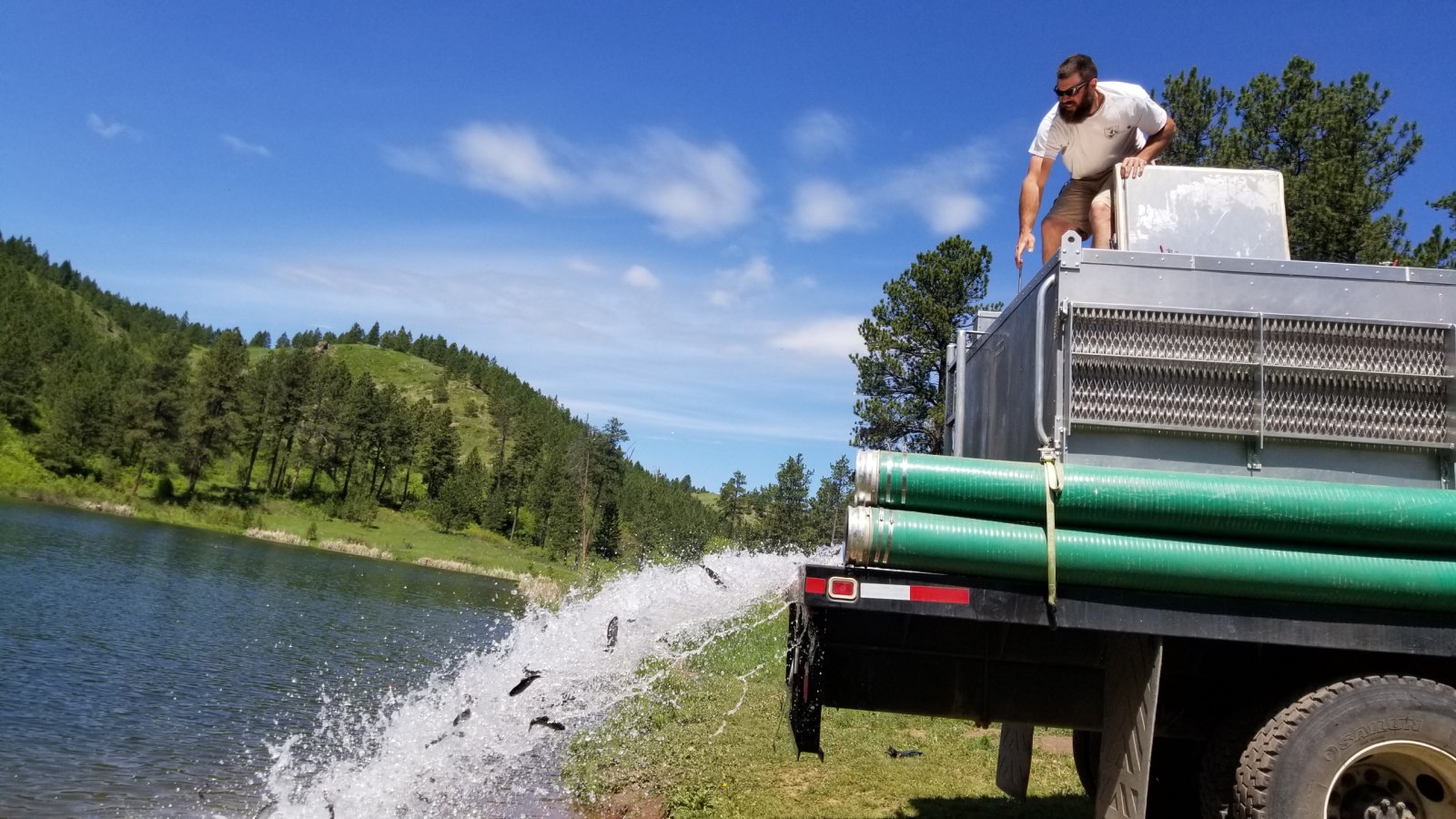
- Inline image: Stocked-trout calendars are seasonal agency programs, not fixed annual promises. Photo: USFWS Mountain Prairie / Wikimedia Commons, public domain.
- Hero image: French Creek at Franklin, Pennsylvania. Photo: Finetooth / Wikimedia Commons, CC BY-SA 3.0.
Continue learning
- Inland Trout Near Steelhead Alley -- the access map.
- Inland Trout vs Steelhead -- what changes when you step off the Alley.
- PA Class A Wild Trout Fundamentals -- the designation explained.
- What is a hatch? -- the aquatic insect framework.
- Brook Trout Lifecycle.
- Brown Trout Lifecycle.
- Steelhead Alley Seasonal Calendar -- the steelhead-side counterpart to this calendar.
- Wading Safety.
- Source Discipline + Tier Hierarchy.