Brown Trout Life Cycle: From Pennsylvania Limestone to Lake Erie Tributary
The inland-trout vertical anchor for SHA. Brown trout (Salmo trutta) is a European-native predator introduced to North America in the late 1800s and established broadly across 50+ US states including PA (53 HUCs per USGS NAS Tier 3) and NY (58 HUCs). One species, three distinct fisheries: PA Class A wild limestone + freestone streams, NY 5-category trout-stream management, and PA Lake Erie tributary lake-run browns. This pillar walks egg, alevin, fry, juvenile, piscivory-shift adult, and spawning-adult stages -- source-anchored where the science is anchored, honest about Lake Erie lake-run-specific gaps still source-required at Tier 1-3.
TL;DR -- if you only read one block
[source-required].
[source-required].[source-required].
Brown trout is the year-round resident predator across SHA's broader trout audience -- the limestone valleys of central PA, freestone tribs of the Catskills + Adirondacks + Finger Lakes, stocked tailwaters of OH, and a smaller-scale presence in the PA Lake Erie tributary lake-run program. This pillar walks egg through spawning adult, anchors to Tier 1-3 sources, and is explicit about Lake Erie lake-run gaps. USFWS classifies Salmo trutta as injurious wildlife; naturalized populations have persisted in PA + NY 140+ years but the species remains taxonomically introduced.
What this pillar is for
- Honors three distinct fisheries inside one species. PA Class A wild brown trout streams (40 kg/ha biomass threshold per Tier 1 PFBC) are NOT the same fishery as NY inland brown trout streams (NY Trout Stream Management Plan's 5 categories per Tier 1 NYSDEC) or PA Lake Erie tributary lake-run brown trout (~100,000 PFBC-stocked annually per Tier 1 PFBC Summary). Editorial discipline does not collapse them.
- Sources everything that can be sourced. 1880 introduction + 50+ state distribution + injurious-wildlife status (Tier 3 USGS NAS SpeciesID 931). 40 kg/ha Class A biomass threshold (Tier 1 PA Bulletin Vol 55 No 10). Thermal envelope (Tier 2 ODNR via CFRTU + Tier 3 NDEP). The 25-30 cm piscivory shift (Tier 3 Jensen et al. 2012). ~100,000-annual PA Lake Erie stocking (Tier 1 PFBC Summary). Where Lake Erie lake-run timing + diet selectivity remain widely-attested but NOT Tier 1-3 anchored, we flag
[source-required]. - Maps each lifecycle stage to angler tactics across the ontogenetic shift. The Jensen et al. 2012 25-30 cm piscivory inflection is the single most important biological fact for brown trout fly-pattern selection.
Identity
- Common name: Brown Trout
- Scientific name: Salmo trutta (Linnaeus, 1758)
- Family: Salmonidae
- Native range (Tier 3 USGS NAS): Europe, northern Africa, and western Asia. Single biological species; "strains" (German brown, Loch Leven, lake-run) reflect hatchery genetic origin or life-history strategy, not separate species.
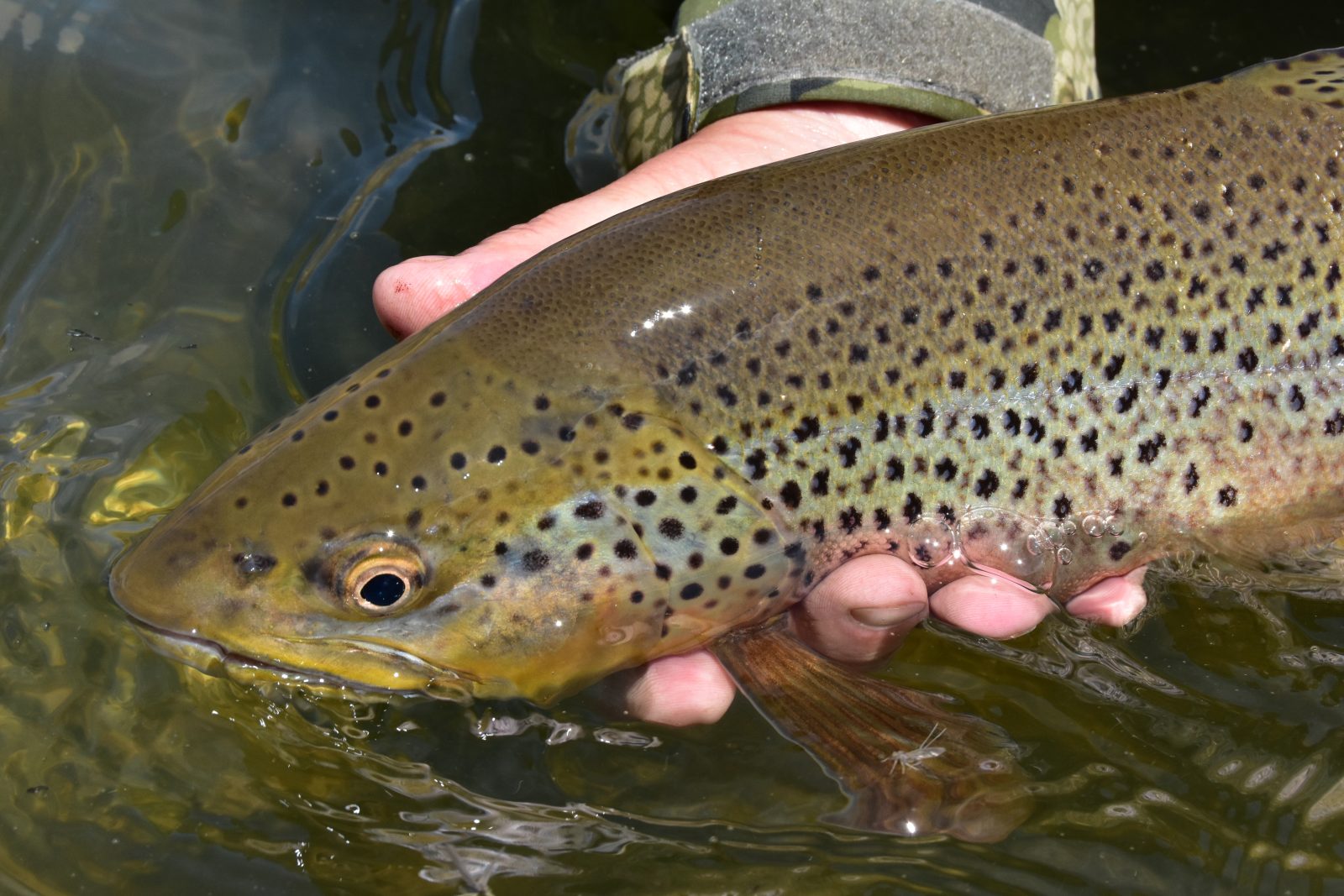
- Identification (Tier 3 USGS NAS): elongated body; brown to yellow-brown hue with numerous spots below the lateral line; black spots with pale halos above; red spots on the lower body; adipose fin with red margin.
- North America introduction (Tier 3 USGS NAS): Connecticut records by 1865; first US documented introduction ~1880 (Arizona + Colorado). Among the earliest established exotic fish in North America.
- US distribution (Tier 3 USGS NAS): 50+ states including NY (58 HUCs), PA (53 HUCs), CA (52), ID (51), MT (51), CO (43), MI (41).
- Federal status (Tier 3 USGS NAS): USFWS injurious wildlife; classified Exotic Fish (Nonindigenous).
- Working scope: species-level Salmo trutta across the three SHA-relevant management contexts. Pacific anadromous sea-run browns are out of SHA scope.
- Regional aliases (heuristic): "german brown", "brownie", "lake-run brown", "wild brown", "Loch Leven".
Sources for identity + invasion context:
USGS Nonindigenous Aquatic Species, Brown Trout (Salmo trutta) species profile, SpeciesID 931 -- Tier 3
Pennsylvania Bulletin Vol 55 No 10, "Class A Wild Trout Streams; Statements of Policy" (effective November 2, 2024) -- Tier 1 PA
NYSDEC, Inland Trout Stream Management in New York -- Tier 1 NY
Lifecycle stage 1: Egg
Stage summary: Deposited on gravel substrate in stream redds during fall spawn (October-December). Buried in gravel for protection. Incubation through winter.
Timing. Brown trout spawn October-December in PA + NY + OH inland streams, peak activity late October through November per general fisheries literature + widely-attested angler tradition. Some redd activity documented as late as early January and as early as mid-October. Specific Tier 1-3 thermal-trigger threshold for spawn-run initiation remains [source-required] -- declining water temperatures + shortening photoperiod is the broadly-cited mechanism but precise thermal cutoff has not been confirmed.
Habitat. Pea-gravel to golf-ball-sized substrate in shallow riffle tailouts -- typically a foot or less deep, moderate current. Females excavate a redd; males fertilize; the female covers the redd with displaced gravel. Brown trout redds are typically smaller and shallower than steelhead redds.
Incubation. At 50 deg F eggs hatch in ~3 weeks per general fisheries literature. At typical PA + NY + OH late-fall + early-winter temperatures (35-45 deg F), incubation extends through winter with most fry emerging January-February.
Fecundity. Roughly 1,500-2,000 eggs per pound of female body weight per general salmonid pattern. A 4-lb wild brown female could carry ~6,000-8,000 eggs; tributary-specific fecundity is [source-required].
Predator notes + ethics. Per Tier 3 Animal Diversity Web, piscivorous browns commonly eat trout eggs during fall + early winter -- including conspecific brown trout eggs. Egg-pattern fly fishing during October-December is widely-attested angler tradition. Anglers should avoid wading across visible redds; targeting browns ON redds is a community-norm violation. Egg patterns drifted BELOW spawning redds catch non-spawning + post-spawn browns ethically.
Source-status: general salmonid spawning behavior source-backed (Tier 3-5); October-December timing source-backed Tier 5 angler + Tier 3 general literature; precise thermal-trigger threshold source-required; PA Lake Erie tributary brown-trout-on-eggs selectivity source-required.
Lifecycle stage 2: Alevin (sac-fry)
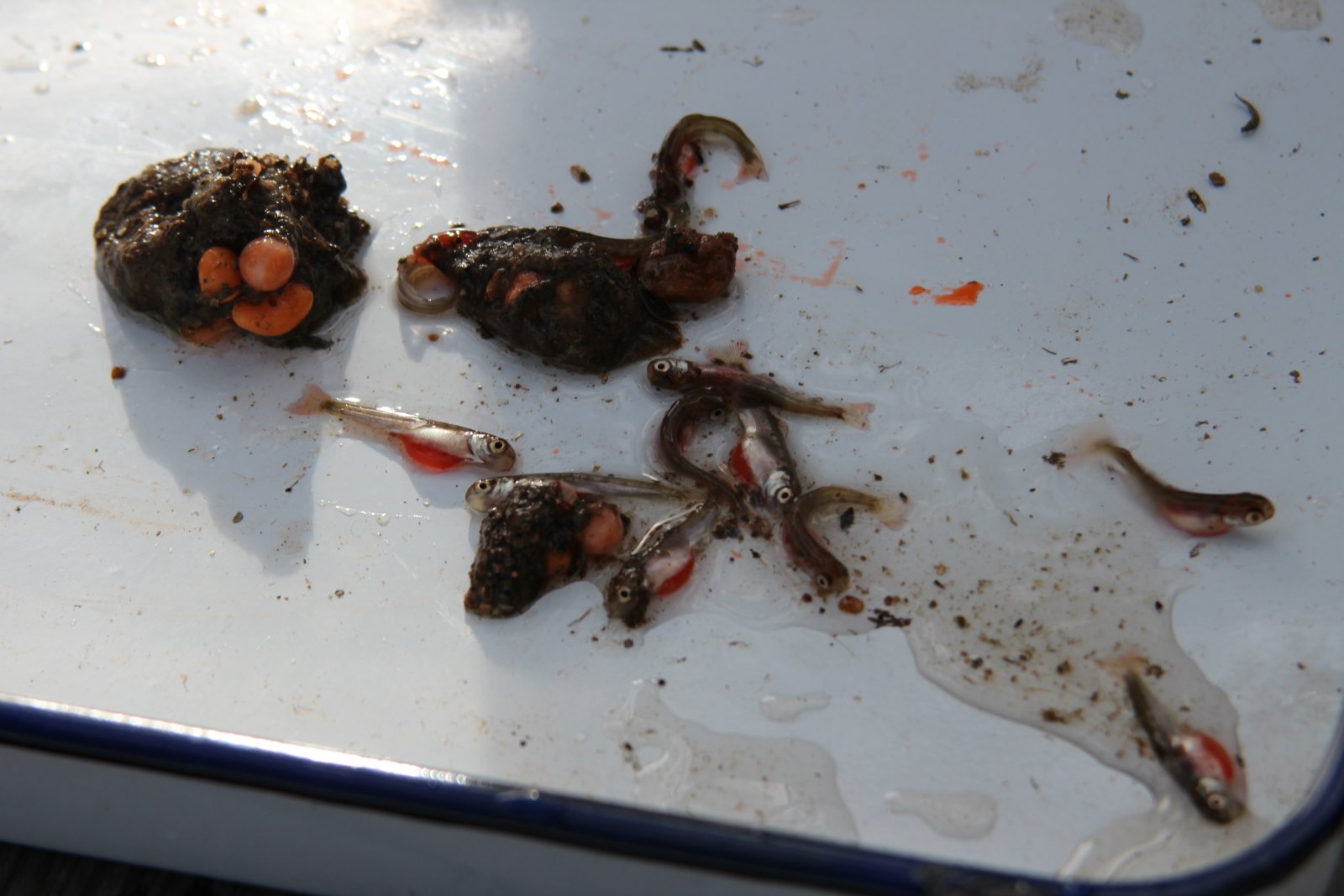
Stage summary: Newly hatched larvae buried in gravel, nourished by attached yolk sac. ~2-4 weeks underground before emerging as free-swimming fry.
Timing + habitat. Brown trout alevin hatch in mid-winter (January-February in most PA + NY + OH inland streams), remain in gravel absorbing yolk sac ~2-4 weeks before emerging late winter / early spring. Inside the redd; alevin do not feed. Sediment-clogged gravel suffocates alevin -- one mechanism by which degraded streams lose natural reproduction. PA Class A wild streams require clean gravel for ongoing self-sustaining populations.
Source-status: general salmonid alevin biology source-backed (Tier 3-5); SHA-stream-specific alevin survival rates source-required.
Lifecycle stage 3: Fry (emergence and swim-up)
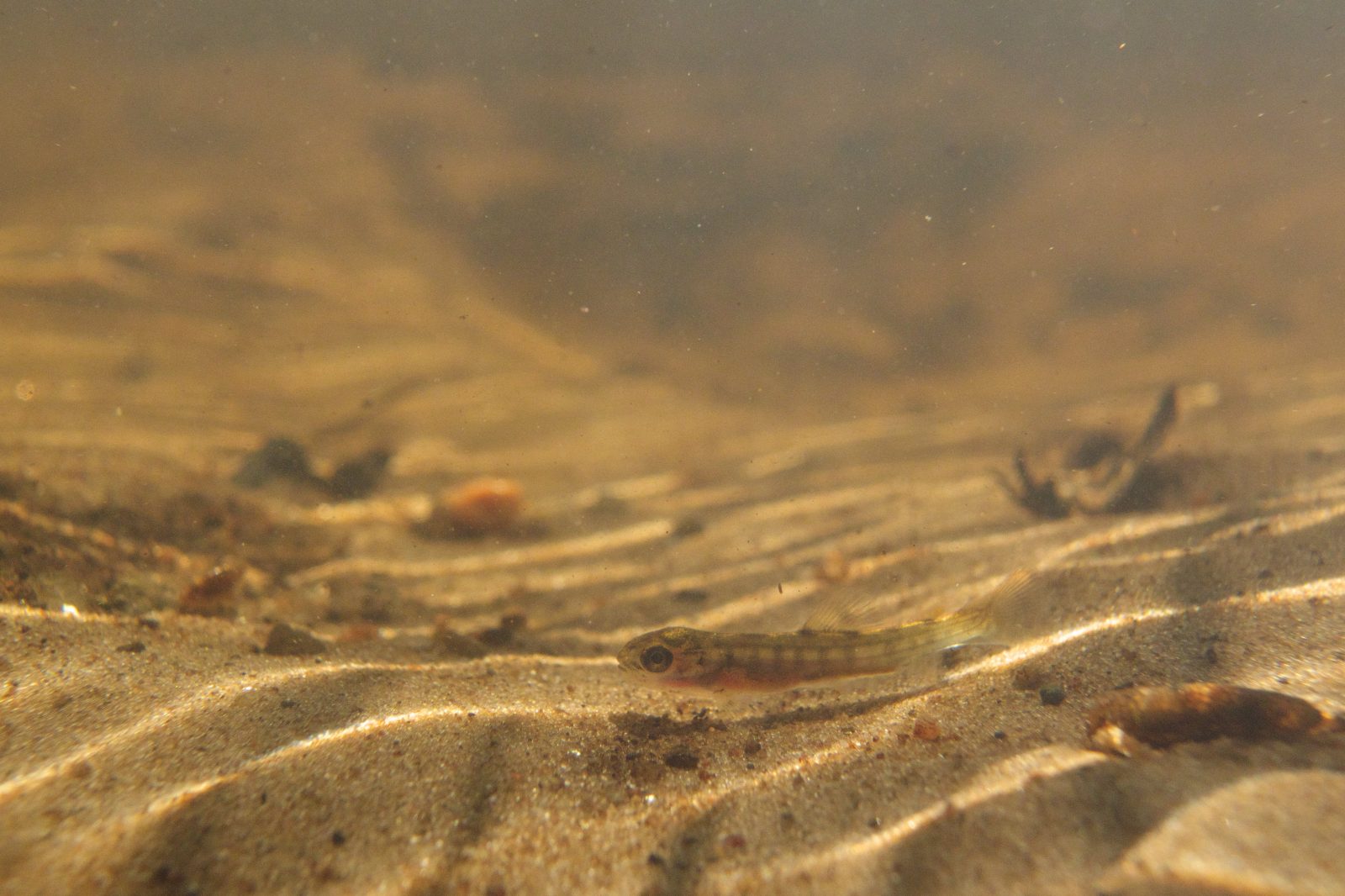
Stage summary: Emerge from gravel after yolk sac absorption, swim up into the water column, begin feeding on micro-invertebrates. Per Tier 3 Animal Diversity Web, newly emerged brown trout fry prey on chironomid larvae and baetid nymphs.
Timing + habitat + diet. Fry emergence in most PA + NY + OH inland brown trout streams falls late winter through early spring (February-April). Stream-by-stream emergence timing is [source-required] at Tier 1-3. Margin habitat -- slow shallow water along banks, behind rocks, in vegetation; fry are weak swimmers and depend on hydraulic refuges. Per Tier 3 Animal Diversity Web + general literature: chironomid (midge) larvae, baetid mayfly nymphs, small caddis larvae, terrestrial drift, other benthic macroinvertebrates. Zooplankton commonly absent.
Predator notes. Fry vulnerable to virtually all larger fish in the stream -- including larger brown trout (cannibalism broadly cited). Sculpin, creek chubs, and co-occurring smallmouth bass are documented fry predators.
Source-status: general fry emergence + early diet source-backed Tier 3 Animal Diversity Web; SHA-stream-specific fry density + cannibalism rates source-required.
Lifecycle stage 4: Juvenile / pre-piscivory (Age 0-2, < 25-30 cm)
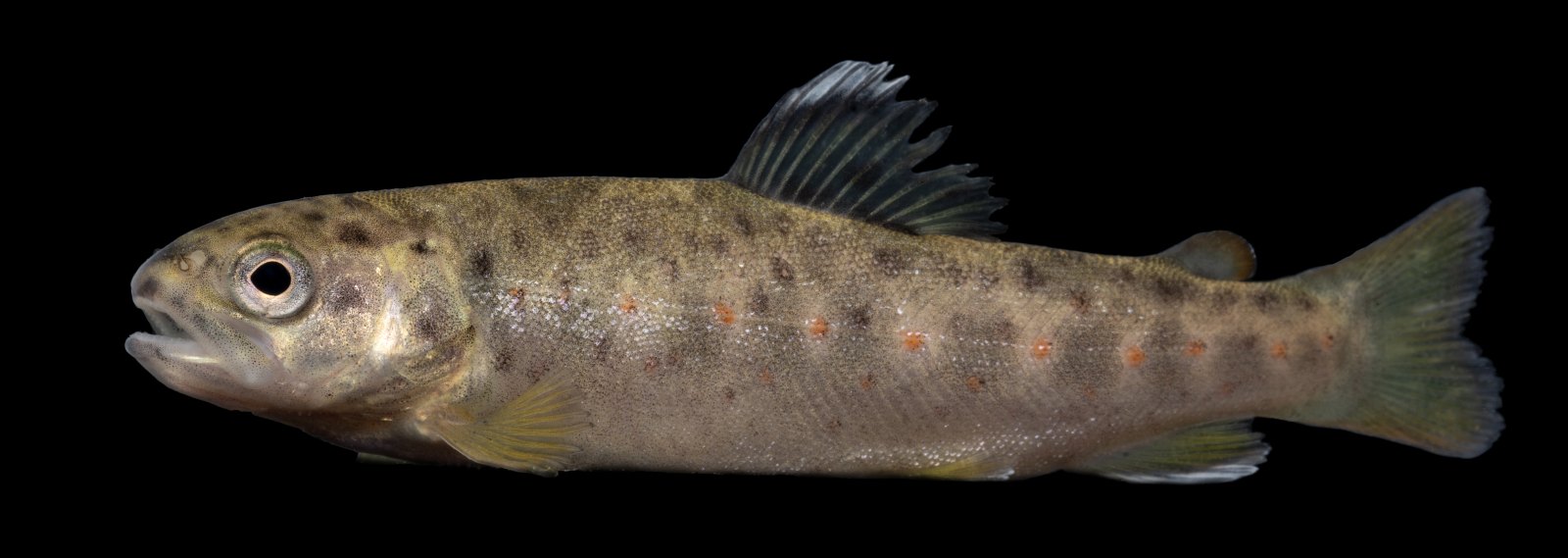
Stage summary: Juvenile brown trout from sub-fry through Age 2 typically range under 25-30 cm (~10-12 in) and feed PRIMARILY on benthic invertebrates + surface insects per Jensen et al. 2012 (Tier 3). The dry-fly + nymph window. Per ODNR via CFRTU (Tier 2), Ohio-stocked yearling browns reach 12 in in approximately 2 years.
Size. Per Tier 2 ODNR via CFRTU: 6-8 in yearling stocked browns; 12 in at ~Age 2. Per Tier 1 NYSDEC: 9+ in desired stocking size for NY spring stocked browns; the 2024 drought reduced brown trout growth resulting in many 2025 stocked browns under 9 inches. Working pre-piscivory band: Age 0 fry through Age 2-3 sub-adults, under 25-30 cm.
Habitat. Coldwater envelope. Deep slow pools, undercut banks, log jams, ledge structure, riffle-pool transitions. More tolerant of warm water than brook trout but still require coldwater refugia in summer. PA Class A streams span famous limestone valleys (Spring Creek, Penns Creek, Letort) to small mountain freestoners to larger tailwater rivers (Upper + West Branch Delaware, Youghiogheny). Per Tier 2 ODNR via CFRTU: Clear Creek tagged browns moved few hundred yards typical, up to 5 miles mostly upstream -- browns are less mobile than steelhead.
Diet. Per Jensen et al. 2012 (Tier 3): smaller size classes under 25-30 cm feed on benthic invertebrates + surface insects -- mayfly nymphs (Baetidae + larger family-level), stonefly nymphs, caddis larvae, midge larvae, occasional terrestrial drift (hoppers, ants, beetles). The bread-and-butter dry-fly + nymph + soft-hackle window.
Source-status: Jensen et al. 2012 (Tier 3) anchors pre-piscivory diet; size-at-age source-backed Tier 1 NYSDEC + Tier 2 ODNR via CFRTU; SHA-stream-specific juvenile densities source-required.
Lifecycle stage 5: Adult piscivory shift (~25-30 cm / ~10-12 in)
Stage summary. THE single most important biological inflection point for brown trout fly-pattern selection. Per Jensen et al. 2012 (Tier 3 peer-reviewed): dietary shift to piscivory at ~30 cm (~12 in) total length; gradual transition 25-30 cm; piscivory most frequent in large brown trout > 30 cm. Below threshold: invertebrate-focused. Above: predominantly fish-eaters.
Timing + size class. Size-driven, not date-driven. Browns reach the 25-30 cm threshold at approximately Age 2-3 in productive streams (ODNR yearlings reach 12 in / ~30 cm in ~2 years per Tier 2 CFRTU). Wild PA Class A browns in nutrient-rich limestone streams may reach faster; freestone headwater browns slower. Lake-run browns in PA Lake Erie tribs typically arrive at or above the piscivory-shift threshold (18-26 in for stocked yearlings that have lived in Lake Erie and returned). Adult resident: 12-22 in (30-56 cm). Trophy resident: 22+ in (56+ cm). Maximum documented (Tier 3 USGS NAS): 103 cm (~40 in). The shift is gradual -- 25-30 cm browns retain some invertebrate feeding alongside fish predation; trophy browns (> 20 in) are predominantly fish-eaters.
Diet above piscivory shift. Per Jensen et al. 2012 (Tier 3) + Animal Diversity Web (Tier 3): primarily piscivorous; feeds on small suckers, minnows (shiners), sculpin, darters; will eat larger aquatic insects but fish dominate by biomass. In lake systems, lacustrine browns shift to whitefish where available. North American stream validation of the 25-30 cm shift is [source-required] -- Jensen et al. was European lacustrine.
Cross-references to SHA forage profiles. Above-threshold browns eat sculpin (primary documented coldwater forage; "healthy sculpin = healthy trout" bioindicator), white sucker fry, emerald shiner + general minnows, round goby (Lake Erie tributary translation heuristic), and salmonid eggs + fry during fall + early winter.
Source-status: 25-30 cm ontogenetic piscivory shift source-backed Tier 3 Jensen et al. 2012 (European lacustrine); broad piscivorous diet source-backed Tier 3 Animal Diversity Web; North American stream validation source-required; SHA-tributary-specific diet selectivity source-required.
Source for the ontogenetic piscivory shift:
Jensen et al. (2012), "Dietary ontogeny and niche shift to piscivory in lacustrine brown trout Salmo trutta", Journal of Fish Biology -- Tier 3
Lifecycle stage 6: Spawning adult (October-December)
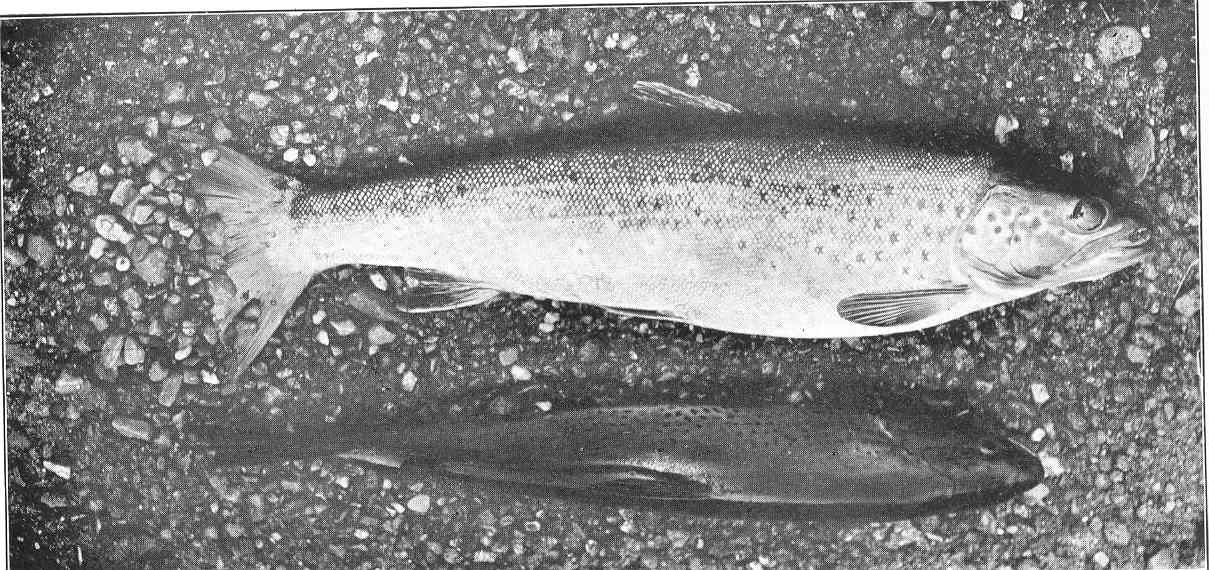
Stage summary. Sexually mature adult brown trout return to natal (or imprint) spawning gravel in fall. Brown trout are ITEROPAROUS -- they survive spawning and can return to spawn multiple times across successive years (same as steelhead + Atlantic salmon; distinct from Pacific salmon which are semelparous).
Timing structure. Three sub-windows (Tier 5 angler tradition + Tier 3 general literature; tributary-by-tributary peak weeks remain [source-required]):
- Early spawn run (October): First fresh fish move toward gravel as water temperatures drop.
- Peak spawn (late October through November): The bulk of activity across PA + NY + OH inland streams. PA Lake Erie tributary lake-run browns reportedly enter PA tribs (notably Walnut Creek) on a fall run beginning October and peaking November per Tier 5 local angler context; state-agency confirmation source-required.
- Late spawn + post-spawn (December-early January): Tail end. Post-spawn browns drop off redds and resume feeding.
Diet during spawn window. Adult browns in spawn-window physiology are NOT actively feeding -- reproductive priorities take over. They will OPPORTUNISTICALLY take eggs (drifting from upstream redds, including conspecific brown trout eggs), aquatic insect nymphs (in-stream drift), small baitfish (sculpin, dace, fry), and aggressive intrusion strikes on streamers (territorial / predator-instinct, not hunger). This is why egg + nymph + streamer patterns all produce on spawn-window browns despite reproductive physiology.
Iteroparity. Multi-spawn capable. Quantitative repeat-spawn rates for SHA-relevant PA Class A streams + PA Lake Erie lake-run browns remain [source-required].
Source-status: October-December peak late-October through November source-backed Tier 5 + Tier 3; iteroparity source-backed; tributary-by-tributary peaks + repeat-spawn rates source-required.
The three distinct brown trout fisheries -- a SHA-scope spotlight
The single most important editorial discipline for SHA brown trout content. Same species -- three different fisheries, three different management contexts, three different angler experiences. Content should not collapse them.
1. PA Class A wild brown trout streams (inland)
Spring Creek, Penns Creek, Letort, Yellow Breeches, Little Juniata, and dozens of other PA streams where wild brown trout biomass meets or exceeds 40 kg/ha (35.6 lbs/acre) per Tier 1 Pennsylvania Bulletin Vol 55 No 10 (effective November 2, 2024). Approximately 4% of PA flowing waters are designated Class A. Year-round wild populations sustained by natural reproduction without ongoing stocking. Class A = wild natural-reproduction populations of sufficient size + abundance to support a long-term sport fishery per Tier 1 PFBC Trout Water Classifications. NOT Steelhead Alley geographically -- predominantly Susquehanna + Delaware drainages. PFBC publishes Class A biomass data in Operational Guidelines but per-stream lists for SHA editorial use are [source-required].
2. NY inland 5-category trout stream management
Catskill + Adirondack + Finger Lakes tributaries where wild + stocked brown trout populations are managed under the NYSDEC Trout Stream Management Plan. Per Tier 1 NYSDEC: 5 management categories (Stocked, Stocked-Extended, Wild-Quality, Wild-Premier referenced in the NYSDEC map) distinguishing wild + stocked management with emphasis on habitat improvement + self-sustaining populations. Stocked categories receive ongoing NYSDEC spring stocking from the statewide ~1.9 million annual trout program (Tier 1 NYSDEC Spring 2026 Trout Stocking Summary). Adjacent to NY Lake Erie + Lake Ontario tributaries but managed as inland-stream fishery.
3. PA Lake Erie tributary lake-run brown trout
Walnut Creek and adjacent PA Lake Erie tributaries where PFBC stocks approximately 100,000 brown trout annually under the Lake Erie Committee's 1.1 million fish allocation per Tier 1 PFBC Summary. SEPARATE fishery from the steelhead run -- different fish, different scale, different angler experience. Tier 5 local angler context (Keystone Fly Girl, August 2024) reports October-November lake-run timing and a wild + stocked mixture; state-agency confirmation source-required. Lake-run browns typically 18-26 in -- well above the Jensen et al. 25-30 cm piscivory-shift threshold. NY + OH Lake Erie tributary lake-run brown trout coverage is [source-required]; ODNR Lake Erie tributaries are stocked with steelhead not browns.
Sources for the three-fisheries framing:
Pennsylvania Bulletin Vol 55 No 10 (effective November 2, 2024) -- Tier 1 PA
PFBC, Trout Water Classifications -- Tier 1 PA
NYSDEC, Inland Trout Stream Management in New York -- Tier 1 NY
NYSDEC, Spring 2026 Trout Stocking Summary -- Tier 1 NY
PFBC Summary Book, Lake Erie and Tributary Streams -- Tier 1 PA
CFRTU, "The Brown Trout Research Program in Ohio" -- Tier 2
Thermal envelope -- the load-bearing biological constraint
Brown trout is a coldwater obligate. Compiled from Tier 2 ODNR via CFRTU + Tier 3 NDEP Brown Trout Thermal Tolerance Analyses:
| Threshold | deg F | deg C | Source |
|---|---|---|---|
| YOY optimal growth | 62.6-64.4 | 17-18 | Tier 3 NDEP |
| Adult optimal growth | 60.8-64.4 | 16-18 | Tier 3 NDEP |
| Stress threshold | ~68 | ~20 | Tier 2 ODNR via CFRTU |
| Positive growth limit | ~76.5 | ~24.7 | Tier 3 NDEP |
| Incipient lethal (50% mortality / week) | ~76 | ~24.4 | Tier 2 ODNR via CFRTU |
| Upper thermal tolerance | ~78.8 | ~26 | Tier 3 NDEP |
SHA commerce posture. Brown trout targeting becomes biologically defensible below 68 deg F and unethical above 70 deg F. Browns are moderately more heat-tolerant than brook trout but still coldwater obligate with 50% mortality within a week above 76 deg F per ODNR. Summer high-temperature windows should shift target species toward smallmouth bass + panfish.
Why this matters for brown trout anglers
The lifecycle is the operating manual for what to tie on across brown trout size classes:
- Pre-piscivory (under 25-30 cm / 10-12 in) -> dries + nymphs + soft hackles. Match the hatch. Dry flies during hatches (BWO, sulphur, hendrickson, march-brown, midges), small nymphs (size 14-18), soft hackles, micro-streamers (size 8-10), terrestrials. See our aquatic insect lifecycle pillar.
- Piscivory shift (medium browns 10-15 in / 25-38 cm) -> transitional. Medium streamers (size 4-8), wooly buggers, sculpin-profile flies, larger nymphs. The 25-30 cm Jensen et al. inflection is the angler-decision point.
- Adult piscivory (> 15 in / > 38 cm) -> sculpin + baitfish streamers. Match the forage. Sculpin streamers, articulated patterns, baitfish patterns (Clouser, Tigofly Zonker), mouse patterns in summer trophy water.
- Spawn window (October-December) -> egg patterns BELOW redds. Per Tier 3 Animal Diversity Web. DO NOT target browns ON visibly active redds. Egg patterns are widely-attested angler tradition during the fall spawn window, NOT a Tier 1-3 quantitatively anchored selectivity claim.
- PA Lake Erie tributary lake-run (October-November per Tier 5) -> smaller-profile streamers + egg patterns. Treated similarly to steelhead patterns but typically lighter weight + smaller size. Walnut Creek is the recurring reference; state-agency confirmation
[source-required]. - Summer thermal stress (water > 68-70 deg F) -> target species shift. Brown trout targeting yields to warmwater species.
Honest gaps -- what this pillar cannot yet say at Tier 1-3
Several things still [source-required] at Tier 1-3:
- PA Lake Erie tributary lake-run brown trout wild reproduction status. Reported as a wild + stocked mixture per Tier 5 local angler context; tributary-by-tributary wild reproduction status at Tier 1-3 source-required.
- Per-stream PA Class A wild brown trout biomass figures. PFBC publishes data in Operational Guidelines but the per-stream list (Spring Creek X kg/ha, etc.) is source-required for SHA editorial use.
- State-agency confirmation of October-November PA Lake Erie tributary lake-run timing. Reported in Tier 5 angler content; agency tributary-by-tributary timing tables remain source-required.
- Quantitative diet selectivity for Lake Erie tributary lake-run brown trout. No equivalent of GLFC 2004 steelhead diet study exists for browns.
- North American stream validation of the Jensen et al. 2012 25-30 cm piscivory shift. Jensen et al. was European lacustrine; PA + NY + OH stream-population validation studies have not surfaced.
- Brown trout kelt rates + quantitative repeat-spawner frequencies. Iteroparity is biological fact; SHA-stream kelt + repeat-spawn rates are source-required.
- Lake Ontario lake-run brown trout applicability. NY Lake Ontario tributary brown trout context for the 9 SHA Lake Ontario rivers is source-required.
- NY + OH Lake Erie tributary brown trout coverage. NYSDEC documents wild + stocked browns broadly; NY + OH Lake Erie tributary-specific brown trout content remains source-required.
If you have studies that close any of these gaps, send them to us.
Image credits and licensing
- Hero / featured image -- Brown Trout (Salmo trutta). USGS Nonindigenous Aquatic Species, SpeciesID 931. Public domain federal-agency species reference image.
If you are a rights-holder and believe an image attribution needs correction, contact us at SHA -- we will fix it promptly.
Full source list
| Source | Tier | Use |
|---|---|---|
| USGS NAS, Brown Trout SpeciesID 931 | 3 | LOAD-BEARING identity + invasion + distribution. |
| Pennsylvania Bulletin Vol 55 No 10, Class A Wild Trout Streams (Nov 2, 2024) | 1 | LOAD-BEARING PA Class A wild brown trout biomass threshold 40 kg/ha. |
| PFBC, Trout Water Classifications | 1 | PFBC trout-water designation framework; Class A definition. |
| NYSDEC, Inland Trout Stream Management | 1 | NY 5-category Trout Stream Management Plan. |
| NYSDEC, Spring 2026 Trout Stocking Summary | 1 | NYSDEC ~1.9M trout statewide annually; 2024 drought reduced 2025 stocked brown size. |
| PFBC Summary Book, Lake Erie and Tributary Streams | 1 | PFBC ~100,000 brown trout annually into Lake Erie + tributaries. |
| CFRTU, "Brown Trout Research Program in Ohio" | 2 | ODNR 25,000 yearlings (6-8 in) mid-October across Mad River + Clear Fork + Clear Creek; stress 68 deg F; incipient lethal 76 deg F; ~2 yrs to 12 in; movement few hundred yards typical, up to 5 mi upstream. |
| Nevada DEP, Brown Trout Thermal Tolerance Analyses | 3 | Adult optimal 60.8-64.4 deg F; YOY 62.6-64.4 deg F; upper tolerance ~78.8 deg F; positive growth limit ~76.5 deg F. |
| Jensen et al. (2012), Journal of Fish Biology | 3 | LOAD-BEARING ontogenetic shift to piscivory at ~30 cm; gradual 25-30 cm; piscivory most frequent > 30 cm. European lacustrine. |
| Animal Diversity Web, Salmo trutta | 3 | Piscivorous browns eat trout eggs fall + early winter; small suckers, minnows, sculpin, darters, terrestrials; newly emerged fry prey on chironomid larvae + baetid nymphs. |
| Keystone Fly Girl, "Brown Trout in Steelhead Alley" (Aug 2024) | 5 | Translation-support: PA Walnut Creek lake-run Oct-Nov timing + wild/stocked mixture. |
Common questions about the brown trout life cycle
When do brown trout spawn?
Brown trout spawn in fall -- primarily October through December, with peak activity late October through November in PA + NY + OH inland streams. Some redd activity is documented as early as mid-October and as late as early January. Declining water temperatures + shortening photoperiod is the broadly-cited trigger; the specific Tier 1-3 thermal-trigger threshold for spawn-run initiation remains [source-required]. PA Lake Erie tributary lake-run browns are reported to enter PA tribs (notably Walnut Creek) October-November per Tier 5 local angler context (Keystone Fly Girl, August 2024); state-agency confirmation remains [source-required].
What's the optimal temperature for brown trout?
Adult optimal growth is 60.8-64.4 deg F (16-18 deg C) per Tier 3 Nevada DEP Brown Trout Thermal Tolerance Analyses; YOY optimal 62.6-64.4 deg F. Stress threshold approximately 68 deg F per Tier 2 ODNR via CFRTU. Incipient lethal approximately 76 deg F with documented 50% mortality within a week per ODNR. Upper thermal tolerance ~78.8 deg F per NDEP. Productive brown trout targeting becomes biologically defensible below 68 deg F and unethical above 70 deg F per the SHA thermal-stress posture.
How big do PA brown trout get?
Per Tier 3 USGS NAS SpeciesID 931, maximum brown trout size is 103 cm (~40 in); trophy specimens are rare. Per Tier 2 ODNR via CFRTU, Ohio-stocked yearlings (6-8 in at stocking) reach 12 in in approximately 2 years. SHA size classes: newly stocked yearlings 6-9 in; sub-adult resident 8-15 in; adult resident 12-22 in (30-56 cm); trophy resident 22+ in. PA Class A wild streams produce 12-22 in adult fish routinely; trophy 24+ in PA wild browns exist in nutrient-rich limestone systems but per-stream size-class distributions remain [source-required]. PA Lake Erie tributary lake-run browns are typically 18-26 in.
Are brown trout native to North America?
No. Brown trout (Salmo trutta) is native to Europe, northern Africa, and western Asia per Tier 3 USGS NAS SpeciesID 931. Connecticut records date to 1865; the first US documented introduction was approximately 1880 (Arizona + Colorado). Now established in 50+ US states -- NY 58 HUCs, PA 53 HUCs, CA 52, ID 51, MT 51, CO 43, MI 41. USFWS lists brown trout as injurious wildlife; USGS NAS classifies it as Exotic Fish (Nonindigenous). Naturalized wild populations have persisted in PA + NY systems 140+ years but the species remains taxonomically introduced.
What do brown trout eat?
Brown trout diet shifts dramatically with size per Jensen et al. 2012 (Tier 3 peer-reviewed): below ~25-30 cm (~10-12 in) browns feed primarily on benthic invertebrates + surface insects (mayfly nymphs, stonefly nymphs, caddis larvae, midge larvae, terrestrial drift). Above ~25-30 cm the dietary shift to piscivory occurs; large browns > 30 cm are primarily piscivorous -- feeding on small suckers, minnows (shiners), sculpin, darters per Tier 3 Animal Diversity Web. Browns also commonly eat trout eggs during fall + early winter spawn windows. The 25-30 cm ontogenetic piscivory shift is the single most important biological inflection point for fly-pattern selection. Note: Jensen et al. 2012 was European lacustrine; North American stream validation remains [source-required].
What's the difference between a wild brown trout and a stocked brown trout?
A WILD brown trout was hatched in a stream from a redd built by a wild parent. PA Class A wild brown trout streams are designated by PFBC as supporting wild biomass >= 40 kg/ha (35.6 lbs/acre) per Tier 1 Pennsylvania Bulletin Vol 55 No 10 (effective November 2, 2024); ~4% of PA flowing waters are designated Class A. A STOCKED brown trout was raised in a hatchery and released by a state agency. PFBC stocks ~100,000 brown trout annually into PA Lake Erie + tributaries per Tier 1 PFBC Summary. NYSDEC includes brown trout in the statewide ~1.9 million annual spring trout program (Tier 1). ODNR stocks 25,000 yearling browns annually across Mad River + Clear Fork + Clear Creek per Tier 2 ODNR via CFRTU. NY Trout Stream Management Plan uses 5 categories distinguishing these management contexts.
How long do brown trout live?
Brown trout typically live 5-7 years in productive wild stream systems; longer in nutrient-rich tailwater + limestone systems. Per Tier 2 ODNR via CFRTU, Ohio-stocked yearlings reach 12 in in approximately 2 years; the Jensen et al. 2012 piscivory shift typically occurs around Age 2-3 in productive systems. Brown trout are iteroparous (multi-spawn capable), unlike Pacific salmon which are semelparous. Trophy 22+ in browns are typically 5-8+ years old. Maximum documented 103 cm (~40 in) per Tier 3 USGS NAS represents fish of substantially advanced age. Quantitative lifespan + repeat-spawn data for SHA-relevant streams remain [source-required].
Continue learning
This is the inland-trout lifecycle anchor. Continue with:
- Steelhead Life Cycle -- flagship Lake Erie steelhead biology pillar; sibling Salmonidae lifecycle.
- Brook Trout Life Cycle -- Pennsylvania's only native wild trout; native coldwater complement to introduced brown trout.
- Aquatic Insect Life Cycles: What Exactly Is a Hatch? -- entomology glossary that defines pre-piscivory brown trout fly-pattern selection below the Jensen et al. 25-30 cm inflection.
- White Sucker Life Cycle -- documented brown trout forage; small suckers are documented brown trout prey per Tier 3 Animal Diversity Web.
- Emerald Shiner Life Cycle -- documented brown trout forage broadly; PA Lake Erie lake-run brown trout selectivity on emerald shiner is translation heuristic.
- The Steelhead Alley Seasonal Calendar -- the annual rhythm -- brown trout fall spawn windows are in the October + November sections.
- Brown Trout Stocking Programs Across PA, NY, OH -- the state-level stocking program comparison.