Gizzard Shad Life Cycle: The Walleye and Smallmouth Forage Engine
The documented Lake Erie clupeid forage anchor for adult walleye and age-0 smallmouth bass -- over 84% of 2015 adult walleye diets by dry weight, and 34% of smallmouth + white bass fall diets per the GLFC Forage Task Group March 2016 report. Egg, larva, YOY, Age 1, adult -- the lifecycle stages every Lake Erie warmwater angler should understand before tying on a shad-pattern streamer or rigging a paddle-tail swimbait, and the honest reason gizzard shad is NOT a documented Lake Erie steelhead pattern.
TL;DR -- if you only read one block
The Lake Erie warmwater predator fishery rides on a clupeid, not a hatch. The GLFC Lake Erie Forage Task Group's March 2016 report documents 2015 adult walleye diets at over 84% gizzard shad by dry weight and age-0 gizzard shad at 34% of smallmouth bass + white bass fall diets. That single set of numbers anchors shad biology near the top of the priority list for anyone targeting walleye or smallmouth on Lake Erie's western and central basins. This article walks Dorosoma cepedianum from egg through adult, ties each stage to the angler-translation patterns SHA surfaces in the gear rotation, and is explicit about one of the most important honest gaps in the Steelhead Alley forage library: gizzard shad is NOT documented in the GLFC 2004 Coldwater Task Group's top Lake Erie steelhead prey items, and we will not invent a steelhead-on-shad linkage the source record does not support.
What this pillar is for
This is the walleye and smallmouth bass pillar of the SHA forage library. Most of the other lifecycle pillars on this site (emerald shiner, rainbow smelt, round goby, white sucker, sculpin, crayfish, salmonid eggs) are built around the GLFC 2004 Lake Erie steelhead diet study and its documented top prey items. Gizzard shad is different. The Tier 1 anchor for gizzard shad is the warmwater predator complex -- adult walleye and age-0 smallmouth bass + white bass -- not steelhead or trout. We are publishing this pillar because gizzard shad is a structurally important Lake Erie forage species, because the walleye + smallmouth selectivity is well-anchored to a GLFC Tier 1 source, and because preserving the honest absence of steelhead-on-shad evidence is part of the source-discipline that defines this library.
Primary anchor: GLFC Lake Erie Committee Forage Task Group, March 2016 report (covering 2015 data) -- Tier 1
Identity
- Common name: Gizzard Shad (also "American Gizzard Shad")
- Scientific name: Dorosoma cepedianum (Le Sueur, 1818)
- Family: Clupeidae (herring family) -- the same family as alewife, rainbow smelt's distant cousin via Osmeridae, and the eastern shad species. A true clupeid, not a shiner (which would be Leuciscidae / Cyprinidae).
- Native range: Mississippi, Atlantic, and Gulf Slope drainages from Quebec to central North Dakota and New Mexico, south to central Florida and Mexico, per USGS Nonindigenous Aquatic Species (Tier 3 federal species reference).
- Great Lakes status: CRYPTOGENIC in the southern Great Lakes per USGS NAS (Lake Ontario, Lake St. Clair, southern Lake Erie, southern Lake Michigan). "Cryptogenic" is the deliberate scientific posture: native-vs-introduced is genuinely uncertain in those basins. This is structurally different from rainbow smelt (unambiguously introduced via 1912 Crystal Lake stocking) or emerald shiner (clearly native to the Great Lakes basin). Honest publication wording: "cryptogenic in the southern Great Lakes," NOT "native to Lake Erie" or "introduced to Lake Erie."
- Working scope for this article: species-level, Lake Erie focus. Lake Ontario applicability requires separate citation and is not made in this pillar.
- Regional aliases (heuristic): "shad", "mud shad", "hickory shad" (locally; not the true Hickory Shad Alosa mediocris).
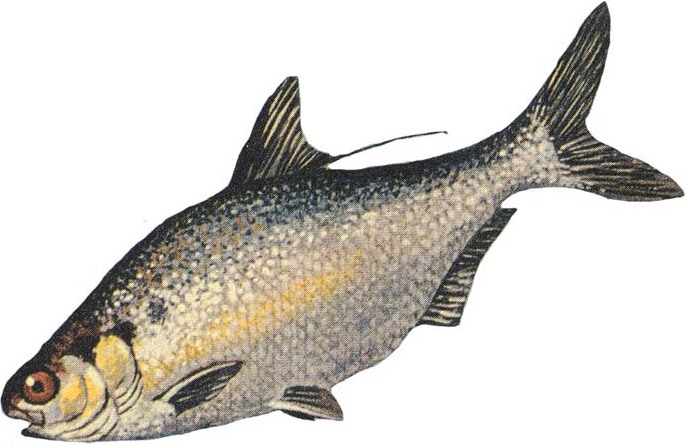
Identification field marks per USGS NAS: deep-bodied silvery clupeid with a distinctive long, threadlike last ray of the dorsal fin (the "thread" that gives the genus its alternative common name "threadfin"); blunt rounded snout overhanging an inferior (subterminal) mouth; muscular gizzard-like stomach (the trait the common name comes from) used for grinding phytoplankton + detritus; large dark shoulder spot behind the gill cover in juveniles, fading with age. Maximum length 52 cm (~20.5 in) per USGS NAS.
Sources:
USGS Nonindigenous Aquatic Species, Gizzard Shad (Dorosoma cepedianum) species profile -- Tier 3
Lifecycle stage 1: Egg
Stage summary: Spring-into-early-summer broadcast spawning event over shallow vegetation or open water; eggs are adhesive demersal; no parental care.
Timing. Per Bodola 1966 (Tier 3, USGS Great Lakes Science Center Fishery Bulletin), western Lake Erie gizzard shad spawn from mid-May to mid-June, with the most intensive activity near mid-June. The thermal trigger is approximately 67 deg F (~19.5 deg C). Per USGS NAS (Tier 3), spawning generally runs mid-May to mid-June across the species' range. This is one of the most defensibly source-anchored Lake-Erie-specific spawn timing windows in the entire SHA forage library -- Bodola's western Lake Erie work is exactly the geography and species these claims apply to.
Fecundity. Roughly 300,000 eggs per female per USGS NAS. High fecundity is typical for the broadcast-spawning clupeids and underwrites the year-class swings the GLFC FTG tracks annually.
Habitat. Shallow nearshore zones, embayments, harbor flats, and lower-river sections with soft mud bottoms and aquatic vegetation per USGS NAS habitat profile. Gizzard shad eggs are adhesive and demersal, sticking to vegetation or substrate where they hatch in roughly 2-3 days per USGS NAS.
Predator encounter notes. Eggs are not a documented Lake Erie sport-fish target item -- there is no gizzard-shad-egg fly-pattern tradition the way there is a sucker-spawn fly-pattern tradition (PFBC's 50 deg F sucker spawn trigger is the dominant Lake Erie egg-pattern anchor; see our white sucker forage pillar for that lane). Gizzard shad eggs go into the broader spring food web as panfish + warmwater incidental prey, but quantitative selectivity is [source-required].
Source-status labels for this stage: spawn timing + thermal trigger is source-backed via Bodola 1966 (Tier 3); fecundity + hatch time is source-backed via USGS NAS (Tier 3); spawning habitat is source-backed via USGS NAS; egg-stage predator selectivity is source-required.
Sources for this stage:
Bodola, Anthony (1966), "Life history of the gizzard shad, Dorosoma cepedianum (Le Sueur), in western Lake Erie", Fishery Bulletin -- Tier 3
USGS Nonindigenous Aquatic Species, Gizzard Shad species profile -- Tier 3
Lifecycle stage 2: Larva
Stage summary: Hatched larvae are small, transparent, weak swimmers; drift in nearshore shallows; transition to active feeding on small zooplankton (copepods, cladocerans) within days to weeks.
Habitat. Larval gizzard shad use nearshore shallows, embayments, and protected harbor zones as nursery habitat per USGS NAS. The same shallow warm-water zones where adult shad spawn double as larval rearing habitat -- juveniles do not need to move far to find food.
Feeding. Per USGS NAS, juveniles feed on copepods and cladocerans -- the zooplankton classes that dominate spring-into-summer Lake Erie nearshore water columns. This is a fast-growth-phase diet that drives the rapid juvenile size gains documented later.
Predator encounter notes. Larval shad are below the gape-limit of adult walleye, smallmouth bass, and steelhead. They enter the food web for yellow perch fry, juvenile smallmouth, white bass YOY, and other shallow-water planktivores, but quantitative Lake Erie selectivity is [source-required].
Source-status labels for this stage: larval feeding + nearshore nursery habitat is source-backed via USGS NAS; quantitative larval predator selectivity is source-required.
Source for this stage:
USGS Nonindigenous Aquatic Species, Gizzard Shad species profile -- Tier 3
Lifecycle stage 3: YOY / age-0 juvenile
Stage summary: Young-of-year by autumn of their first summer. This is the most predator-relevant Lake Erie gizzard shad size class and the size band that drives the documented 34% age-0 contribution to smallmouth bass + white bass fall diets per GLFC FTG March 2016.
Size. Per USGS NAS, juveniles reach 10-18 cm (3.9-7.1 in) within their first year. This is a remarkable first-year growth curve for a forage species and is structurally why gizzard shad outgrows steelhead and smallmouth gape so quickly. By the end of their first summer, many YOY shad already sit at the upper end of the predator-relevant 2-6 in band.
Habitat. Juvenile gizzard shad use the same nearshore + harbor + lower-river-section habitat band as larval shad initially, then expand into the open western and central basin water columns as they grow. Schooling behavior is pronounced -- the dense YOY shad schools that drive late-summer / fall predator feeding are a Lake Erie warmwater commerce target.
Predator encounter notes. This is the source-backed predator-relevant window:
- Smallmouth bass + white bass FALL diet anchor: source-backed (Tier 1 GLFC FTG March 2016) -- age-0 gizzard shad accounted for 34% of 2015 Lake Erie smallmouth bass + white bass fall diets. This is the structural Tier 1 source for shad-pattern lure + streamer commerce targeting smallmouth in fall windows.
- Walleye summer YOY-diet anchor (historical): source-backed (Tier 3 USGS) -- young-of-year walleyes in extreme western Lake Erie historically fed primarily on gizzard shad and alewives in summer, then shifted to emerald shiners in fall. This is historical YOY context and complements the current GLFC FTG adult-walleye anchor below.
- Population status: source-backed (Tier 1 GLFC FTG March 2026) -- 2025 age-0 gizzard shad biomass came in at 0.8 kg/ha, down 74.8% from 2024 and 75.4% below the 2014-2024 mean. YOY year-class strength was at a multi-year low.
Source-status labels for this stage: YOY first-year size is source-backed via USGS NAS; smallmouth + white bass fall diet selectivity is source-backed via GLFC FTG March 2016 (Tier 1); historical YOY walleye summer diet is source-backed via USGS historical Tier 3; current YOY biomass status is source-backed via GLFC FTG March 2026 (Tier 1).
Sources for this stage:
GLFC Lake Erie Forage Task Group, March 2016 report (covering 2015 data) -- Tier 1
GLFC Lake Erie Forage Task Group, March 2026 report -- Tier 1
USGS Nonindigenous Aquatic Species, Gizzard Shad species profile -- Tier 3
USGS publication, "Food of young-of-the-year walleyes in Lake Erie" (historical) -- Tier 3
Lifecycle stage 4: Adult (Age 1+ / spawning)
Stage summary: Age 1 onward. Sexual maturity at 2-3 years per USGS NAS; northern-population life expectancy 5-7 years with individuals reaching 10-11 years. Adult shad are above most Lake Erie sport-fish gape thresholds and are primarily targeted by very large walleye, pike, and muskie, plus open-water trolling presentations.
Size at age (Bodola 1966, Tier 3 USGS Great Lakes Science Center, western Lake Erie):
| Age class | Males (mm SL) | Males (in) | Females (mm SL) | Females (in) |
|---|---|---|---|---|
| Age 1 | 141 mm | 5.5 in | 140 mm | 5.5 in |
| Age 2 | 273 mm | 10.7 in | 285 mm | 11.2 in |
| Age 3 | 313 mm | 12.3 in | 335 mm | 13.2 in |
| Age 4 | 343 mm | 13.5 in | 364 mm | 14.3 in |
| Age 5 | 349 mm | 13.7 in | 386 mm | 15.2 in |
Maximum length 52 cm (~20.5 in) per USGS NAS. Seasonal growth is most rapid in July-August and reduced or nil January-April per Bodola 1966 -- winter is a survival window, not a growth window.
Habitat. Adult gizzard shad use warm, fertile, shallow water with soft mud bottoms per USGS NAS; tolerate high turbidity; avoid waters with dissolved oxygen below 2 mg/L. Optimal thermal range is 22-29 deg C (72-84 deg F) per USGS NAS, with satisfactory growth up to 34 deg C. This is fundamentally a warmwater species -- its temperature window overlaps the late-spring through summer warmwater predator window, NOT the coldwater steelhead/trout window.
Predator encounter notes -- the walleye anchor. Per GLFC Lake Erie Forage Task Group March 2016 (Tier 1, 2015 data): 2015 adult walleye diets in Lake Erie were over 84% gizzard shad by dry weight. This is the single most important quantitative anchor for shad-pattern lure + streamer commerce at the Lake Erie scope. Combined with the 34% age-0 contribution to smallmouth + white bass fall diets, the walleye + smallmouth + white bass forage relationship with gizzard shad is among the best-documented predator-prey couplings in the Lake Erie food web.
Source-status labels for this stage: size-at-age is source-backed via Bodola 1966 (Tier 3); maximum length + thermal range + habitat is source-backed via USGS NAS (Tier 3); adult walleye diet selectivity is source-backed via GLFC FTG March 2016 (Tier 1); gape-limit explanation for steelhead absence is structural inference, not directly sourced.
Sources for this stage:
Bodola, Anthony (1966), "Life history of the gizzard shad, Dorosoma cepedianum (Le Sueur), in western Lake Erie", Fishery Bulletin -- Tier 3
GLFC Lake Erie Forage Task Group, March 2016 report -- Tier 1
USGS Nonindigenous Aquatic Species, Gizzard Shad species profile -- Tier 3
Walleye + smallmouth diet anchor spotlight
This is the source-backed anchor at the core of the gizzard shad pillar. The GLFC Lake Erie Forage Task Group's March 2016 report (Tier 1 multi-agency state authority) documents two numbers worth memorizing:
- 2015 adult walleye diets: gizzard shad over 84% by dry weight. This is the adult-walleye diet-composition snapshot for the year covered by the March 2016 report. Gizzard shad is the dominant energy-density forage in the Lake Erie adult walleye diet at that snapshot.
- Age-0 gizzard shad: 34% of smallmouth bass + white bass FALL diets. This is the structural autumn coupling -- the dense YOY shad schools that fatten through July-August (Bodola 1966 rapid-growth window) become the dominant fall predator diet item for the two warmwater bass species that overlap shad nearshore zones.
Practical implications for the angler:
- Shad-pattern presentations are at their highest defensibility for Lake Erie walleye in open-water and harbor-mouth windows during warmwater months -- exactly where Bodola 1966's western Lake Erie shad-growth window sits (rapid July-August).
- Shad-pattern presentations are at their highest defensibility for smallmouth bass in the fall YOY-shad window -- when age-0 shad school densely and the GLFC FTG diet-composition data anchors the bite.
- White bass overlap heavily with smallmouth in the fall age-0-shad window per the same GLFC source. Shad-pattern jigs + spoons + swimbaits sized for the YOY 2-5 in band cover both species.
- Steelhead and trout are NOT part of this anchor. The GLFC 2004 Coldwater Task Group steelhead diet study documented top prey as emerald shiner, rainbow smelt, round goby, and juvenile yellow perch. Gizzard shad does not appear in that top list.
Source for the walleye + smallmouth anchor:
GLFC Lake Erie Forage Task Group, March 2016 report (covering 2015 data) -- Tier 1
Winterkill spotlight
One of the structural facts of gizzard shad biology in Lake Erie is winter cold-stress mortality. The peer-reviewed primary source is Fetzer et al. 2011 in Transactions of the American Fisheries Society 140(6): controlled-temperature laboratory experiments demonstrating that gizzard shad mortality is low above 46 deg F (~7.8 deg C) and high below 39 deg F (~3.9 deg C). Cold stress -- not starvation -- was identified as the primary driver, and within each temperature treatment YOY shad died faster than larger fish. Oneida Lake (New York) sits near the northern edge of the species' distribution and is the study site context.
Practical implications:
- YOY are the most vulnerable size class -- the same size class that drives the 34% age-0 contribution to smallmouth + white bass fall diets per GLFC FTG March 2016. A hard winter that pulls Lake Erie harbor + lower-river water below 39 deg F can compound year-class loss already underway from the 2025 multi-year-low biomass.
- Harbor mouths and lower river sections concentrate winterkill events -- per Fetzer et al. 2011, those are the zones where water stratifies cold rapidly and prevents acclimation. This is also where steelhead anglers fish in late winter and early spring.
- The post-winterkill shoreline-scavenging window is the ONE thermal scenario where gizzard shad and steelhead/trout co-occur in time + space. Water 34-46 deg F is the dying-shad window; it overlaps the late-winter / early-spring Lake Erie steelhead tributary window. The biological coupling is structurally plausible; the Tier 1-3 steelhead-diet evidence to anchor it is not present. Treat any "steelhead eating dead winterkill shad" claim as translation heuristic.
Source for the winterkill spotlight:
Fetzer, W.W., Brooking, T.E., Jackson, J.R., and Rudstam, L.G. (2011), "Overwinter mortality of gizzard shad: evaluation of starvation and cold temperature stress", Transactions of the American Fisheries Society 140(6) 1460-1477 -- Tier 3 peer-reviewed primary technical source
Why this matters for anglers
Pattern selection priority for shad imitations at the Lake Erie scope is structural -- driven by the source record, not by angler folklore:
walleye > smallmouth bass >> steelhead / trout
Walleye sits first because the GLFC FTG March 2016 anchor is overwhelming: 84% by dry weight in 2015 adult diets. Smallmouth sits second because the same source documents 34% age-0 contribution to fall diets -- a strong but narrower seasonal coupling. Steelhead and trout sit far behind a "much less than" -- not zero, but translation heuristic only beyond walleye and smallmouth.
Lifecycle stages map to angler patterns as follows:
- Egg stage: not a target for shad-pattern fishing. (Sucker spawn fly patterns + glo bugs cover the broader egg-availability translation -- but those are sucker eggs, not shad eggs. See our white sucker forage profile for that lane.)
- Larva stage: not directly targeted by adult sport-fish anglers; below gape-limit for adult walleye and smallmouth.
- YOY / age-0 (2-5 in by late summer / fall): the dominant predator-relevant size class. Pearl/silver shad-profile streamers in size 4-8 hooks (fly), 3-5 in paddle-tail swimbaits + jigging spoons (gear/spin). This is the GLFC FTG fall smallmouth + white bass anchor in lure form.
- Age 1 (5.5 in): upper end of typical predator-relevant range; size 1/0 to 4 hooks; full-size Sparkle Minnow + Murdich Minnow + larger paddle-tail swimbaits. Walleye summer diet anchor (Tier 1 GLFC FTG March 2016) sits here.
- Age 2+ (10+ in): outgrows typical Lake Erie sport-fish gape; targeted only by very large walleye, pike, muskie, or open-water trolling rigs. Not a typical Steelhead Alley commerce target.
Presentation maps to seasonal stage:
- Late spring / early summer (Bodola 1966 spawn window, mid-May to mid-June, ~67 deg F trigger): spawning aggregations of adult shad in harbor flats and lower river sections; large walleye target adult shad at the spawn. Shad-pattern jigs and swung streamers along harbor mouths.
- Summer (July-August Bodola growth peak): YOY shad schools fatten through the rapid-growth window; adult walleye on shad schools in open-water and harbor zones; trolling shad-pattern lures + casting paddle-tail swimbaits along harbor walls.
- Fall (GLFC FTG smallmouth + white bass anchor): age-0 shad school densely; 34% of smallmouth + white bass fall diets. Pearl/silver shad-profile streamers and 3-4 in paddle-tail swimbaits along nearshore structure.
- Late winter / early spring (Fetzer et al. 2011 winterkill window): dying shad in harbor mouths and lower river sections; post-winterkill shoreline scavenging window. Steelhead/trout co-occur with dying shad here, but the diet-selectivity linkage is translation heuristic, not Tier 1-3 anchored.
Color choice: pearl/silver/white is the documented silvery clupeid baseline. Chrome/silver flash extends the profile in clear-water conditions. Chartreuse + flash is the stained-water visibility heuristic from angler-translation.md.
Curator's Picks
Four patterns from our gear set that map directly to the gizzard shad lifecycle stages -- editor context tied to walleye + smallmouth bass, NOT steelhead/trout, per the source record.
- Clouser Minnow in pearl/silver. The canonical baitfish streamer reframed for the walleye + smallmouth shad-imitation lane. Size 1/0 to 4 hooks sit in the YOY-to-Age-1 predator-relevant 2-6 in body band per Bodola 1966. Pearl/silver/white is the documented silvery clupeid profile. The GLFC FTG March 2016 anchor (84% by dry weight in 2015 adult walleye diets; 34% age-0 in smallmouth + white bass fall diets) is the source anchor behind this pattern selection. Editor framing intentionally walleye + smallmouth; not a steelhead pattern at the Lake Erie scope per GLFC 2004 documented top prey.
- Tigofly weighted Zonker streamer. Second shad-profile anchor for walleye + smallmouth swung-fly presentations. The Zonker strip + silver body covers the broader Age-1 5.5 in shad silhouette per Bodola 1966 western Lake Erie size-at-age. Weight pulls the fly into deeper harbor-mouth and offshore zones where walleye stack on shad schools during the July-August Bodola growth-peak window. Useful for the open-water + harbor-mouth walleye + smallmouth angler.
- Articulated Sparkle Minnow. Larger / flash-heavy variant of the shad-imitation set. Articulation gives wider swim profile that matches the Age-1+ adult-shad silhouette and pairs with the energy-density-rich gizzard shad forage value driving the 84% dry-weight walleye-diet anchor. Pearl/silver flash density works the chartreuse + flash stained-water visibility heuristic when western basin turbidity rises. Target species: walleye and smallmouth bass.
- Brass beadhead glo-bug + assorted nymph kit. Complementary entry-level kit that covers the small-profile / YOY-context lane around the shad-imitation streamer set. Not a shad-pattern fly itself -- glo bugs honor the spring egg-availability window (sucker spawn at 50 deg F per PFBC, not the gizzard shad spawn at ~67 deg F), and the assorted nymph variety covers incidental small-prey cues. Use this kit as the budget on-ramp for new anglers building toward the shad-pattern streamer + swimbait + spoon rotation. Target context remains walleye + smallmouth-leaning warmwater predators; not a steelhead pattern.
Honest gaps -- what this pillar cannot yet say at Tier 1-3
SHA is building toward an authoritative Lake Erie forage library. Several things you might want from this article -- and that we will not invent -- are still [source-required] at the Tier 1-3 level:
- Steelhead-on-gizzard-shad diet selectivity at the Lake Erie tributary scope. The GLFC 2004 Coldwater Task Group steelhead diet study (Tier 1, n=349 stomachs, West Central Basin June-October) documented top prey items as emerald shiner, rainbow smelt, round goby, and juvenile yellow perch. Gizzard shad was NOT in the top documented prey items. Two structural explanations are honest and both should be preserved: (a) adult gizzard shad outgrow steelhead mouth gape quickly -- by Age 1 already 5.5 in per Bodola 1966; and (b) the GLFC 2004 sampling window (primarily July-September) biases AGAINST the late-winter / early-spring winterkill scavenging window when shoreline-dead shad would be most accessible. Neither explanation is itself directly sourced; both are structural inferences from the surrounding evidence. The honest gap remains: there is no Tier 1-3 study quantifying steelhead-on-shad selectivity for Lake Erie.
- Brown-trout-on-gizzard-shad diet selectivity for Lake Erie tributaries. Same gap as steelhead, same gape + sampling-window reasoning.
- Winterkill incident timing for named Steelhead Alley tributaries. The Fetzer et al. 2011 thermal thresholds (low mortality above 46 deg F, high below 39 deg F) are Oneida Lake-derived but generalize to Lake Erie's northern-edge distribution. Specific Conneaut / Chagrin / Grand / Rocky / Cattaraugus / Elk / Walnut harbor + lower-river winterkill incident records would require state-agency surveys that have not surfaced in our reference set.
- Tributary-specific shad spawning windows beyond Bodola 1966's western Lake Erie aggregate. Bodola anchors the mid-May to mid-June window for western Lake Erie. Per-tributary peak timing for Steelhead Alley rivers is
[source-required]. - Quantitative gape-limit thresholds for steelhead size classes consuming specific gizzard shad size classes. The gape-limit explanation is structurally sound; quantifying it (which steelhead size eats which shad age class) would require a directed diet study at Lake Erie scope.
- Wind-driven nearshore-concentration of dying or dead gizzard shad in pre-ice-up cold-front windows. Real phenomenon per angler observation; not source-anchored for Lake Erie.
- Current adult walleye gizzard-shad selectivity beyond the 2015 GLFC FTG snapshot. The 84% by dry weight is anchored to 2015 data. A multi-year selectivity series would require additional GLFC FTG annual-report extraction.
- Whether the GLFC FTG March 2026 multi-year-low (0.8 kg/ha, down 74.8% from 2024) is a transient signal or part of a longer trend. One year of data is not a trend; the GLFC FTG report flags it as below average; durable trajectory needs additional reporting cycles.
If you have access to studies that close any of these gaps, send them to us. The library grows when source-backed evidence does.
The takeaways
What is gizzard shad? Dorosoma cepedianum (family Clupeidae) is a deep-bodied silvery filter-feeding clupeid native to the Mississippi + Atlantic + Gulf Slope drainages, cryptogenic in the southern Great Lakes per USGS NAS Tier 3. Maximum length 52 cm (~20.5 in); juveniles reach 10-18 cm in their first year; western Lake Erie Age 1 already 5.5 in per Bodola 1966.
Why does it matter for anglers? Per GLFC Lake Erie Forage Task Group March 2016 (Tier 1): 2015 adult Lake Erie walleye diets were over 84% gizzard shad by dry weight; age-0 gizzard shad accounted for 34% of smallmouth bass + white bass fall diets. This is the warmwater predator anchor of the SHA forage library.
Lifecycle to angler-translation: egg + larva stages aren't sport-fish targets; YOY age-0 (2-5 in by fall) drives the smallmouth + white bass fall-diet anchor and matches pearl/silver shad-profile streamers + 3-4 in paddle-tail swimbaits; Age 1 (5.5 in) drives the adult walleye summer-diet anchor and matches full-size streamers + 4-5 in swimbaits + jigging spoons; Age 2+ (10+ in) outgrows typical Lake Erie sport-fish gape.
Spawn window: mid-May to mid-June peak in western Lake Erie per Bodola 1966, ~67 deg F thermal trigger, ~300,000 eggs per female, 2-3 day hatch per USGS NAS.
Winterkill window: low mortality above 46 deg F, high below 39 deg F, cold stress not starvation, YOY most susceptible per Fetzer et al. 2011 TAFS 140(6). Harbor mouths and lower river sections concentrate winterkill.
2025 abundance status: age-0 biomass 0.8 kg/ha, down 74.8% from 2024 and 75.4% below the 2014-2024 mean per GLFC FTG March 2026.
Honest caveat: gizzard shad is NOT in the GLFC 2004 documented Lake Erie steelhead top prey items. Adult shad outgrow steelhead mouth gape quickly, and the GLFC 2004 sampling window biases against the late-winter / early-spring winterkill scavenging window. Both explanations are structural inference. We will not invent a steelhead-on-shad linkage the source record does not support. Pattern selection priority: walleye > smallmouth >> steelhead/trout.
Why we're publishing this
SHA is building toward being the authoritative Lake Erie biology + forage library across the warmwater + coldwater predator spectrum. Most fishing content treats gizzard shad as a generic "shad" without anchoring walleye + smallmouth selectivity to the GLFC FTG March 2016 numbers, without honoring the cryptogenic-vs-native USGS framing, and without preserving the honest absence of steelhead-on-shad evidence. This pillar cites size-at-age to Bodola 1966 (Tier 3 USGS Great Lakes Science Center), cites the walleye + smallmouth diet anchor to GLFC FTG March 2016 (Tier 1), cites the winterkill mechanism to Fetzer et al. 2011 TAFS 140(6) (Tier 3 peer-reviewed primary technical), cites the 2025 population status to GLFC FTG March 2026 (Tier 1), preserves the USGS Tier 3 cryptogenic-Great-Lakes framing, and is explicit that steelhead/trout are NOT a target species for shad-pattern commerce at the Lake Erie scope. That discipline is what we want behind every biology pillar on the site.
Full source list
| Source | Tier | Use |
|---|---|---|
| GLFC Lake Erie Forage Task Group, March 2016 report (covering 2015 data) | 1 | Walleye + smallmouth diet anchor: 2015 adult Lake Erie walleye diets were over 84% gizzard shad by dry weight; age-0 gizzard shad accounted for 34% of smallmouth bass + white bass fall diets. Primary Tier 1 quantitative anchor for walleye + smallmouth_bass target species defaults in pattern-mapping.md. |
| GLFC Lake Erie Forage Task Group, March 2026 report | 1 | 2025 age-0 gizzard shad biomass 0.8 kg/ha, down 74.8% from 2024 and 75.4% below the 2014-2024 mean. Gizzard shad classified as part of the clupeid functional grouping in current Lake Erie forage assessments. |
| USGS Nonindigenous Aquatic Species, Gizzard Shad (Dorosoma cepedianum) species profile | 3 | Taxonomy (Clupeidae); native Mississippi/Atlantic/Gulf Slope drainages from Quebec to North Dakota/New Mexico south to Florida/Mexico; cryptogenic in southern Great Lakes (Ontario, Lake St. Clair, southern Lake Erie, southern Lake Michigan); max length 52 cm (~20.5 in); juveniles reach 10-18 cm within first year; juveniles feed on copepods/cladocerans; adults planktivorous filter-feeders; optimal temp 22-29 deg C; spawning mid-May to mid-June; ~300,000 eggs per female; eggs hatch in 2-3 days; sexual maturity at 2-3 years; part of diet of at least 17 game fishes including walleye, largemouth bass, white crappie. |
| Bodola, Anthony (1966), "Life history of the gizzard shad, Dorosoma cepedianum (Le Sueur), in western Lake Erie", Fishery Bulletin | 3 | Western Lake Erie spawning early June into July, peak mid-June at ~67 deg F trigger. Size at age: males Age 1 = 141 mm, Age 2 = 273 mm, Age 3 = 313 mm, Age 4 = 343 mm, Age 5 = 349 mm; females Age 1 = 140 mm, Age 2 = 285 mm, Age 3 = 335 mm, Age 4 = 364 mm, Age 5 = 386 mm. Seasonal growth most rapid July-August, reduced or nil January-April. |
| Fetzer, W.W., Brooking, T.E., Jackson, J.R., and Rudstam, L.G. (2011), "Overwinter mortality of gizzard shad: evaluation of starvation and cold temperature stress", Transactions of the American Fisheries Society 140(6) 1460-1477 | 3 | Peer-reviewed primary technical source for gizzard shad overwinter mortality. Controlled-temperature experiments demonstrating low mortality above 46 deg F + high mortality below 39 deg F; cold stress (not starvation) as primary driver; YOY shad most susceptible (smaller fish died faster within each treatment). Oneida Lake NY near northern edge of distribution. |
| USGS publication, "Food of young-of-the-year walleyes in Lake Erie" (historical) | 3 | HISTORICAL: young-of-year walleyes in extreme western Lake Erie fed primarily on gizzard shad and alewives in summer, then shifted to emerald shiners in fall. Historical YOY context complements the current Tier 1 GLFC FTG March 2016 adult-walleye diet anchor. |
| GLFC Coldwater Task Group, "An Analysis of the Diet of Steelhead Trout in Lake Erie" (~2004) | 1 | Lake Erie steelhead top documented prey items: emerald shiner, rainbow smelt, round goby, juvenile yellow perch. Gizzard shad NOT in the top documented prey items at n=349 stomach sampling scope (West Central Basin June-October). Absence is a sampling/selectivity-scope observation, NOT proof steelhead never eat gizzard shad. Source for the honest-gap framing in this pillar. |
Common questions about gizzard shad
Are gizzard shad native to Lake Erie?
Per USGS Nonindigenous Aquatic Species (Tier 3 federal species reference), gizzard shad is cryptogenic in the southern Great Lakes -- Lake Ontario, Lake St. Clair, southern Lake Erie, and southern Lake Michigan. "Cryptogenic" is the deliberate scientific posture: native-vs-introduced is genuinely uncertain in those basins. The species' undisputed native range covers the Mississippi, Atlantic, and Gulf Slope drainages from Quebec to central North Dakota and New Mexico, south to central Florida and Mexico. Honest publication wording is "cryptogenic in the southern Great Lakes," NOT "native to Lake Erie" and NOT "introduced to Lake Erie." This is structurally different from rainbow smelt, which is unambiguously introduced via 1912 Crystal Lake stocking.
What temperature triggers the gizzard shad spawn?
Per Bodola 1966 (Tier 3, USGS Great Lakes Science Center Fishery Bulletin) for western Lake Erie, gizzard shad spawning is triggered at approximately 67 deg F water temperature. Spawning runs early June into July with the most intensive activity near mid-June; USGS NAS (Tier 3) generalizes the spawn window to mid-May to mid-June across the species' range. Females release roughly 300,000 eggs each; eggs are adhesive and demersal, hatching in 2-3 days per USGS NAS.
How big do gizzard shad get?
Per USGS NAS (Tier 3), maximum length is 52 cm (~20.5 in). Per Bodola 1966 western Lake Erie size-at-age: males Age 1 = 141 mm (5.5 in), Age 2 = 273 mm (10.7 in), Age 3 = 313 mm (12.3 in), Age 4 = 343 mm (13.5 in), Age 5 = 349 mm (13.7 in); females Age 1 = 140 mm (5.5 in), Age 2 = 285 mm (11.2 in), Age 3 = 335 mm (13.2 in), Age 4 = 364 mm (14.3 in), Age 5 = 386 mm (15.2 in). Juveniles reach 10-18 cm (3.9-7.1 in) within their first year per USGS NAS. Seasonal growth is most rapid July-August and reduced or nil January-April per Bodola.
Do walleye eat gizzard shad?
Yes -- definitively, and at high selectivity. Per the GLFC Lake Erie Forage Task Group March 2016 report (Tier 1, multi-agency state authority), 2015 adult Lake Erie walleye diets were over 84% gizzard shad by dry weight. Age-0 gizzard shad accounted for 34% of smallmouth bass + white bass fall diets in the same dataset. Historical USGS Tier 3 evidence also documents young-of-year walleyes in extreme western Lake Erie feeding primarily on gizzard shad and alewives in summer before shifting to emerald shiners in fall. Walleye is the strongest Tier 1 quantitative anchor for shad-pattern angling at the Lake Erie scope.
Why don't steelhead eat gizzard shad?
The honest answer is "we don't know with Tier 1-3 certainty, but here's what the source record says." Gizzard shad does NOT appear in the GLFC 2004 Coldwater Task Group's top documented Lake Erie steelhead prey items (emerald shiner, rainbow smelt, round goby, juvenile yellow perch; n=349 stomachs, West Central Basin June-October). Two structural explanations are plausible and both should be preserved: (a) adult gizzard shad outgrow steelhead mouth gape quickly -- by Age 1 already 5.5 in per Bodola 1966, well above the 1.5-4.4 in emerald shiner band that dominates the documented steelhead diet; and (b) the GLFC 2004 sampling window (primarily July-September) biases AGAINST the late-winter / early-spring winterkill scavenging window when shoreline-dead shad would be most accessible. Neither explanation is directly sourced; both are structural inferences. We will not invent a steelhead-on-shad diet linkage the source record does not support. The honest commerce framing: gizzard shad is a walleye + smallmouth pattern at the Lake Erie scope, NOT a steelhead pattern.
What causes gizzard shad winterkill?
Cold stress -- not starvation -- is the primary driver per Fetzer et al. 2011 in Transactions of the American Fisheries Society 140(6) (Tier 3 peer-reviewed primary technical source). Controlled-temperature laboratory experiments at 34, 36, and 39 deg F demonstrated low mortality above 46 deg F (~7.8 deg C) and high mortality below 39 deg F (~3.9 deg C). Within each temperature treatment, YOY shad died faster than larger fish -- smaller individuals are most susceptible. Oneida Lake, New York sits near the northern edge of the species' distribution and provides the study site context. In Lake Erie, harbor mouths and lower river sections (where water can stratify cold rapidly and prevent acclimation) are documented winterkill concentration zones -- which places winterkill events near steelhead tributary access points and creates the one thermal scenario (water 34-46 deg F, late winter / early spring) where gizzard shad and steelhead/trout co-occur in time + space. Whether steelhead actually scavenge dying winterkill shad is widely-attested in angler practice but NOT Tier 1-3 anchored.
Image credits and licensing
This article uses a combination of public-domain federal-source and SHA-original images. Every image is credited to its source with a link back to the original. Source-cited attribution is part of what we mean by an authoritative library.
- Hero / featured image -- Gizzard Shad (Dorosoma cepedianum). Image from USGS Nonindigenous Aquatic Species, Gizzard Shad species profile. Federal-source public domain.
If you are a rights-holder and believe an image attribution needs correction, contact us at SHA -- we will fix it promptly.
Continue learning
This pillar is one node in the SHA Lake Erie biology library. Continue with these source-anchored pillars:
- Emerald Shiner Life Cycle -- the documented primary Lake Erie steelhead forage per GLFC 2004 Coldwater Task Group (47.7% frequency / 57.71% biomass species-confirmed). Direct contrast with gizzard shad: emerald shiner anchors the steelhead diet that gizzard shad does NOT.
- Rainbow Smelt Life Cycle -- the second-place Lake Erie steelhead forage at ~24% biomass per GLFC 2004. Unambiguously introduced (1912 Crystal Lake stocking) -- structurally different from gizzard shad's cryptogenic Great Lakes status.
- The Goby Takeover -- how the post-1993 round goby invasion rewrote the Lake Erie smallmouth bass diet from 53.5% crayfish to 64% round goby. NYSDEC 2024 + Steinhart 2004. Companion to the gizzard shad smallmouth anchor.
- Steelhead Alley Forage Briefing -- what Lake Erie steelhead actually eat per the GLFC 2004 Coldwater Task Group diet study. Source-anchored at Tier 1. Cross-species briefing that explains gizzard shad's honest absence from the documented steelhead diet.
- The Steelhead Alley Seasonal Calendar -- the annual rhythm placing gizzard shad in the seasonal forage picture.