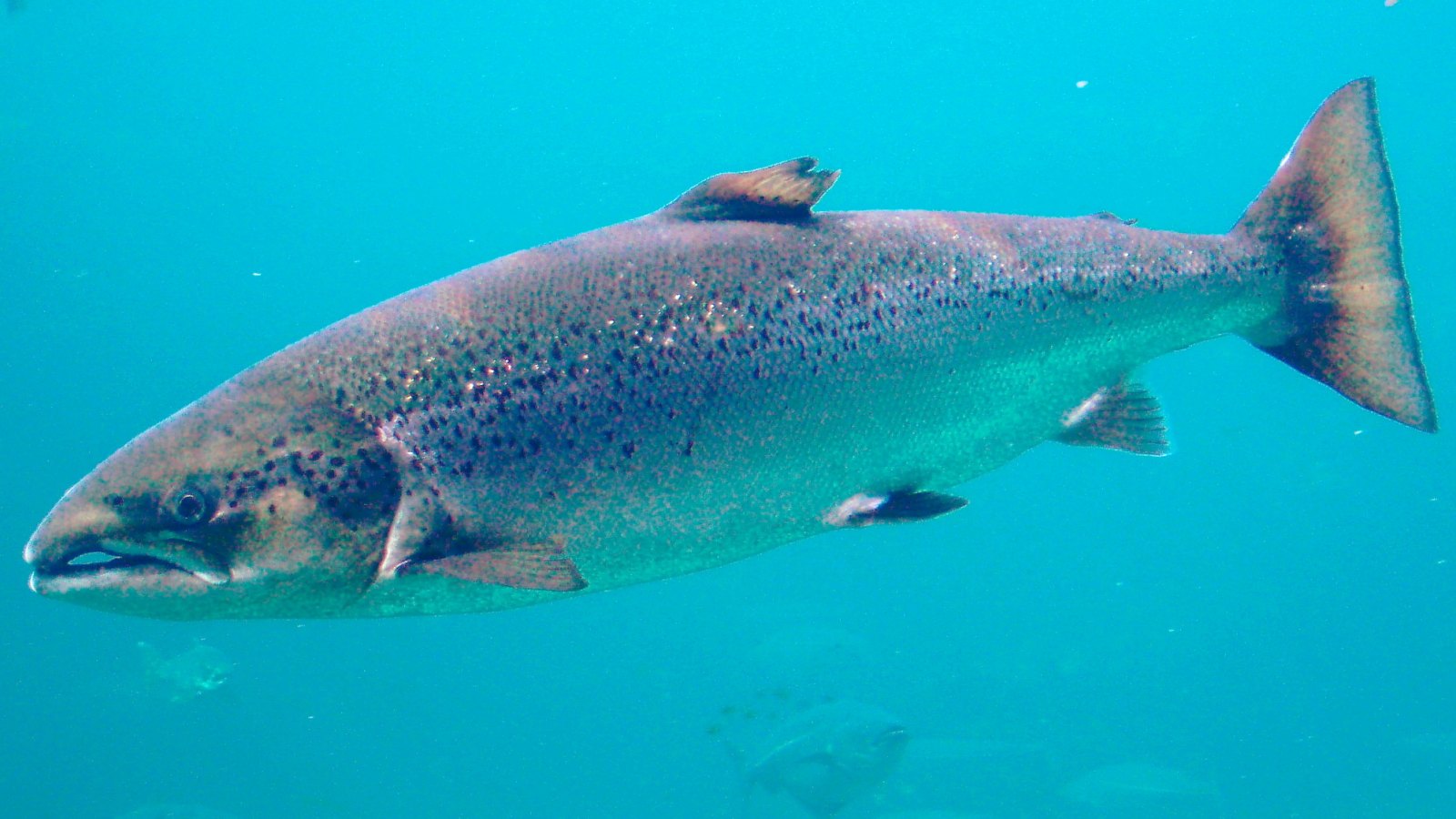
Atlantic salmon are the salmon that nobody asked for and everyone, eventually, demanded back. The Lake Ontario population is the focus of a long-running NYSDEC + USFWS restoration program working to undo a hundred-plus years of decline. They are not, technically, related to the Pacific salmon stocked alongside them, but they are willing to consort with anglers nonetheless.
Identity & ID
Who this fish is, how to ID, world & state records.
Atlantic salmon (Salmo salar) are the only Atlantic-origin salmonid in the SHA tributary set. They are in a different genus from Pacific salmon -- Salmo rather than Oncorhynchus -- and share their genus with brown trout (Salmo trutta), which is a useful mnemonic for the family relationships.
Identification cues, in order of usefulness:
- X-shaped or cross-shaped spots on the upper body -- the spots are large and irregularly shaped, not round dots. This is the single best ID separating Atlantic salmon from any Pacific salmon.
- Forked tail without spots -- the caudal fin has a deep V-fork and carries no significant spotting. Pacific salmon (Chinook + Coho) carry spots on the tail.
- Mouth extends only to below the eye -- the upper jaw stops at or before the rear margin of the eye. Pacific salmon mouths extend beyond.
- Slate-bronze coloration with chrome pre-spawn flanks -- distinctive metallic look in sea-fresh or lake-fresh condition.
- Pre-spawn coloration -- adults develop a bronze-and-rose pre-spawn appearance; less dramatic than the Chinook or Coho color change.
- Kype -- mature males develop a hooked jaw; less pronounced than Pacific salmon.
- Body shape -- streamlined, similar to a large brown trout; less heavy than Pacific salmon of equivalent length.
Range & abundance in the Alley
Where in the SHA region they live and where they're best targeted.
Atlantic salmon are native to the North Atlantic basin -- the eastern coast of North America (from Maine to Labrador) and the western coast of Europe (Scotland, Norway, Iceland, etc.). The North American sea-run population has declined dramatically over the last 150 years; many U.S. populations are now endangered or extirpated.
Of more direct relevance to SHA: Lake Ontario was historically the only Great Lake with a native Atlantic salmon population. The Lake Ontario fish were landlocked (lake-going rather than sea-going) but were genuine native Salmo salar. The native population was extirpated by approximately 1900 due to:
- Commercial overharvest
- Dam construction blocking tributary spawning access
- Pollution from industrial development around Lake Ontario
- Loss of cool-water tributary habitat
The current Lake Ontario Atlantic salmon population is the product of a restoration program operated cooperatively by NYSDEC, the U.S. Fish and Wildlife Service, and Canadian partners (Ontario Ministry of Natural Resources and Forestry). Stocked fish derive from various brood-stock lineages including landlocked Maine (Sebago) and Quebec (Lake Memphremagog) sources.
Lake Ontario tributaries currently receiving Atlantic salmon stocking include the Salmon River and select other Lake Ontario tribs. The program is more modest in scope than the Chinook + Coho programs and is more conservation-focused than recreational-volume-focused.
Seasonal calendar
Month-by-month: when they bite, spawn, hide, or run.
| Window | What's happening |
|---|---|
| September - November | Fall spawning run window. Adult Atlantic salmon push into the Salmon River + other restoration-program tribs. Spawning typically October - November. |
| December - February | Post-spawn adults return to Lake Ontario. Eggs incubate over winter in tributary gravel. |
| March - May | Spring window. Post-spawn (kelt) drop-back into Lake Ontario; emerging fry in tributary nurseries; smolts may emigrate to lake. |
| June - August | Lake feeding. Adult Atlantic salmon hold in cool deep Lake Ontario water following thermoclines. |
Per-cycle program activity varies year to year; consult NYSDEC for current-cycle stocking and angling guidance specific to Atlantic salmon.
Spawning & life cycle
Reproduction biology, age curves, lifespan, behavioral phases.
Atlantic salmon life-history differs from Pacific salmon in one critically important way: Atlantic salmon are iteroparous, not semelparous. Unlike Chinook and Coho, which spawn once and die, Atlantic salmon can survive spawning and return to the lake to feed and spawn again. Repeat-spawning fish (sometimes called "kelts" in post-spawn condition) are biologically and ecologically distinct from the dying post-spawn Pacific salmon.
The life-history sequence:
- Eggs deposited in tributary gravel October-November. Females excavate redds; eggs overwinter.
- Alevin and emergence -- spring hatching.
- Parr -- juveniles rear in the tributary for 2-3 years (longer than Pacific salmon parr).
- Smoltification -- typically at age 2-3 (4-6 inches); smolts migrate to Lake Ontario.
- Lake-feeding adults -- 1-3 years of growth in Lake Ontario before first spawning.
- First spawning -- adults return to natal tributary at age 3-5.
- Post-spawn survival -- a percentage of fish survive spawning, drop back to the lake, and return to spawn again in subsequent years.
The iteroparous life-history is a key reason Atlantic salmon are the target of restoration work despite the smaller per-fish stocking yield -- a successful population can rebuild more efficiently than a strictly semelparous population, and the long-lived repeat-spawning individuals contribute substantially to genetic diversity.
Diet & forage
What they eat at each life stage; key forage species.
Atlantic salmon diet overlaps with Pacific salmon in the lake-feeding phase but differs in the tributary phase. Unlike Pacific salmon (which stop feeding entirely once in spawning tributaries), Atlantic salmon will feed opportunistically on insects and small fish in tributary habitat, especially outside the immediate pre-spawn window.
| Food | Notes |
|---|---|
| Alewife | Primary lake-going forage in Lake Ontario, same as the Pacific salmon programs. |
| Rainbow smelt | Secondary lake forage. |
| Aquatic insects | Tributary parr feeding; also adult opportunistic feeding outside the immediate pre-spawn window. |
| Small fish | Sculpin, juvenile shiners, etc.; tributary opportunism. |
The behavioral implication for anglers: Atlantic salmon will take swung flies, dry flies, and traditional Atlantic salmon patterns far more readily than Pacific salmon (whose strikes are exclusively territorial). The historical Atlantic salmon fly-fishing tradition transferred more or less intact to the Great Lakes restoration program.
Behavior patterns
Daily rhythm, weather response, water temp tipping points.
Atlantic salmon are the most fly-rod-receptive salmonid in the SHA tributary set. The traditional Atlantic salmon angling experience -- swung flies on long single-hand or Spey rods, light tippets, careful presentation -- transfers to the Lake Ontario program with minimal adjustment.
Notable behavioral patterns:
- Strong jumpers -- a hooked Atlantic salmon will jump similarly to a Coho but with less frequency; the body shape and tail provide enormous power per pound.
- Receptive to swung flies -- traditional patterns (Green Highlander, Blue Charm, Black Bear Green Butt, etc.) work in the Lake Ontario program as they do on sea-run fisheries.
- Pool-holding -- tributary fish hold in pools between spawning runs; classic "lies" that hold Atlantics on sea-run rivers translate to Lake Ontario tribs.
- Iteroparous behavior -- repeat-spawning fish behave somewhat differently from first-time spawners; experienced anglers learn to read the difference.
- Reduced feeding-stop -- unlike Pacific salmon, Atlantic salmon will feed in tributary holding water outside the immediate pre-spawn window, which expands the technique palette available to the angler.
Today's conditions read for Atlantic Salmon
Live from the river network. Pulled at page load — refresh for the latest.
Today's read for Atlantic Salmon is editorial-only — no temp window has been calibrated yet for the dynamic feed.
Alley Index today: 97 (Excellent) · Lake Erie surface: 75.9°F
Habitat preferences
Pool / run / riffle, depth, structure, cover, current speed.
Atlantic salmon habitat requirements are similar to the Pacific salmon -- cold water, gravel-bottom spawning, accessible tributary habitat. The species is somewhat more demanding on water-temperature tolerance: Atlantic salmon prefer 50-60 degF and stress above 65 degF.
- Lake habitat -- cold mid-depth Lake Ontario water following the thermocline summer through fall.
- Tributary habitat -- pool + run + riffle structure with gravel spawning bottoms. The Salmon River reaches that hold Pacific salmon also hold Atlantics during restoration-program windows.
- Spawning habitat -- clean gravel and cobble, 1-3 ft depth, moderate flow.
- Juvenile habitat -- 2-3 years of parr-stage rearing requires extended quality tributary habitat, which is one reason the species is harder to restore than the shorter-cycle Pacific salmon.
How locals fish for it
Editorial — DJ + community on signature presentations.
Salmon River, Pulaski, NY. The focal restoration river for Lake Ontario Atlantic salmon. NYSDEC + USFWS stocking work concentrates here. Run timing is similar to Chinook + Coho but more dispersed. See the Salmon River guide.
Black River (Watertown), NY. Eastern Lake Ontario; Atlantic salmon are a periodic presence in the lower river. See the Black River (Watertown) guide.
Lake Ontario open water. Lake-feeding adults are targeted by charter boats following the thermocline. Different fishery from SHA's tributary focus.
Outside SHA scope but worth noting:
- Lake Champlain -- supports a parallel landlocked Atlantic salmon restoration program; Vermont + New York jurisdictions.
- Maine Sebago Lake -- the original "Sebago salmon" landlocked Atlantic population; brood stock contributor.
- Sea-run populations -- the Maine sea-run Atlantic salmon population is listed as endangered; conservation focus rather than recreational.
Local lore & storied waters
Specific Alley waters, history, ethics, traditions.
Atlantic salmon are the fish that justified the modern term "Atlantic salmon fishing" as an entire angling tradition. The species' willingness to take swung flies in tributary lies built the Scottish + Norwegian + Icelandic salmon-fishing economies, and the same techniques produced enormous quantities of fishing literature.
The Lake Ontario story:
- Pre-1850. Native landlocked Atlantic salmon were abundant in Lake Ontario tributaries. Commercial harvests for hatchery brood stock, smoking, and salting were substantial.
- 1850-1900. Commercial overharvest, dam construction (eliminating spawning access), pollution from emerging industrial Toronto + Rochester + Hamilton, and habitat loss combined to functionally extirpate the population.
- 1900-1960. Atlantic salmon absent from Lake Ontario as a viable population.
- 1960s-present. Restoration program initiated under multiple US and Canadian agencies. Various brood-stock lineages introduced; population slowly rebuilding.
- Current state. The Lake Ontario Atlantic salmon population is recovering but remains substantially smaller than the Chinook + Coho populations. Annual stockings + monitoring continue.
The Lake Ontario Atlantic salmon program is one of the most ambitious freshwater fish restoration programs in North America. The 25-year+ timeline parallels the lake sturgeon restoration on Lake Erie tribs in scope and ambition.
Regulations & ethics
OH/PA/NY/Ontario regs, slot limits, season dates, C&R.
| Authority | Rules of note |
|---|---|
| New York (NYSDEC) | Atlantic salmon are managed as a restoration-program species. Specific regulations vary by reach + per-cycle. Some sections may be catch-and-release only; some allow limited harvest under specific rules. Consult NYSDEC + the Salmon River-specific Special Regulations posting. |
| Ontario (MNRF) | Lake Ontario Canadian-jurisdiction regulations apply on the north shore; varies by Fisheries Management Zone. |
| Ohio, Pennsylvania | Atlantic salmon are not present in Lake Erie tribs in any meaningful number; no targeted regulations. |
Best practice for any Atlantic salmon encounter: assume catch-and-release unless specific per-cycle NYSDEC rules clearly allow harvest. The restoration program depends on returning fish surviving spawning + post-spawn. Foul-hooked fish must be released immediately as on Pacific salmon water.