Rainbow Trout Life Cycle: From Hatchery Pellet to Cuyahoga Falls Holdover
Rainbow trout (Oncorhynchus mykiss) in the SHA region exist in two parallel reproductive contexts: hatchery rearing for the put-and-take stocked fishery, and natural reproduction in select wild populations including the recently-established Cuyahoga River fish. This article covers both. For the lake-run anadromous form, see the steelhead lifecycle.
TL;DR
What this article covers
The rainbow trout species pillar covers identity, range, regulations, and the broader SHA-region context. This lifecycle article focuses specifically on the reproductive + developmental biology of the species, plus the parallel hatchery program lifecycle that defines so much of the SHA-region inland rainbow fishery.
For the lake-run anadromous form (Lake Erie + Lake Ontario steelhead), see /articles/steelhead-lifecycle. Same species, different life history.
Wild rainbow trout life cycle (freshwater resident)
1. Spawning
Inland wild rainbow trout spawn in spring (March-May depending on water temperatures). Females excavate redds in clean gravel; pairs spawn over the redd; eggs are deposited and covered with displaced gravel. Spawning water requirements:
- Water temperature 50-58 degF.
- Clean gravel + cobble substrate (sediment burial significantly reduces egg survival).
- Moderate flow over the redd (1-3 ft/sec range).
- 1-3 ft depth.
Egg deposition: 1,000-5,000 eggs per female depending on size and condition. Eggs are demersal and adhere to gravel.
2. Incubation
Eggs incubate in gravel for 4-7 weeks at typical spawning temperatures. Embryonic development is temperature-dependent; warmer water shortens incubation, colder water extends it.
3. Alevin
Hatchlings (alevins) remain in the gravel for an additional 2-4 weeks, feeding on yolk sac reserves. Emerges as a free-swimming fry once yolk is absorbed.
4. Fry
Newly emerged fry are 1-1.5 inches; settle into shallow margin habitat; feed on small aquatic invertebrates + drift. Survival is highly dependent on habitat quality.
5. Parr
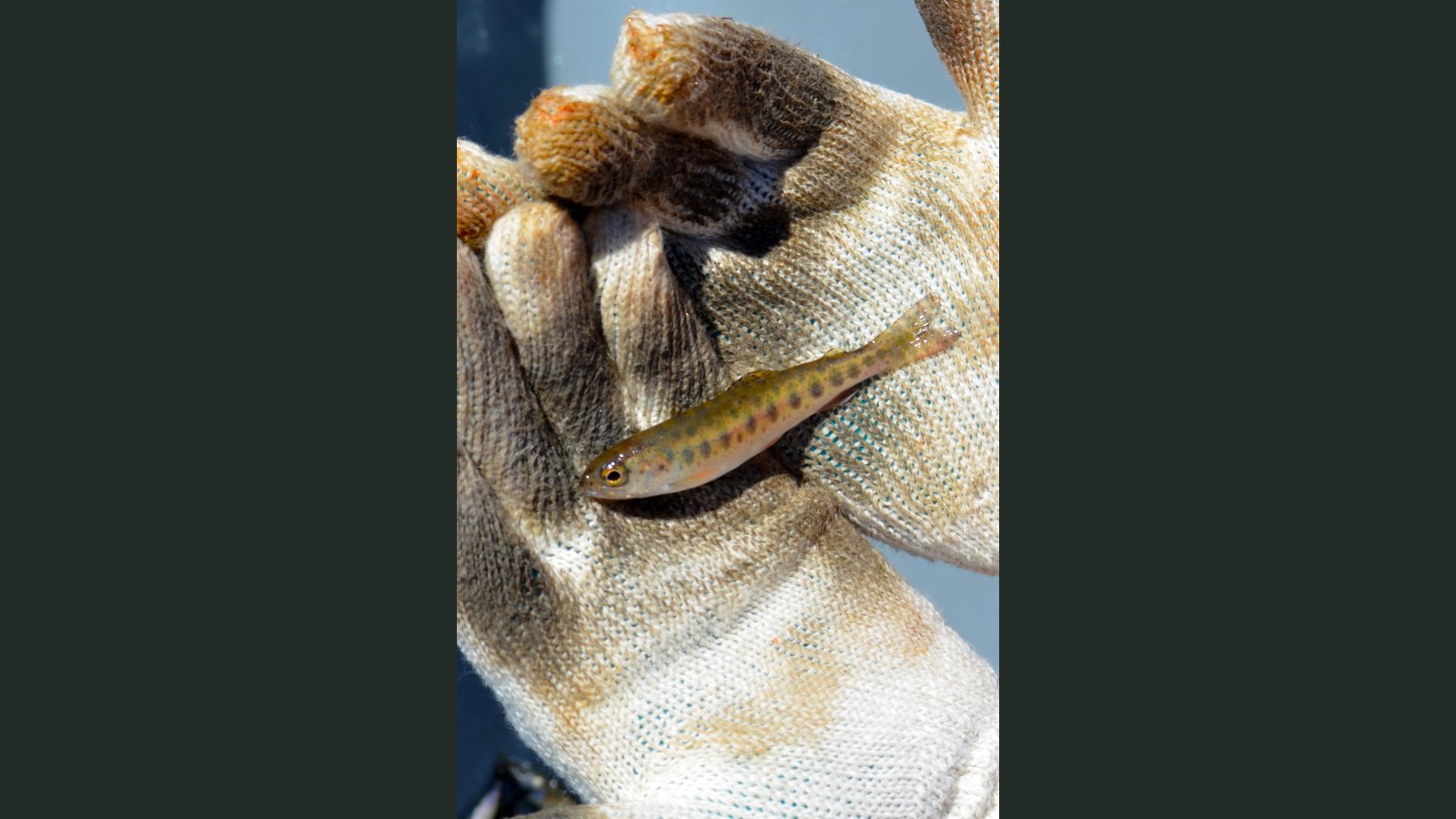
Juvenile rainbow trout 4-12 inches; territorial within the natal stream system. Distinctive parr marks (dark vertical bars along sides) plus the developing red lateral stripe. Habitat overlap with adult fish; resident in stream year-round.
6. Adult
Sexual maturity at age 2-3 in wild inland populations. Adults remain in the natal stream system; may move within the watershed in response to flow and temperature changes; do not migrate to a lake (the distinction from anadromous steelhead).
7. Repeat spawning
Unlike Pacific salmon (Chinook, Coho), rainbow trout are iteroparous -- they survive spawning and can reproduce multiple times. Individual wild fish in good habitat may spawn 4-6 times during their lifetime.
8. Lifespan
Wild inland rainbow trout: 4-7 years typical; exceptional individuals to 10+ years. Hatchery-origin fish stocked into wild populations typically survive 2-3 years post-release at most.
Hatchery rainbow trout lifecycle (stocked fishery)
The hatchery program lifecycle is parallel but distinct:
1. Brood-stock selection
State hatcheries maintain rainbow trout brood stocks selected for fast growth, uniform size, disease resistance, and (sometimes) sterility (triploid technology). PA + OH + NY hatcheries operate independently; brood stock origins vary.
2. Spawning
Brood fish are manually stripped; eggs and milt are mixed by hatchery staff; fertilized eggs are placed in incubation trays in controlled-temperature environments.
3. Hatchery rearing
Eggs hatch in 3-5 weeks. Alevins absorb yolk in incubation trays. Fry are transferred to indoor raceways. Juveniles are transferred to outdoor raceways. Fish are fed commercial pellets throughout development. Total hatchery cycle from egg to catchable-size fish: 12-24 months.
4. Stocking event
Hatchery fish are transported to receiving water in oxygenated tanker trucks; released at access points just before angling season opener. Standard catchable size: 10-14 inches.
5. Post-stocking
Released fish disperse in the receiving stream. Most are caught within 2-3 weeks of release; pressure peaks during the opener weekend. Holdover rate (fish surviving past season) varies 5-25% depending on stream conditions, water temperature, predator load, and angler pressure.
6. Holdover fish
Surviving rainbows transition from hatchery-pellet behavior to natural food. Fish that holdover gain stream-fish behavior over weeks. Holdover fish that survive multiple seasons can reach 14-20+ inches and become visually indistinguishable from wild fish.
The cumulative implication: the stocked rainbow trout in your local stream by August may have been there for one weekend or for two years. The angler experience differs substantially between freshly-stocked + holdover fish.
The Cuyahoga River wild rainbow trout story
The recently-established wild rainbow trout population at Cuyahoga Falls is the SHA-region's most remarkable inland rainbow story. ODNR + Western Reserve TU + the city of Cuyahoga Falls have run stocking programs in the Cuyahoga Falls area for years; some of those stocked fish have apparently survived, established, and begun reproducing successfully in the river. The Cuyahoga River that caught fire in 1969 is now hosting wild reproducing rainbow trout.
Per the Cuyahoga Recovery Story, the wild reproduction is part of a broader watershed-recovery arc that includes lake sturgeon reintroduction + dam removal + ongoing water-quality investment. The rainbow trout success is one piece of the larger recovery story; not the whole story but a meaningful indicator.
Honest gaps
- No quantitative Cuyahoga wild rainbow population estimate -- ODNR monitoring is ongoing.
- No genetic analysis of Cuyahoga wild fish origins (which hatchery strains seeded the population).
- No comprehensive holdover-rate data for individual SHA-region streams.
- No coverage of triploid sterile-fish stocking program specifics.
Full source list
- Tier 3 -- Animal Diversity Web: Oncorhynchus mykiss.
- Tier 3 -- USFWS species profile for rainbow trout.
- Tier 1 -- PFBC + NYSDEC + ODNR -- state hatchery + stocking programs.
- Tier 2 -- Trout Unlimited -- conservation policy + wild trout advocacy + Cuyahoga Falls partnership.
Common questions
Are rainbow trout and steelhead the same species?
Yes -- both are Oncorhynchus mykiss. The difference is anadromy: steelhead migrate to large lakes (or oceans in the native range); rainbow trout stay in freshwater. Same DNA; same fish.
Why do hatchery rainbow trout fight differently from wild rainbow trout?
Hatchery fish have shorter histories of avoiding angler pressure + natural predation. Their reflexes are different. Within weeks of stocking, holdover fish develop more wild-fish behavior.
Is the Cuyahoga wild rainbow population sustainable?
Currently unknown. ODNR is monitoring; the population is small enough that any conclusion is provisional. The water-quality + habitat trends are favorable but not guaranteed.
What's a "triploid" rainbow trout?
Hatchery-produced sterile fish created through controlled pressure treatment of fertilized eggs. Triploid rainbows grow larger than diploid fish + cannot reproduce, which makes them useful for stocking in wild-fish waters without genetic concerns.
Image credits and licensing
- Inline image: Juvenile rainbow trout carry parr marks before the adult lateral stripe becomes the dominant field cue. Photo: U.S. Fish and Wildlife Service Midwest Region, public domain.
- Hero image: Photo: Timothy Knepp / USFWS, public domain.
Continue learning
- Rainbow Trout Species Pillar -- the broader profile.
- Steelhead Species Pillar -- the lake-run anadromous form.
- Steelhead Lifecycle -- the anadromous lifecycle.
- Brown Trout Lifecycle.
- Brook Trout Lifecycle.
- Cuyahoga River Recovery Story.
- Inland Trout Seasonal Calendar.
- Source Discipline + Tier Hierarchy.